Comparative Study
. 2010 Mar;78(3):1229-38.
doi: 10.1128/IAI.00897-09. Epub 2009 Dec 28.

Activation of human and chicken toll-like receptors by Campylobacter spp

Affiliations
Comparative Study

Activation of human and chicken toll-like receptors by Campylobacter spp

Marcel R de Zoete et al. Infect Immun. 2010 Mar.

Abstract

Campylobacter infection in humans is accompanied by severe inflammation of the intestinal mucosa, in contrast to colonization of chicken. The basis for the differential host response is unknown. Toll-like receptors (TLRs) sense and respond to microbes in the body and participate in the induction of an inflammatory response. Thus far, the interaction of Campylobacter with chicken TLRs has not been studied. Here, we investigated the potential of four Campylobacter strains to activate human TLR1/2/6, TLR4, TLR5, and TLR9 and chicken TLR2t2/16, TLR4, TLR5, and TLR21. Live bacteria showed no or very limited potential to activate TLR2, TLR4, and TLR5 of both the human and chicken species, with minor but significant differences between Campylobacter strains. In contrast, lysed bacteria induced strong NF-kappaB activation through human TLR1/2/6 and TLR4 and chicken TLR2t2/16 and TLR4 but not via TLR5 of either species. Interestingly, C. jejuni induced TLR4-mediated beta interferon in human but not chicken cells. Furthermore, isolated chromosomal Campylobacter DNA was unable to activate human TLR9 in our system, whereas chicken TLR21 was activated by DNA from all of the campylobacters tested. Our data are the first comparison of TLR-induced immune responses in humans and chickens. The results suggest that differences in bacterial cell wall integrity and in TLR responses to Campylobacter LOS and/or DNA may contribute to the distinct clinical manifestation between the species.


Figures
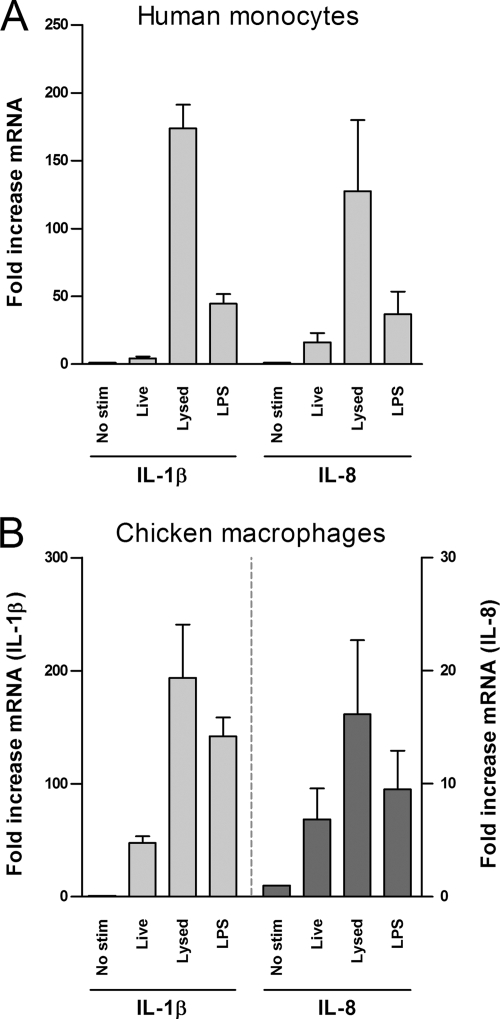
FIG. 1.
FIG. 1.
Induction of IL-1β and IL-8 by live and disrupted C. jejuni. MM6 cells (A) and chicken HD11 cells (B) were stimulated for 2 h with 5 × 10⁷ CFU of live or lysed C. jejuni strain 81116 ml−1. As a positive control, 1 μg of LPS from serovar Enteritidis was used. IL-1β and IL-8 transcripts were analyzed by RT-PCR and are presented as the fold increase mRNA levels after stimulation compared to nonstimulated cells. Live Campylobacter induced statistically significant levels of IL-1β and IL-8 mRNA in MM6 cells (P < 0.05), whereas in HD11 cells only the induction of IL-1β was statistically significant (P < 0.05). Stimulation of MM6 and HD11 cells with lysed Campylobacter resulted in significantly higher levels of IL-1β and IL-8 mRNA compared to mock stimulation or stimulation with live bacteria (P < 0.05). Values are means ± the standard errors of the mean (SEM) of three independent experiments.
FIG. 2.
FIG. 2.
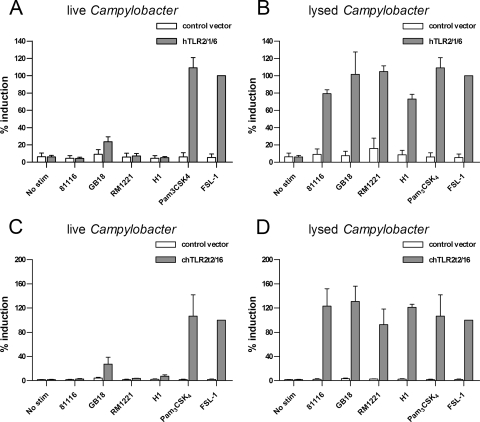
Activation of human and chicken TLR2 by Campylobacter. HeLa 57A cells expressing human TLR2, TLR1, TLR6, and CD14 (A and B) or chicken TLR2t2, TLR16, and human CD14 (C and D) were stimulated with live or disrupted C. jejuni strain 81116, GB18, or RM1221 or C. coli strain H1 for 5 h. Cells transfected with control vector were stimulated simultaneously to ensure TLR-specific NF-κB activation. Pam3CSK4 (100 ng/ml) and FSL-1 (100 ng/ml) were used as positive controls. Values are the percent induction of NF-κB activation after stimulation with the positive control and are means ± the SEM of three independent experiments. The P values for human and chicken TLR2 responses were as follows: live Campylobacter versus control, not significant; lysed Campylobacter versus control, P < 0.05; lysed versus live Campylobacter, P < 0.05.
FIG. 3.
FIG. 3.
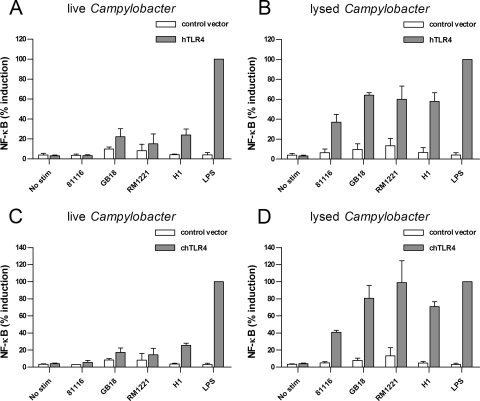
Activation of human and chicken TLR4 by Campylobacter. HeLa 57A cells expressing human TLR4, MD-2, and CD14 (A and B) or chicken TLR4, MD-2 and human CD14 (C and D) were stimulated with live or lysed C. jejuni strain 81116, GB18, or RM1221 or C. coli strain H1 for 5 h. Cells transfected with control vector were stimulated simultaneously to ensure TLR-specific NF-κB activation. LPS from serovar Enteritidis (20 ng/ml) was used as a positive control. Values are the percent induction of NF-κB activation after stimulation with the positive control and are means ± the SEM of three independent experiments. The P values for human and chicken TLR4 responses were as follows: live Campylobacter versus control, not significant, except for C. coli H1 (P < 0.05); lysed Campylobacter versus control, P < 0.05; lysed versus live Campylobacter, P < 0.05 for chicken TLR4 and P < 0.001 for human TLR4.
FIG. 4.
FIG. 4.
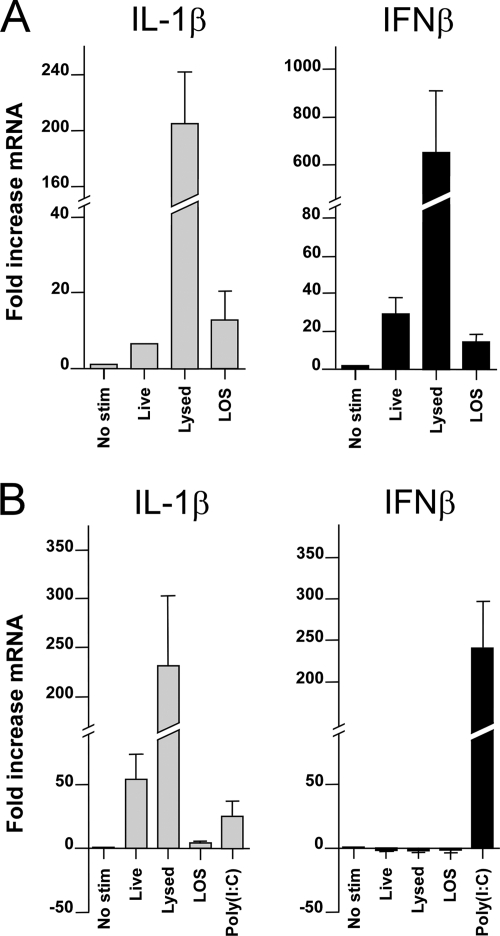
Induction of IFN-β by live, lysed, and purified LOS of C. jejuni. MM6 cells (A) and chicken HD11 cells (B) were stimulated for 2 h with 5 × 10⁷ CFU of live or lysed C. jejuni strain 81116 ml−1 or 1 μg of LOS ml−1. As a positive control, 500 ng of poly(I:C) ml−1 with FuGENE-6 was used. IL-1β and IFN-β transcripts were analyzed by RT-PCR and are presented as the fold increase in mRNA levels after stimulation compared to nonstimulated cells. Stimulation of MM6 cells with live Campylobacter, lysed Campylobacter, or LOS induced statistically significant levels of IL-1β and IFN-β mRNA (P < 0.05). In HD11 cells, stimulation with live Campylobacter, lysed Campylobacter, or LOS but not with poly(I:C) induced statistically significant levels of IL-1β, whereas IFN-β was only induced (P < 0.05) after stimulation with poly(I:C). Values are means ± the SEM of three independent experiments.
FIG. 5.
FIG. 5.
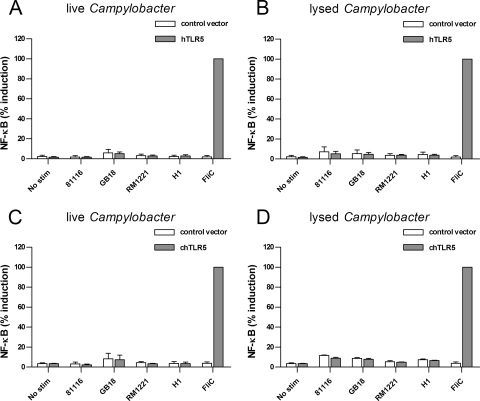
Activation of human and chicken TLR5 by Campylobacter. HeLa 57A cells expressing human TLR5 (A and B) or chicken TLR5 (C and D) were stimulated with live or disrupted C. jejuni strains 81116, GB18, or RM1221 or C. coli strain H1 for 5 h. Cells transfected with control vector were stimulated simultaneously to ensure TLR-specific NF-κB activation. Flagellin from serovar Enteritidis (1 μg ml−1) was used as a positive control. None of the Campylobacter strains, either live or lysed, induced statistically significant activation of NF-κB in HeLa 57A cells transfected with human or chicken TLR5. Values are the percent induction of NF-κB activation after stimulation with the positive control and are means ± the SEM of three independent experiments.
FIG. 6.
FIG. 6.
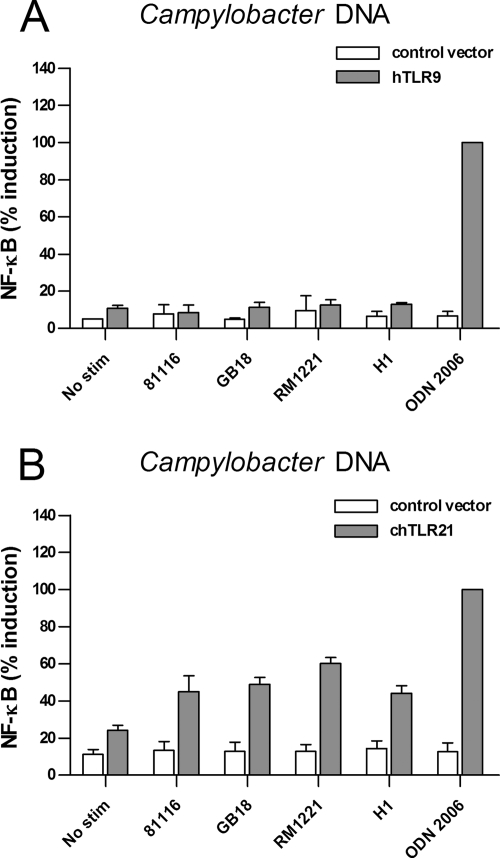
Activation of human TLR9 and chicken TLR21 by Campylobacter. HEK293 cells expressing human TLR9 (A) or HeLa 57A cells expressing chicken TLR21 (B) were stimulated with 30 μg of purified chromosomal DNA ml−1 from C. jejuni strain 81116, GB18, or RM1221 or C. coli strain H1 for 5 h. Cells transfected with control vector were stimulated simultaneously to ensure TLR-specific NF-κB activation. ODN 2006 (0.5 μM) was used as positive control. None of the chromosomal Campylobacter DNA significantly activated TLR9. In contrast, DNA from all Campylobacter strains induced significant NF-κB activation in TLR21-transfected HEK 293 cells (P < 0.05). Values are the percent induction of NF-κB activation after stimulation with the positive control and are means ± the SEM of three independent experiments.

References

    1. Akira, S. 2006. TLR signaling. Curr. Top. Microbiol. Immunol. 311:1-16. - PubMed
    1. Allos, B. M. 2001. Campylobacter jejuni Infections: update on emerging issues and trends. Clin. Infect. Dis. 32:1201-1206. - PubMed
    1. Andersen-Nissen, E., K. D. Smith, K. L. Strobe, S. L. Barrett, B. T. Cookson, S. M. Logan, and A. Aderem. 2005. Evasion of Toll-like receptor 5 by flagellated bacteria. Proc. Natl. Acad. Sci. U. S. A. 102:9247-9252. - PMC - PubMed
    1. Bakhiet, M., F. S. Al-Salloom, A. Qareiballa, K. Bindayna, I. Farid, and G. A. Botta. 2004. Induction of alpha and beta chemokines by intestinal epithelial cells stimulated with Campylobacter jejuni. J. Infect. 48:236-244. - PubMed
    1. Beery, J. T., M. B. Hugdahl, and M. P. Doyle. 1988. Colonization of gastrointestinal tracts of chicks by Campylobacter jejuni. Appl. Environ. Microbiol. 54:2365-2370. - PMC - PubMed

Publication types