Grading and reporting health and health disparities
- PMID: 20040231
- PMCID: PMC2811511
Grading and reporting health and health disparities
Abstract
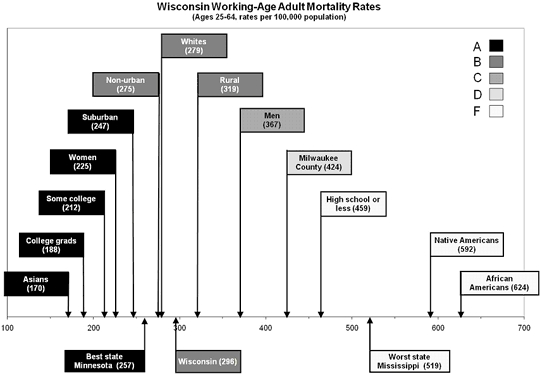
Report cards are widely used in health for drawing attention to performance indicators. We developed a state health report card with separate grades for health and health disparities to generate interest in and awareness of differences in health across different population subgroups and to identify opportunities to improve health. We established grading curves from data for all 50 states for 2 outcomes (mortality and unhealthy days) and 4 life stages (infants, children and young adults, working-age adults, and older adults). We assigned grades for health within each life stage by sex, race/ethnicity, socioeconomics, and geography. We also assigned a health disparity grade to each life stage. Report cards can simplify complex information for lay audiences and garner media and policy maker attention. However, their development requires methodologic and value choices that may limit their interpretation.
Figures
References
-
- General Accounting Office "Report cards" are useful but significant issues need to be addressed. GAO-HEHS-94-219. 1994.
-
- Fielding JE, Sutherland CE, Halfon N. Community health report cards: results of a national survey. Am J Prev Med. 1999;17(1):79–86. - PubMed
-
- Healthy people 2010. 2nd edition Washington (DC: US Department of Health and Human Services; 2000.
-
- Smedley BD, Stith AY, Nelson AR. Unequal treatment: confronting racial and ethnic disparities in health care. Washington (DC): Institute of Medicine; 2002. - PubMed
Publication types
MeSH terms
LinkOut - more resources
Full Text Sources