


Social cognition mediates illness-related and cognitive influences on social function in patients with schizophrenia-spectrum disorders
- PMID: 20040246
- PMCID: PMC2799504
- DOI: 10.1503/jpn.080039
Social cognition mediates illness-related and cognitive influences on social function in patients with schizophrenia-spectrum disorders
Abstract
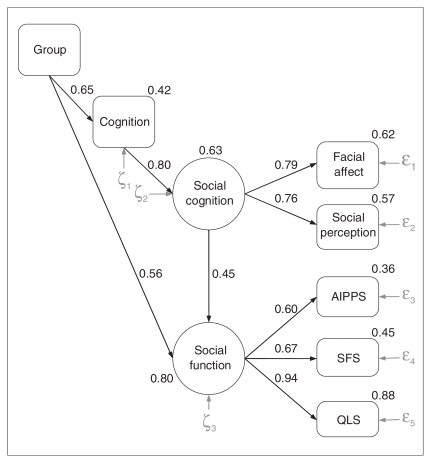
Background: Although cognition has been studied extensively among patients with schizophrenia, social cognition has only recently emerged as an area of interest. The objective of the current study was to use structural equation modelling to test the hypothesis that the relation between cognitive performance and social function is mediated by patients' social cognitive abilities.
Methods: We assessed participants who met criteria for a schizophrenia-spectrum disorder, with equal distribution among first- and multi-episode participants, and nonpsychiatric controls on a range of measures within each of the domains of cognition, social cognition and social function.
Results: Using structural equation modelling, we derived a model that explained 79.7% of the variance in social function and demonstrated that the link between cognition and social function was fully mediated by social cognition.
Limitations: A limitation of this study is that the measures contributing to the structural equation modelling analysis were obtained at the same point in time. Thus, the temporal order of causation suggested by Model 2 remains theoretically specified.
Conclusion: This study provides some first steps in understanding the complex relation between cognition and social function. Such a relation has potential implications for the design of remediation strategies.
Figures
References
-
- Penn DL, Addington J, Pinkham A. Social cognitive impairments. In: Lieberman JA, Stroup TS, Perkins DO, editors. American Psychiatric Association textbook of schizophrenia. Washington (DC): American Psychiatric Publishing Press, Inc; 2006.
-
- Addington J, Young J, Addington D. Social outcome in early psychosis. Psychol Med. 2003;33:1119–24. - PubMed
-
- Brekke J, Kay DD, Lee KS, et al. Biosocial pathways to functional outcome in schizophrenia. Schizophr Res. 2005;80:213–25. - PubMed
-
- Vauth R, Rusch N, Wirtz M, et al. Does social cognition influence the relation between neurocognitive deficits and vocational functioning in schizophrenia? Psychiatry Res. 2004;128:155–65. - PubMed
-
- Baron RM, Kenny DA. The moderator-mediator variable distinction in social psychological research: conceptual, strategic, and statistical considerations. J Pers Soc Psychol. 1986;51:1173–82. - PubMed
Publication types
MeSH terms
Grants and funding
LinkOut - more resources
Full Text Sources
Miscellaneous