


Simvastatin enhances hippocampal long-term potentiation in C57BL/6 mice
- PMID: 20040368
- PMCID: PMC2824052
- DOI: 10.1016/j.neuroscience.2009.12.062
Simvastatin enhances hippocampal long-term potentiation in C57BL/6 mice
Abstract
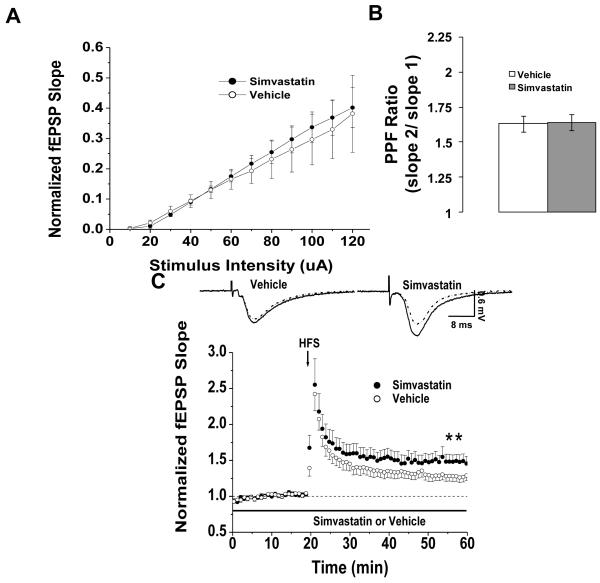
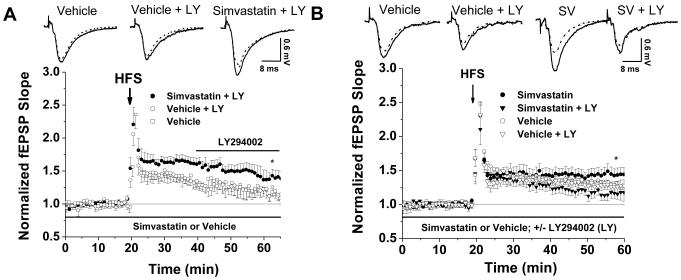
Statins inhibit 3-hydroxy-3-methylglutaryl CoA reductase, the rate-limiting enzyme in the cholesterol biosynthetic pathway, and they are widely used to control plasma cholesterol levels and prevent cardiovascular disease. However, emerging evidence indicates that the beneficial effects of statins extend to the CNS. Statins have been shown to improve the outcome of stroke and traumatic brain injury, and statin use has been associated with a reduced prevalence of Alzheimer's disease (AD) and dementia. However, prospective studies with statins in AD have produced mixed results. Recently, we reported that simvastatin, a widely used statin in humans, enhances learning and memory in non-transgenic mice as well as in transgenic mice with AD-like pathology on a mixed genetic background. However, the cellular and molecular mechanisms underlying the beneficial effects of simvastatin on learning and memory remain elusive. The present study was undertaken to investigate the effect of acute simvastatin treatment on hippocampal long-term potentiation (LTP), a cellular model of learning and memory, in brain slices from C57BL/6 mice. Our results demonstrate that a prolonged in vitro simvastatin treatment for 2-4 h, but not a short-term 20-min exposure, significantly increases the magnitude of LTP at CA3-CA1 synapses without altering basal synaptic transmission or the paired-pulse facilitation ratio in hippocampal slices. Furthermore, we show that phosphorylation of Akt (protein kinase B) is increased significantly in the CA1 region following 2-hour treatment with simvastatin, and that inhibition of Akt phosphorylation suppresses the simvastatin-induced enhancement of LTP. These findings suggest activation of Akt as a molecular pathway for augmented hippocampal LTP by simvastatin treatment, and implicate enhancement of hippocampal LTP as a potential cellular mechanism underlying the beneficial effects of simvastatin on cognitive function.
Copyright (c) 2010 IBRO. Published by Elsevier Ltd. All rights reserved.
Figures



References
-
- Balduini W, Mazzoni E, Carloni S, De Simoni MG, Perego C, Sironi L, Cimino M. Prophylactic but not delayed administration of simvastatin protects against long-lasting cognitive and morphological consequences of neonatal hypoxic-ischemic brain injury, reduces interleukin-1beta and tumor necrosis factor-alpha mRNA induction, and does not affect endothelial nitric oxide synthase expression. Stroke. 2003;34:2007–2012. - PubMed
-
- Bosel J, Gandor F, Harms C, Synowitz M, Harms U, Djoufack PC, Megow D, Dirnagl U, Hortnagl H, Fink KB, Endres M. Neuroprotective effects of atorvastatin against glutamate-induced excitotoxicity in primary cortical neurones. J Neurochem. 2005;92:1386–1398. - PubMed
-
- Brown MS, Goldstein JL. A receptor-mediated pathway for cholesterol homeostasis. Science. 1986;232:34–47. - PubMed
-
- Buxbaum JD, Cullen EI, Friedhoff LT. Pharmacological concentrations of the HMG-CoA reductase inhibitor lovastatin decrease the formation of the Alzheimer beta-amyloid peptide in vitro and in patients. Front Biosci. 2002;7:a50–59. - PubMed
-
- Chen J, Zhang ZG, Li Y, Wang Y, Wang L, Jiang H, Zhang C, Lu M, Katakowski M, Feldkamp CS, Chopp M. Statins induce angiogenesis, neurogenesis, and synaptogenesis after stroke. Ann Neurol. 2003;53:743–751. - PubMed
Publication types
MeSH terms
Substances
Grants and funding
LinkOut - more resources
Full Text Sources
Miscellaneous
