


Missense mutations in the MEFV gene are associated with fibromyalgia syndrome and correlate with elevated IL-1beta plasma levels
- PMID: 20041150
- PMCID: PMC2794536
- DOI: 10.1371/journal.pone.0008480
Missense mutations in the MEFV gene are associated with fibromyalgia syndrome and correlate with elevated IL-1beta plasma levels
Abstract
Background: Fibromyalgia syndrome (FMS), a common, chronic, widespread musculoskeletal pain disorder found in 2% of the general population and with a preponderance of 85% in females, has both genetic and environmental contributions. Patients and their parents have high plasma levels of the chemokines MCP-1 and eotaxin, providing evidence for both a genetic and an immunological/inflammatory origin for the syndrome (Zhang et al., 2008, Exp. Biol. Med. 233: 1171-1180).
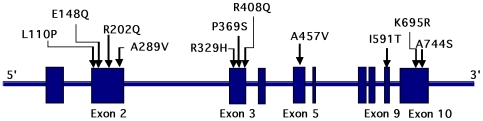
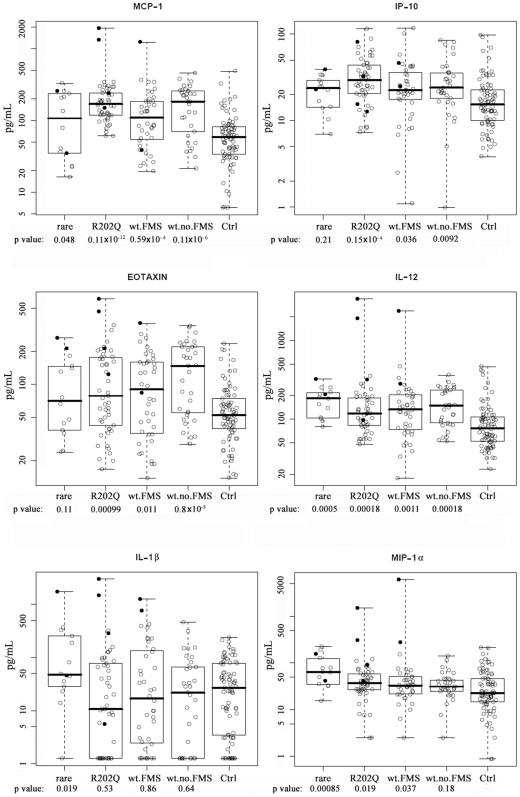
Methods and findings: In a search for a candidate gene affecting inflammatory pathways, among five screened in our patient samples (100 probands with FMS and their parents), we found 10 rare and one common alleles for MEFV, a gene in which various compound heterozygous mutations lead to Familial Mediterranean Fever (FMF). A total of 2.63 megabases of genomic sequence of the MEFV gene were scanned by direct sequencing. The collection of rare missense mutations (all heterozygotes and tested in the aggregate) had a significant elevated frequency of transmission to affecteds (p = 0.0085, one-sided, exact binomial test). Our data provide evidence that rare missense variants of the MEFV gene are, collectively, associated with risk of FMS and are present in a subset of 15% of FMS patients. This subset had, on average, high levels of plasma IL-1beta (p = 0.019) compared to FMS patients without rare variants, unaffected family members with or without rare variants, and unrelated controls of unknown genotype. IL-1beta is a cytokine associated with the function of the MEFV gene and thought to be responsible for its symptoms of fever and muscle aches.
Conclusions: Since misregulation of IL-1beta expression has been predicted for patients with mutations in the MEFV gene, we conclude that patients heterozygous for rare missense variants of this gene may be predisposed to FMS, possibly triggered by environmental factors.
Conflict of interest statement
Figures
References
-
- Wolfe F, Cathey MA. Assessment of functional ability in patients with fibromyalgia. Arch Intern Med. 1990;150:460. - PubMed
-
- Wolfe F, Ross K, Anderson J, Russell IJ, Hebert L. The prevalence and characteristics of fibromyalgia in the general population. Arthritis Rheum. 1995;38:19–28. - PubMed
-
- Wolfe F, Smythe HA, Yunus MB, Bennett RM, Bombardier C, et al. The American College of Rheumatology 1990 Criteria for the Classification of Fibromyalgia. Report of the Multicenter Criteria Committee. Arthritis Rheum. 1990;33:160–172. - PubMed
-
- Buskila D, Neumann L. Fibromyalgia syndrome (FM) and nonarticular tenderness in relatives of patients with FM. J Rheumatol. 1997;24:941–944. - PubMed
-
- Arnold LM, Hudson JI, Hess EV, Ware AE, Fritz DA, et al. Family study of fibromyalgia. Arthritis Rheum. 2004;50:944–952. - PubMed
Publication types
MeSH terms
Substances
Grants and funding
LinkOut - more resources
Full Text Sources
Medical
Molecular Biology Databases
Miscellaneous
