


Role of 5-HT1A receptors in control of lower urinary tract function in anesthetized rats
- PMID: 20042459
- PMCID: PMC2838598
- DOI: 10.1152/ajprenal.00266.2009
Role of 5-HT1A receptors in control of lower urinary tract function in anesthetized rats
Abstract
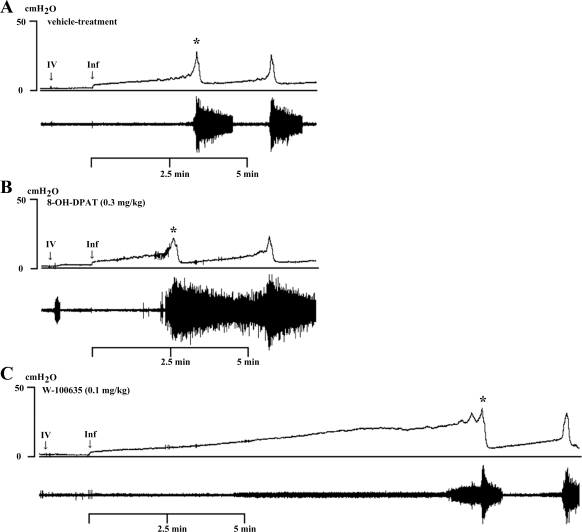
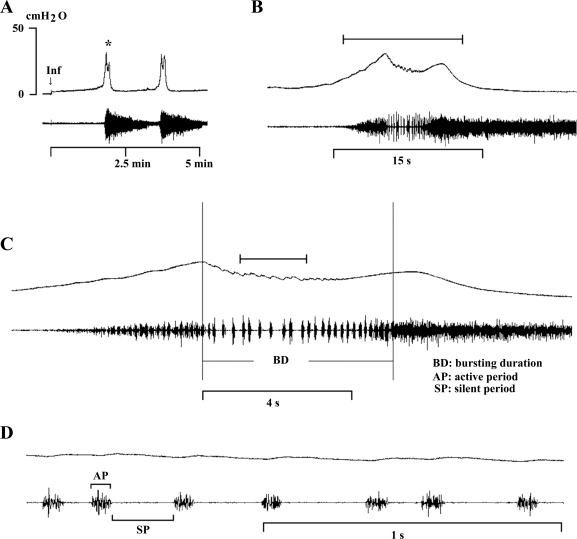
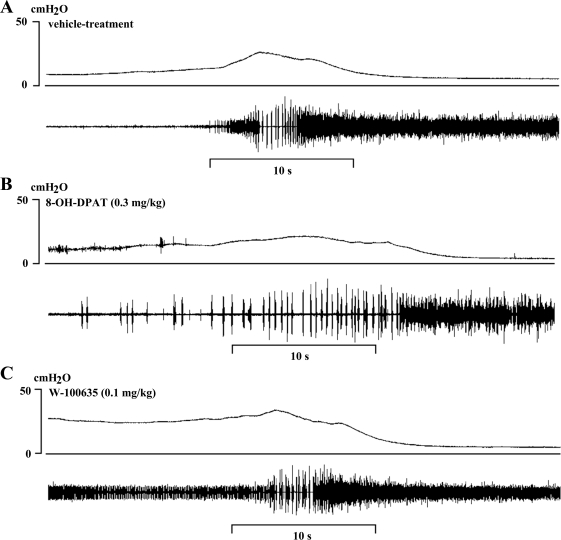
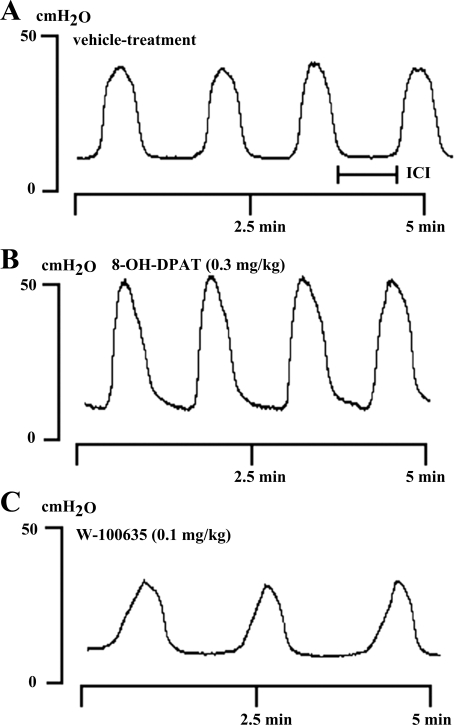
The role of 5-hydroxytryptamine (5-HT) 1A (5-HT1A) receptors in lower urinary tract function was examined in urethane-anesthetized female Sprague-Dawley rats. Bladder pressure and the external urethral sphincter electromyogram (EUS EMG) activity were recorded during continuous-infusion transvesical cystometrograms (TV-CMGs) to allow voiding and during transurethral-CMGs (TU-CMGs) which prevented voiding and allowed recording of isovolumetric bladder contractions. 8-Hydroxy-2-(di-n-propylamino)-tetralin (8-OH-DPAT), a 5-HT1A receptor agonist, decreased volume threshold (VT) for initiating voiding and increased contraction amplitude (CA) during TU-CMGs but decreased CA during TV-CMGs. 8-OH-DPAT prolonged EUS bursting as well as the intrabursting silent periods (SP) during voiding. N-[2-[4-(2-methoxyphenyl)-1- piperazinyl]ethyl]-N-(2-pyridinyl)cyclohexanecarboxamine trihydrochloride (WAY-100635), a 5-HT1A antagonist, increased VT, increased residual volume, markedly decreased voiding efficiency, decreased the amplitude of micturition contractions recorded under isovolumetric conditions, and decreased the SP of EUS bursting. These results indicate that activation of 5-HT1A receptors by endogenous 5-HT lowers the threshold for initiating reflex voiding and promotes voiding function by enhancing the duration of EUS relaxation, which should reduce urethral outlet resistance.
Figures
References
-
- Cheng CL, Chai CY, de Groat WC. Detrusor-sphincter dyssynergia induced by cold stimulation of the urinary bladder of rats. Am J Physiol Regul Integr Comp Physiol 272: R1271–R1282, 1997 - PubMed
-
- Cheng CL, de Groat WC. The role of capsaicin-sensitive afferent fibers in the lower urinary tract dysfunction induced by chronic spinal cord injury in rats. Exp Neurol 187: 445–454, 2004 - PubMed
Publication types
MeSH terms
Substances
Grants and funding
LinkOut - more resources
Full Text Sources
Medical
