


Evolution of the HIV-1 env gene in the Rag2-/- gammaC-/- humanized mouse model
- PMID: 20042504
- PMCID: PMC2826074
- DOI: 10.1128/JVI.02180-09
Evolution of the HIV-1 env gene in the Rag2-/- gammaC-/- humanized mouse model
Abstract
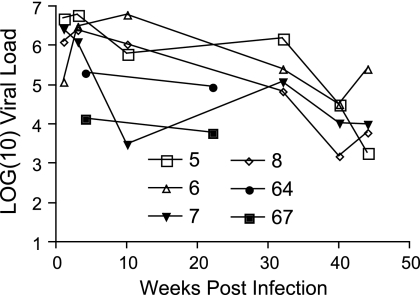
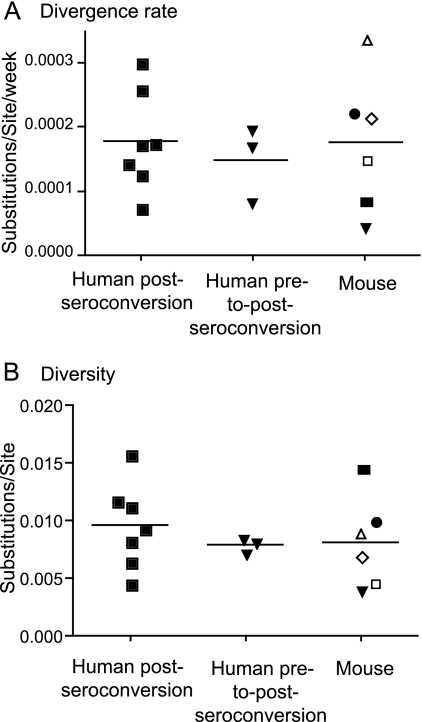
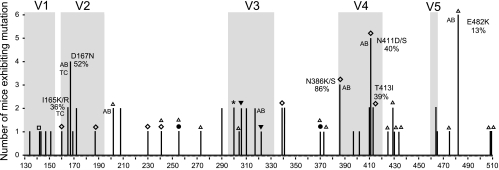
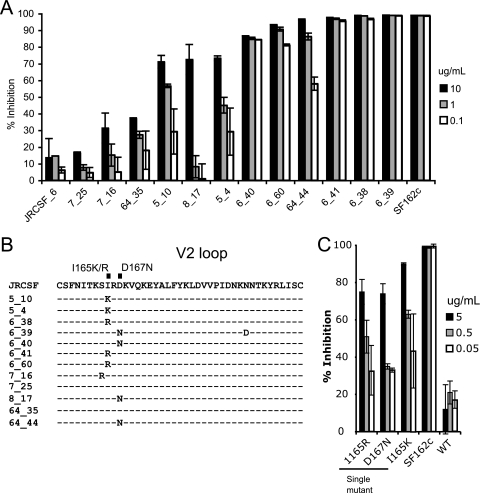
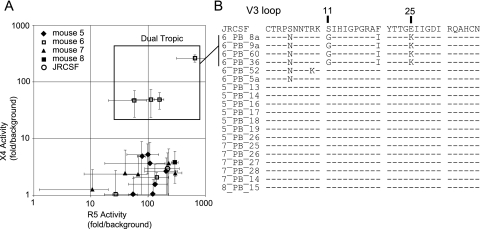
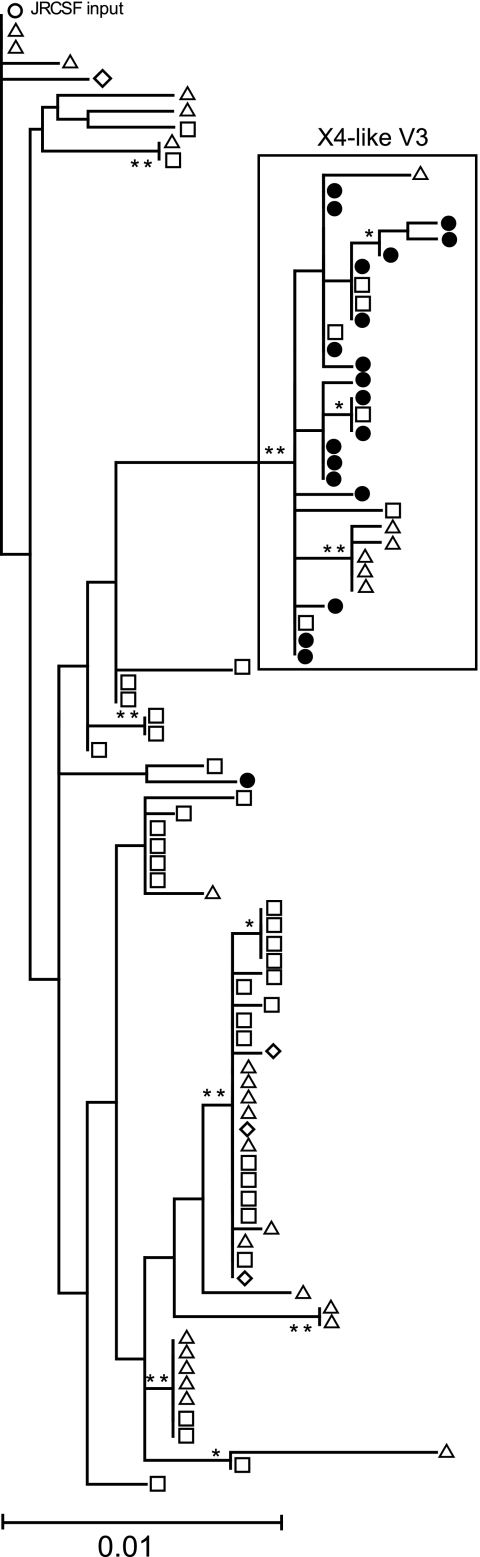
Rag2(-/-) gamma(C)(-/-) mice transplanted with human hematopoietic stem cells (DKO-hu-HSC mice) mimic aspects of human infection with human immunodeficiency virus type 1 (HIV-1), including sustained viral replication and CD4(+) T-cell decline. However, the extent of HIV-1 evolution during long-term infection in these humanized mice, a key feature of the natural infection, has not been assessed fully. In this study, we examined the types of genotypic and phenotypic changes in the viral env gene that occur in the viral populations of DKO-hu-HSC mice infected with the CCR5-tropic isolate HIV-1(JRCSF) for up to 44 weeks. The mean rate of divergence of viral populations in mice was similar to that observed in a cohort of humans during a similar period of infection. Many amino acid substitutions were common across mice, including losses of N-linked glycosylation sites and substitutions in the CD4 binding site and in CD4-induced epitopes, indicating common selective pressures between mice. In addition, env variants evolved sensitivity to antibodies directed at V3, suggesting a more open conformation for Env. This phenotypic change was associated with increased CD4 binding efficiency and was attributed to specific amino acid substitutions. In one mouse, env variants emerged that exhibited a CXCR4-tropic phenotype. These sequences were compartmentalized in the mesenteric lymph node. In summary, viral populations in these mice exhibited dynamic behavior that included sequence evolution, compartmentalization, and the appearance of distinct phenotypic changes. Thus, humanized mice offer a useful model for studying evolutionary processes of HIV-1 in a complex host environment.
Figures

References
-
- Baba, M., O. Nishimura, N. Kanzaki, M. Okamoto, H. Sawada, Y. Iizawa, M. Shiraishi, Y. Aramaki, K. Okonogi, Y. Ogawa, K. Meguro, and M. Fujino. 1999. A small-molecule, nonpeptide CCR5 antagonist with highly potent and selective anti-HIV-1 activity. Proc. Natl. Acad. Sci. USA 96:5698-5703. - PMC - PubMed
-
- Baenziger, S., R. Tussiwand, E. Schlaepfer, L. Mazzucchelli, M. Heikenwalder, M. O. Kurrer, S. Behnke, J. Frey, A. Oxenius, H. Joller, A. Aguzzi, M. G. Manz, and R. F. Speck. 2006. Disseminated and sustained HIV infection in CD34+ cord blood cell-transplanted Rag2−/−gamma c−/− mice. Proc. Natl. Acad. Sci. USA 103:15951-15956. - PMC - PubMed
-
- Beaumont, T., E. Quakkelaar, A. van Nuenen, R. Pantophlet, and H. Schuitemaker. 2004. Increased sensitivity to CD4 binding site-directed neutralization following in vitro propagation on primary lymphocytes of a neutralization-resistant human immunodeficiency virus IIIB strain isolated from an accidentally infected laboratory worker. J. Virol. 78:5651-5657. - PMC - PubMed
Publication types
MeSH terms
Substances
Grants and funding
LinkOut - more resources
Full Text Sources
Molecular Biology Databases
Research Materials
