


Receptor interacting protein 3 suppresses vascular smooth muscle cell growth by inhibition of the phosphoinositide 3-kinase-Akt axis
- PMID: 20042608
- PMCID: PMC2843204
- DOI: 10.1074/jbc.M109.071332
Receptor interacting protein 3 suppresses vascular smooth muscle cell growth by inhibition of the phosphoinositide 3-kinase-Akt axis
Abstract
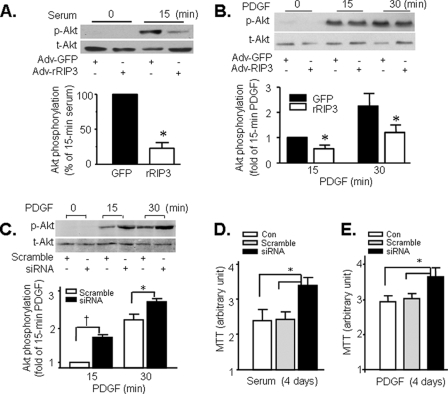
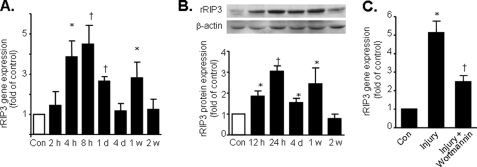
Proliferation of vascular smooth muscle cells (VSMCs) is a primary mechanism underlying cardiovascular proliferative disorders. Phosphoinositide 3-kinase (PI3K)-Akt (or protein kinase B) axis has been assigned at the center of pathways that regulate cell proliferation. Here we demonstrate that enhanced PI3K-Akt signaling by mitogenic stimulation or arterial injury profoundly elevates expression of receptor interacting protein 3 (RIP3) in primary cultured rat VSMCs and in vivo and that the up-regulation of RIP3 leads to VSMC growth arrest and apoptosis via inhibiting the PI3K-Akt signaling pathway, thereby alleviating balloon injury-induced neointimal formation. Specifically, mitogenic stimulation with platelet-derived growth factor-BB or angiotensin II leads to a profound increase in RIP3 expression, which is abolished by inhibition of PI3K or Akt, and increased PI3K-Akt signaling by expression of a constitutively active PI3K mutant also elevates RIP3 expression. Importantly, adenoviral overexpression of RIP3 not only triggers apoptosis but also causes cell cycle arrest at G(1)/G(0) phases that is associated with suppressed Akt activation. In sharp contrast, RIP3 gene silencing enhances serum- and platelet-derived growth factor-induced cell proliferation and Akt activation. In vivo adenoviral gene delivery of rat RIP3 (rRIP3) increased apoptosis and reduced VSMC proliferation, thus, effectively alleviating balloon injury-induced neointimal formation. The growth-suppressive and pro-apoptotic effects are independent of rRIP3 Ser/Thr kinase activity, because overexpression of a kinase-inactive mutant of rRIP3, similar to its wild type, is sufficient to induce growth arrest and apoptosis. These findings reveal a novel growth-suppressive action of RIP3, marking RIP3 as an important factor to prevent excessive mitogenic stimulation- or injury-induced vascular smooth muscle cells hyperplasia.
Figures





References
-
- Braun-Dullaeus R. C., Mann M. J., Dzau V. J. (1998) Circulation 98, 82–89 - PubMed
-
- Dzau V. J., Braun-Dullaeus R. C., Sedding D. G. (2002) Nat. Med. 8, 1249–1256 - PubMed
-
- Forrester J. S., Fishbein M., Helfant R., Fagin J. (1991) J. Am. Coll. Cardiol. 17, 758–769 - PubMed
-
- Novak K. (1998) Nat. Med. 4, 989–990 - PubMed
-
- Ferns G. A., Raines E. W., Sprugel K. H., Motani A. S., Reidy M. A., Ross R. (1991) Science 253, 1129–1132 - PubMed
Publication types
MeSH terms
Substances
Grants and funding
LinkOut - more resources
Full Text Sources
Miscellaneous
