


R7BP complexes with RGS9-2 and RGS7 in the striatum differentially control motor learning and locomotor responses to cocaine
- PMID: 20043004
- PMCID: PMC2887292
- DOI: 10.1038/npp.2009.212
R7BP complexes with RGS9-2 and RGS7 in the striatum differentially control motor learning and locomotor responses to cocaine
Abstract
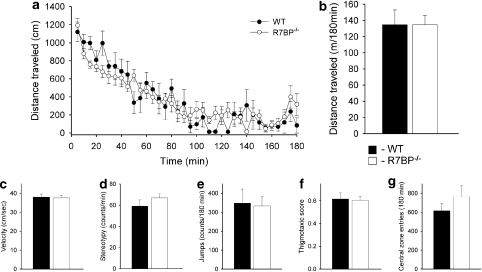
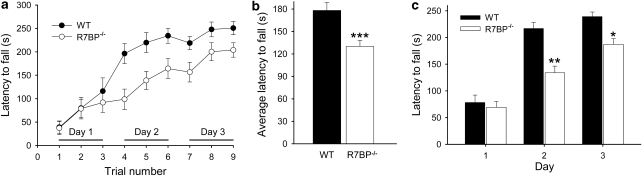
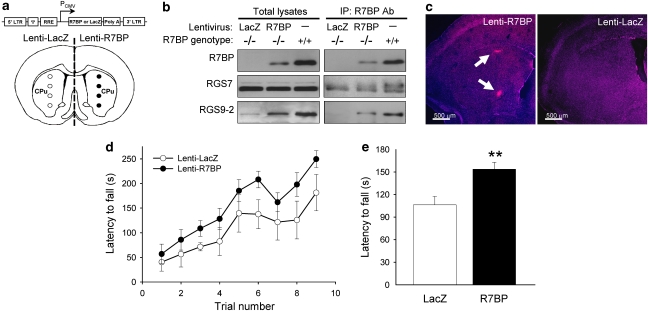
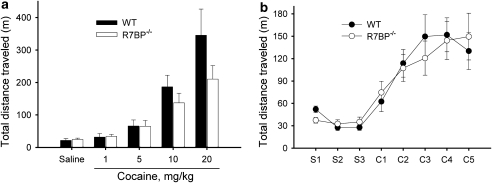
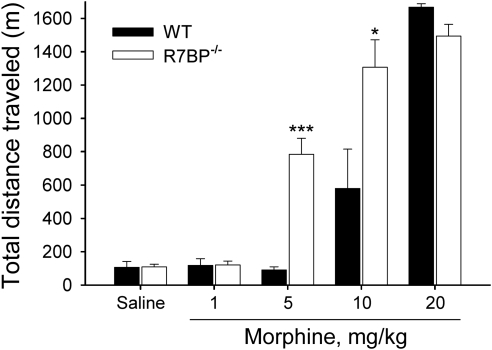
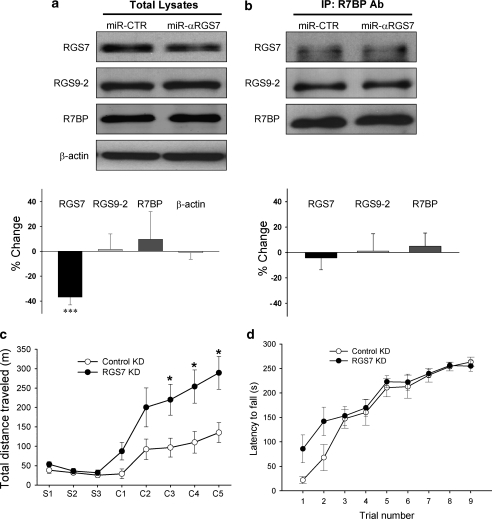
In the striatum, signaling through G protein-coupled dopamine receptors mediates motor and reward behavior, and underlies the effects of addictive drugs. The extent of receptor responses is determined by RGS9-2/Gbeta5 complexes, a striatally enriched regulator that limits the lifetime of activated G proteins. Recent studies suggest that the function of RGS9-2/Gbeta5 is controlled by the association with an additional subunit, R7BP, making elucidation of its contribution to striatal signaling essential for understanding molecular mechanisms of behaviors mediated by the striatum. In this study, we report that elimination of R7BP in mice results in motor coordination deficits and greater locomotor response to morphine administration, consistent with the essential role of R7BP in maintaining RGS9-2 expression in the striatum. However, in contrast to previously reported observations with RGS9-2 knockouts, mice lacking R7BP do not show higher sensitivity to locomotor-stimulating effects of cocaine. Using a striatum-specific knockdown approach, we show that the sensitivity of motor stimulation to cocaine is instead dependent on RGS7, whose complex formation with R7BP is dictated by RGS9-2 expression. These results indicate that dopamine signaling in the striatum is controlled by concerted interplay between two RGS proteins, RGS7 and RGS9-2, which are balanced by a common subunit, R7BP.
Figures
References
-
- Anderson GR, Semenov A, Song JH, Martemyanov KA. The membrane anchor R7BP controls the proteolytic stability of the striatal specific RGS protein, RGS9-2. J Biol Chem. 2007a;282:4772–4781. - PubMed
Publication types
MeSH terms
Substances
Grants and funding
- P01 NS047399/NS/NINDS NIH HHS/United States
- R01 DA019666/DA/NIDA NIH HHS/United States
- DA026405/DA/NIDA NIH HHS/United States
- P50 DA011806/DA/NIDA NIH HHS/United States
- DA021743/DA/NIDA NIH HHS/United States
- NS047399/NS/NINDS NIH HHS/United States
- K02 DA026405/DA/NIDA NIH HHS/United States
- DA011806/DA/NIDA NIH HHS/United States
- MH061933/MH/NIMH NIH HHS/United States
- DA019666/DA/NIDA NIH HHS/United States
- R01 MH061933/MH/NIMH NIH HHS/United States
- R01 DA021743/DA/NIDA NIH HHS/United States
- F31 DA024944/DA/NIDA NIH HHS/United States
LinkOut - more resources
Full Text Sources
Molecular Biology Databases
