. 2010 Mar 8:1318:144-54.
doi: 10.1016/j.brainres.2009.12.050. Epub 2010 Jan 4.

Ethanol self-administration modulation of NMDA receptor subunit and related synaptic protein mRNA expression in prefrontal cortical fields in cynomolgus monkeys

Affiliations

Ethanol self-administration modulation of NMDA receptor subunit and related synaptic protein mRNA expression in prefrontal cortical fields in cynomolgus monkeys

Glen Acosta et al. Brain Res. .

Abstract

Background: Functional impairment of the orbital and medial prefrontal cortex underlies deficits in executive control that characterize addictive disorders, including alcohol addiction. Previous studies indicate that alcohol alters glutamate neurotransmission and one substrate of these effects may be through the reconfiguration of the subunits constituting ionotropic glutamate receptor (iGluR) complexes. Glutamatergic transmission is integral to cortico-cortical and cortico-subcortical communication, and alcohol-induced changes in the abundance of the receptor subunits and/or their splice variants may result in critical functional impairments of prefrontal cortex in the alcohol-addicted state.

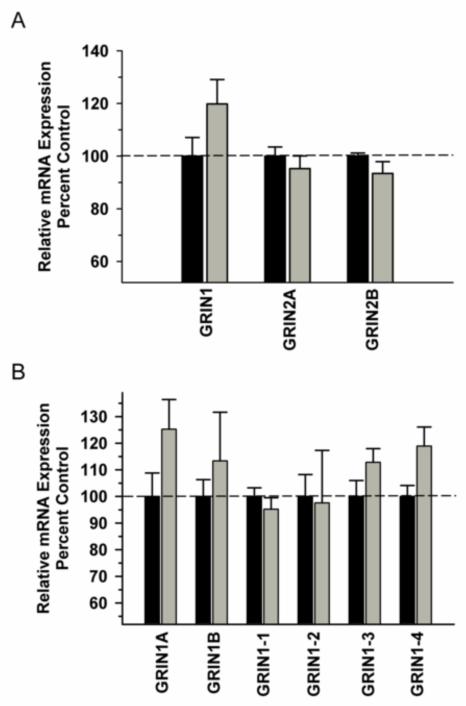
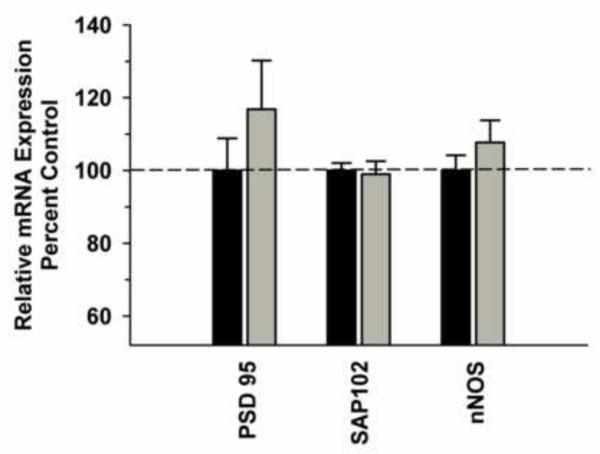
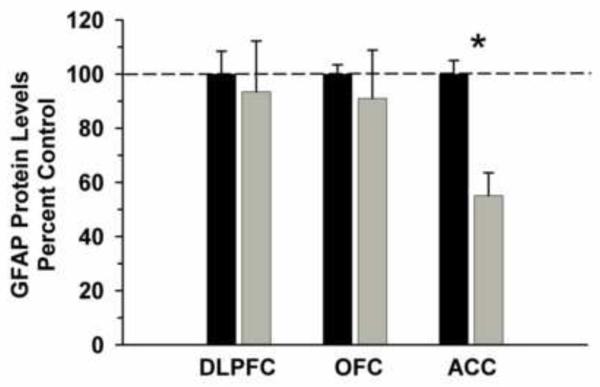
Methods and results: The effects of chronic ethanol self-administration on glutamate receptor ionotropic NMDA (GRIN), as well as GRIN1 splice variant mRNA expression was studied in the orbitofrontal cortex (OFC; Area 13), dorsolateral prefrontal cortex (DLPFC; Area 46) and anterior cingulate cortex (ACC; Area 24) of male cynomolgus monkeys. Chronic ethanol self-administration resulted in significant changes in the expression of NMDA subunit mRNA expression in the DLPFC and OFC, but not the ACC. In DLPFC, the overall expression of NMDA subunits was significantly decreased in ethanol treated monkeys. Slight but significant changes were observed for synaptic associated protein 102 kD (SAP102) and neuronal nitric oxide synthase (nNOS) mRNAs. In OFC, the NMDAR1 variant GRIN1-1 was reduced while GRIN1-2 was increased. Furthermore, no significant changes in GFAP protein levels were observed in either the DLPFC or OFC.

Conclusion: Results from these studies provide the first demonstration of posttranscriptional regulation of iGluR subunits in the primate brain following long-term ethanol self-administration. Furthermore, changes in these transcripts do not appear to reflect changes in glial activation or loss. Further studies examining the expression and cellular localization of subunit proteins and receptor pharmacology would shed more light on the findings reported here.


Figures

Figure 1
Figure 1
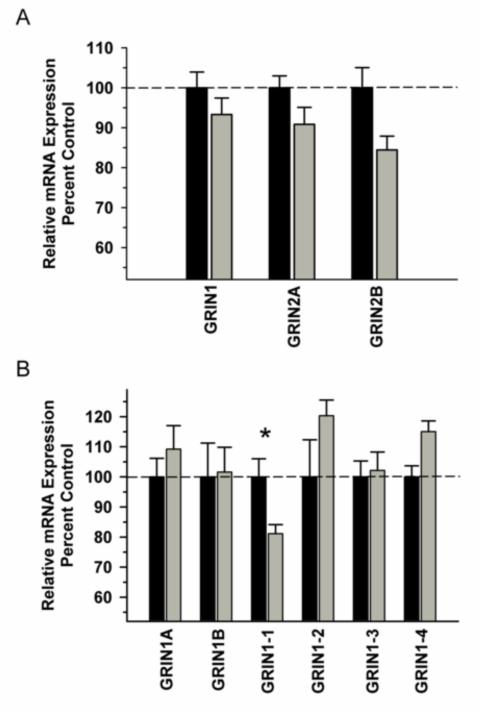
Effect of chronic self-administration by cynomolgus macaques on NMDA subunit expression in DLPFC. Ethanol induced a significant decrease in NMDA receptor subunit expression; however, there was no Group x Subunit interaction (A). A trend towards a significant interaction was observed for GRIN1 splice variant expression, with post hoc analysis revealing a significant decrease GRIN1-1 in the ethanol group (B). Black bar – control subjects, gray bar – ethanol subjects. Asterisks indicate a significant difference compared to control subjects (P<0.05).
Figure 2
Figure 2
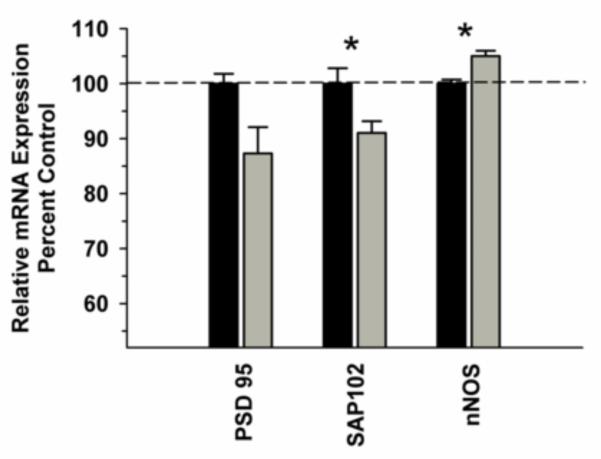
Effect of chronic self-administration on PSD-95, SAP102 and nNOS mRNA expression in the DLPFC. Ethanol induced a significant decrease in SAP102 mRNA, a significant increase in nNOS mRNA and a slight decrease in PSD95 mRNA levels (P=0.053). Black bar – control subjects, gray bar – ethanol subjects. Asterisks indicate a significant difference compared to control subjects (P<0.05).
Figure 3
Figure 3
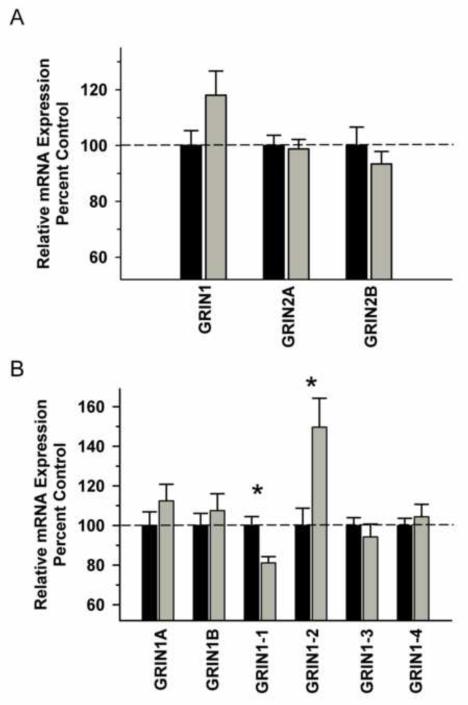
Effect of chronic self-administration by cynomolgus macaques on NMDA subunit expression in OFC. Ethanol self-administration did not affect NMDA receptor subunit mRNA expression in this region (A). A significant interaction was observed for GRIN1 splice variant expression, with post hoc analysis revealing a significantly decreased GRIN1-1 expression and increased GRIN1-2 expression in the ethanol group (B). Black bar – control subjects, gray bar – ethanol subjects. Asterisks indicate a significant difference compared to control subjects (P<0.05).
Figure 4
Figure 4
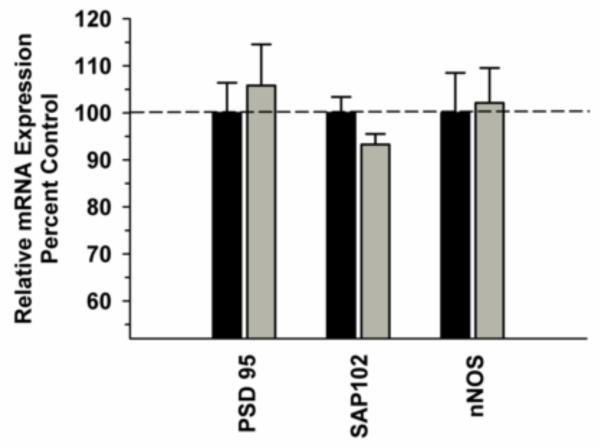
Effect of chronic self-administration on PSD-95, SAP102 and nNOS mRNA expression in the OFC. No significant differences were observed between the groups for PSD-95, SAP102 and nNOS expression. Black bar – control subjects, gray bar – ethanol subjects.
Figure 5
Figure 5
Effect of chronic self-administration by cynomolgus macaques on NMDA subunit expression in ACC. Ethanol induced a significant decrease in NMDA receptor subunit expression; however, there was no Group x Subunit interaction (A). A trend towards a significant interaction was observed for GRIN1 splice variant expression, with post hoc analysis revealing a significant decrease GRIN1-1 in the ethanol group (B). Black bar – control subjects, gray bar – ethanol subjects. Asterisks indicate a significant difference compared to control subjects (P<0.05).
Figure 6
Figure 6
Effect of chronic self-administration on PSD-95, SAP102 and nNOS mRNA expression in the ACC. Ethanol induced a significant decrease in PSD-95 and SAP102 mRNAs and a slight increase in nNOS expression. Black bar – control subjects, gray bar – alcohol subjects. Asterisks indicate a significant difference compared to control subjects (P<0.05).
Figure 7
Figure 7
GFAP protein levels in prefrontal cortical brain regions of ethanol consuming and control cynomolgus monkeys. Cytosolic fractions were isolated and separated on 10% SDS-PAGE. Data are expressed as mean (± S.E.M.) of the percent of control values per amount of protein loaded. Asterisks indicate a significant difference (P<0.05).
Figure 8
Figure 8
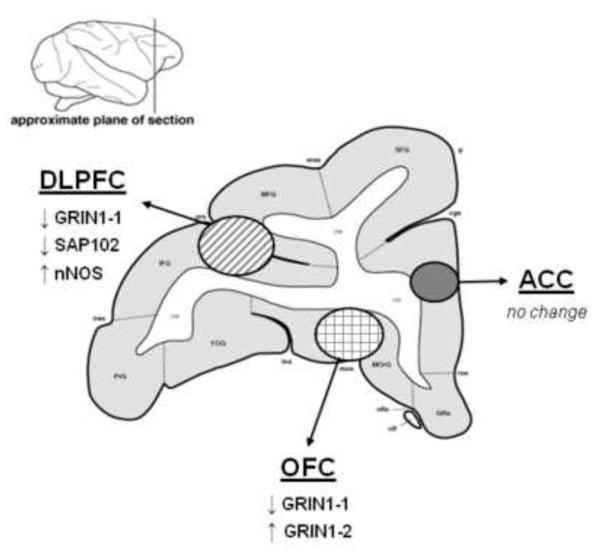
Summary of changes in NMDA receptor subunit and NMDAR1 variants in vulnerable prefrontal cortical regions following ethanol consumption in cynomolgus monkeys.

References

    1. Adams KM, Gilman S, Koeppe RA, Kluin KJ, Brunberg JA, Dede D, Berent S, Kroll PD. Neuropsychological deficits are correlated with frontal hypometabolism in positron emission tomography studies of older alcoholic patients. Alcohol Clin Exp Res. 1993;17:205–210. - PubMed
    1. Anderson NJ, Daunais JB, Friedman DP, Grant KA, McCool BA. Long-term ethanol self-administration by the nonhuman primate, Macaca fascicularis, decreases the benzodiazepine sensitivity of amygdala GABA(A) receptors. Alcohol Clin Exp Res. 2007;31:1061–1070. - PMC - PubMed
    1. Bechara A. Risky business: emotion, decision-making, and addiction. J Gambl Stud. 2003;19:23–51. - PubMed
    1. Bechara A, Damasio H. Decision-making and addiction (part I): impaired activation of somatic states in substance dependent individuals when pondering decisions with negative future consequences. Neuropsychologia. 2002;40:1675–1689. - PubMed
    1. Bechara A, Damasio H, Damasio AR. Emotion, decision making and the orbitofrontal cortex. Cereb Cortex. 2000;10:295–307. - PubMed

Publication types

MeSH terms