


Inflammation and social experience: an inflammatory challenge induces feelings of social disconnection in addition to depressed mood
- PMID: 20043983
- PMCID: PMC2856755
- DOI: 10.1016/j.bbi.2009.12.009
Inflammation and social experience: an inflammatory challenge induces feelings of social disconnection in addition to depressed mood
Abstract
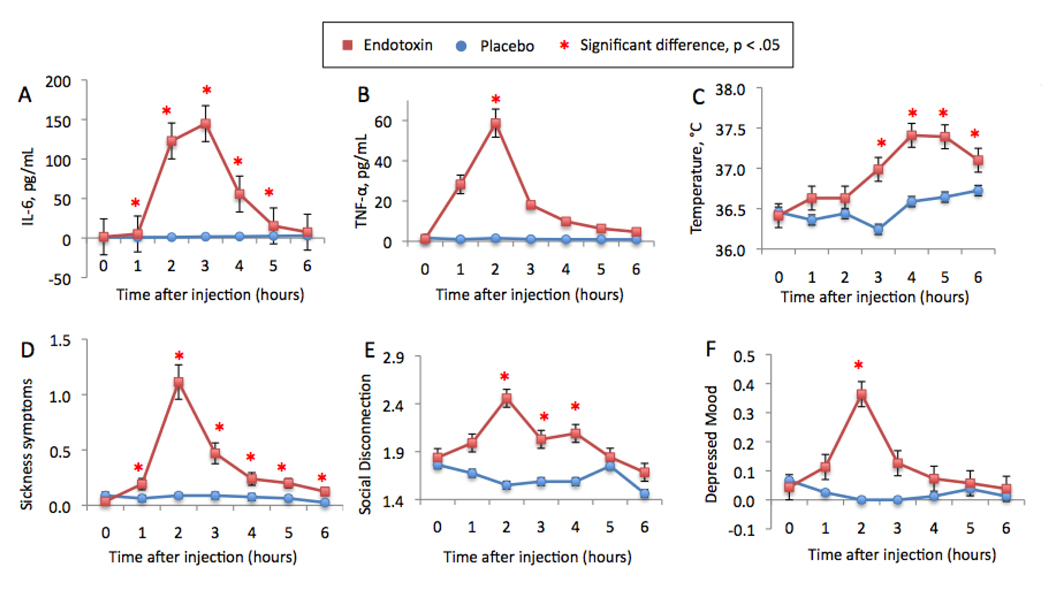
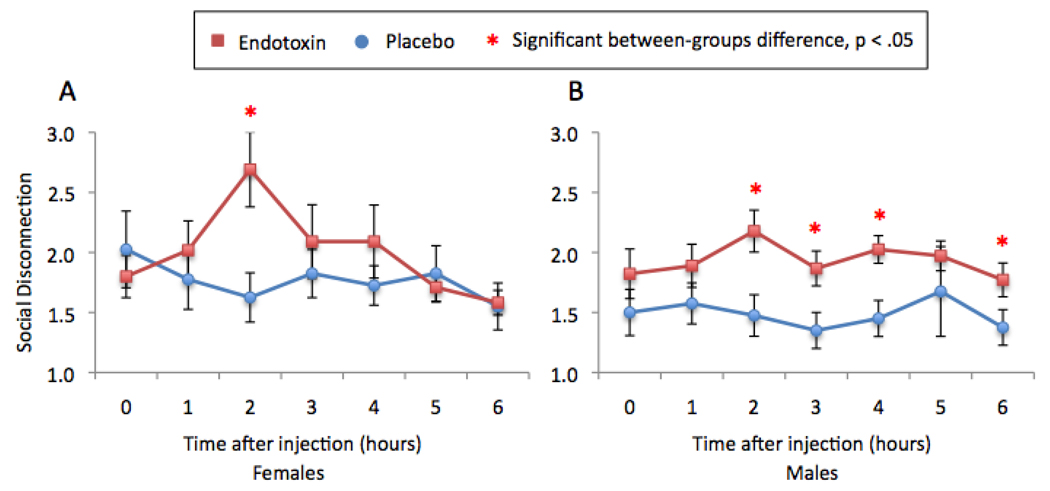
Although research has established links between feelings of social isolation and inflammation, the direction of these effects is unclear. Based on the role that proinflammatory cytokines play in initiating "sickness behavior," which includes symptoms such as social withdrawal, it is possible that inflammatory processes heighten feelings of 'social disconnection.' Here, we examined whether exposure to an inflammatory challenge increased self-reported feelings of social disconnection. In addition, because both inflammatory processes and feelings of social disconnection contribute to depressive symptoms, we also explored whether increases in feelings of social disconnection played a role in the link between inflammation and depressed mood. Participants were randomly assigned to either receive endotoxin, an inflammatory challenge, or placebo. Proinflammatory cytokines (IL-6, TNF-alpha) were collected at baseline and then hourly for 6h. Participants completed self-reports of sickness symptoms ("fatigue"), social disconnection ("I feel disconnected from others"), and depressed mood ("unhappy") hourly. Results revealed that endotoxin led to significant increases (from baseline) in IL-6 and TNF-alpha levels as well as feelings of social disconnection and depressed mood. Moreover, controlling for increases in social disconnection eliminated the relationship between exposure to inflammatory challenge and depressed mood. This study demonstrates that inflammation can have social psychological consequences, which may play a role in cytokine-related depressive symptoms.
Copyright 2009 Elsevier Inc. All rights reserved.
Conflict of interest statement
The authors have no financial gain related to the outcome of this research, and there are no potential conflicts of interest.
Figures
References
-
- Andreasen AS, Krabbe KS, Krogh-Madsen R, Taudorf S, Pedersen BK, Møller K. Human endotoxemia as a model of systemic inflammation. Current Medicinal Chemistry. 2008;15:1697–1705. - PubMed
-
- Cacioppo JT, Hawkley LC. Social isolation and health, with an emphasis on underlying mechanisms. Perspectives in Biology and Medicine. 2003;46:S39–S52. - PubMed
-
- Capuron L, Ravaud A, Miller AH, Dantzer R. Baseline mood and psychosocial characteristics of patients developing depressive symptoms during interleukin-2 and/or interferon-alpha cancer therapy. Brain, Behavior, and Immunity. 2004;18:205–213. - PubMed
-
- Caspi A, Harrington BS, Moffitt TE, Milne BJ, Poulton R. Socially isolated children 20 years later. Archives of pediatrics and Adolescent Medicine. 2006;160:805–811. - PubMed
-
- Cohen S, Doyle WJ, Skoner DP, Rabin BS, Gwaltney JM., Jr Social ties and susceptibility to the common cold. Journal of the American Medical Association. 1997;277:1940–1944. - PubMed
Publication types
MeSH terms
Substances
Grants and funding
- R01 CA116778/CA/NCI NIH HHS/United States
- P30-AG028748/AG/NIA NIH HHS/United States
- T32-MH19925/MH/NIMH NIH HHS/United States
- M01 RR000865/RR/NCRR NIH HHS/United States
- T32 MH019925/MH/NIMH NIH HHS/United States
- HL-079955/HL/NHLBI NIH HHS/United States
- P30 AG028748/AG/NIA NIH HHS/United States
- CA-116778/CA/NCI NIH HHS/United States
- CA-10014152/CA/NCI NIH HHS/United States
- R01 HL079955/HL/NHLBI NIH HHS/United States
- R01 AG026364/AG/NIA NIH HHS/United States
- M01-RR00865/RR/NCRR NIH HHS/United States
- AG-026364/AG/NIA NIH HHS/United States
- R01 AG034588/AG/NIA NIH HHS/United States
LinkOut - more resources
Full Text Sources
Medical
