Review
. 2010 Feb;22(1):34-8.
doi: 10.1016/j.smim.2009.12.001. Epub 2009 Dec 30.

Molecular mechanisms of allorecognition in a basal chordate

Affiliations
Review

Molecular mechanisms of allorecognition in a basal chordate

Tanya R McKitrick et al. Semin Immunol. 2010 Feb.

Abstract

Allorecognition has been described in many metazoan phyla, from the sponges to the mammals. In vertebrates, allorecognition is a result of a MHC-based recognition event central to adaptive immunity. However, the origin of the adaptive immune system and the potential relationship to more primitive allorecognition systems is unclear. The colonial ascidian, Botryllus schlosseri, has been used as a model organism for the study of allorecognition for over a century, as it undergoes a natural transplantation reaction controlled by a single, highly polymorphic locus. Herein we will summarize our current understanding of the molecular mechanisms that underlie this innate allorecognition reaction.


Figures

Figure 1
Figure 1
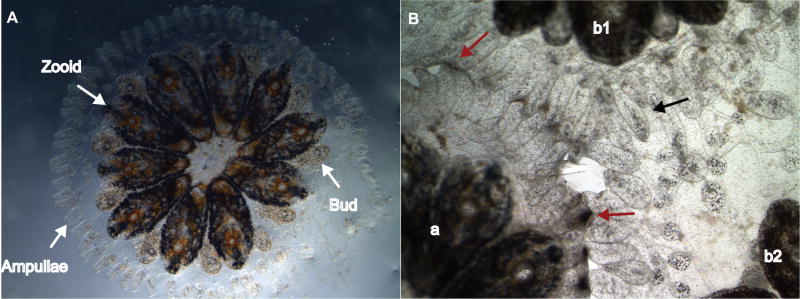
A. A dorsal view of a Botryllus schlosseri colony as described in the text. Adult individuals (zooids), the asexually developing progeny (buds) and the structures involved in allorecognition (ampullae) are highlighted. B. An allorecognition reaction occurring between three distinct colonies (a, b1 and b2). Colonies b1 and b2 are genetically identical subclones that are undergoing vascular reorganization (black arrow) which will eventually lead to a fusion event. Simultaneously, both colonies b1 and b2 are rejecting colony a, and have developed several points of rejection (red arrows) which prevent blood transfer.
Figure 2
Figure 2
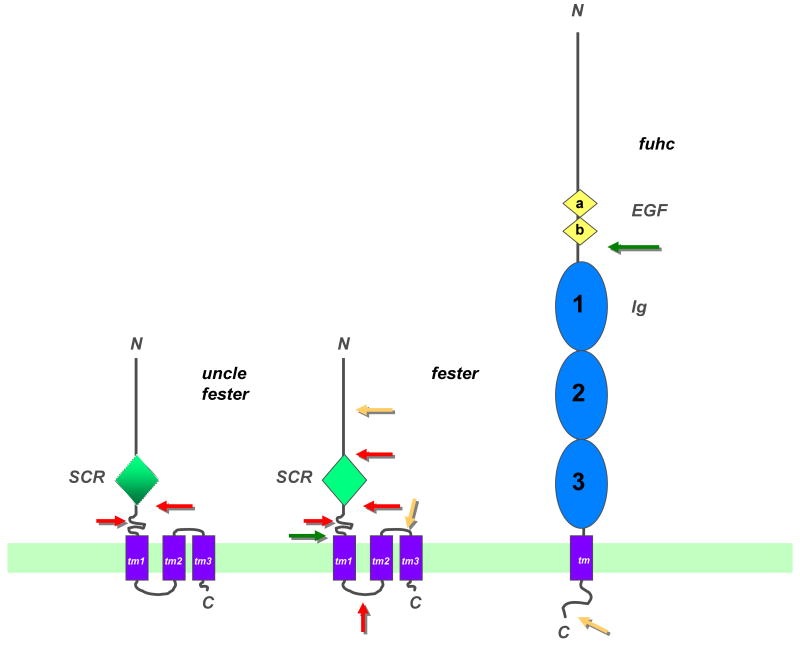
Topological models of uncle fester, fester and the fuhc proteins. Both fester and uncle fester encode an extracellular SCR domain (green diamond), although there is no amino acid homology between the two. This is followed by three predicted transmembrane domains and an intracellular COOH tail. Portions of the molecule deleted by alternative splicing are shown (arrows). Red arrows show regions which are spliced frequently, yellow arrows are regions which are spliced rarely. The green arrow on fester depicts a splice variant which removes all the transmembrane domains, creating a putatively secreted form of the protein (see text for details). The fuhc protein is shown on the right, with two tandem EGF domains (yellow diamonds), followed by three tandem immunoglobulin (C2 type) domains (blue ovals), followed by a TM region and short intracellular tail. Two splice variants of the fuhc have been detected; the green arrow shows a splice which creates a putative secreted form of the protein, containing ca. 50% of the ectodomain, while the yellow arrow indicates a region where a small exon is inserted in ca. 5% of the transcripts, however it encodes no obvious motifs. These structures are based on predictions from multiple algorithms, but have not been directly demonstrated [13]. For example, one program predicts an Ig domain at the N-terminus of fester, and two Ig domains at the N-terminus of the fuhc, preceding the EGF domains (F. Bazan, personal communication). In addition, Ig domain 1 is predicted by some, but not all programs.

References

    1. Burnet FM. “Self-recognition” in Colonial Marine Forms and Flowering Plants in relation ot the Evolution of Immunity. Nature. 1971;232:230–235. - PubMed
    1. Boehm T. Quality control in self/nonself discrimination. Cell. 2006;25:845–858. - PubMed
    1. Pancer Z, Amemlya CT, Ehrhardt GRA, Ceitlin J, Gartland GL, Cooper MD. Somatic diversification of variable lymphocyte recpetors in the agnathan sea lamprey. Nature. 2004;430:174–180. - PubMed
    1. Parham P. MHC class I molecules and KIRs in human history, health and survival. Nature Review Immunology. 2005;5:201–214. - PubMed
    1. Bancroft FW. Variation and fusion in compund ascidians. Proc Calif Acad Sci. 1903;3(3):137–186.