Revisiting anterior atlantoaxial subluxation with overlooked information on MR images
- PMID: 20044504
- PMCID: PMC7964179
- DOI: 10.3174/ajnr.A1941
Revisiting anterior atlantoaxial subluxation with overlooked information on MR images
Abstract
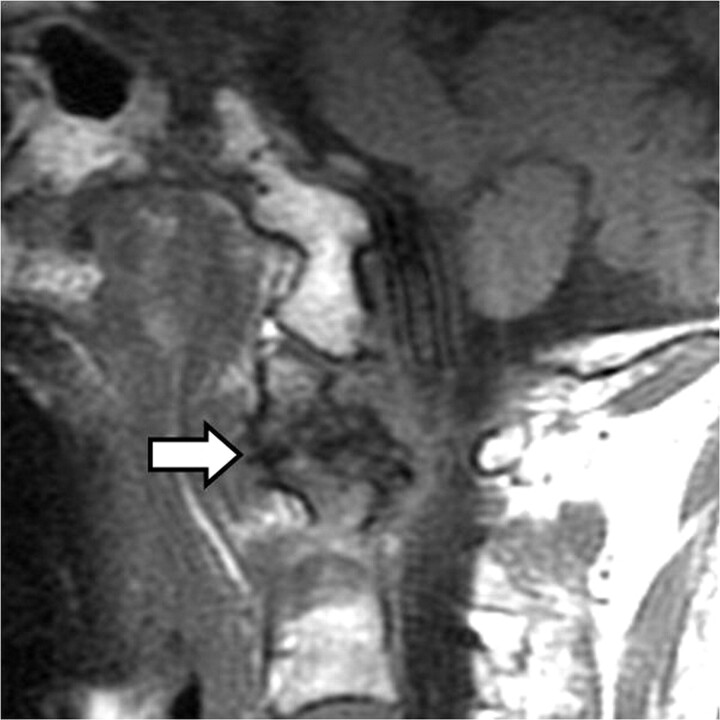
Background and purpose: The ADI is the imaging diagnostic clue to AAA subluxation of the cervical spine. Some MR imaging findings other than abnormal ADI relate to AAA subluxation. However, their relationship is not yet clarified. The present study elucidates the role of MR imaging by employing these previously overlooked findings.
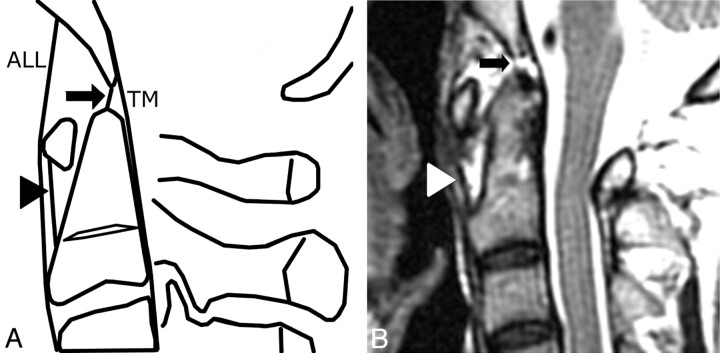
Materials and methods: This study enrolled 40 patients with AAA subluxation and 20 non-AAA subluxation patients as controls. All MR imaging was performed with supine neutral positioning. The morphology of the dens, bilateral facet joints, and surrounding ligaments, as well as the alignment of the anterior atlantoaxial joint, the spinolaminar line, and the intramedullary signal intensity, were assessed. This investigation statistically analyzed the difference among these groups.
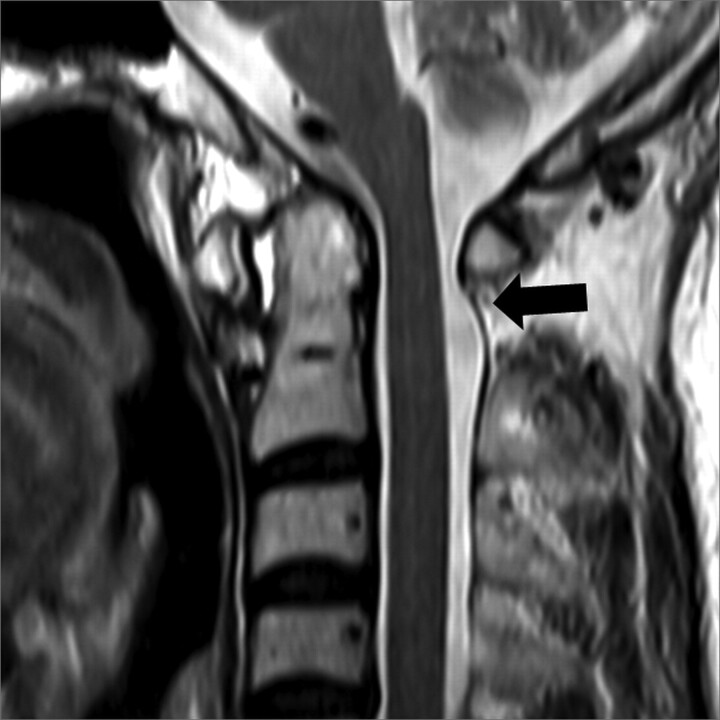
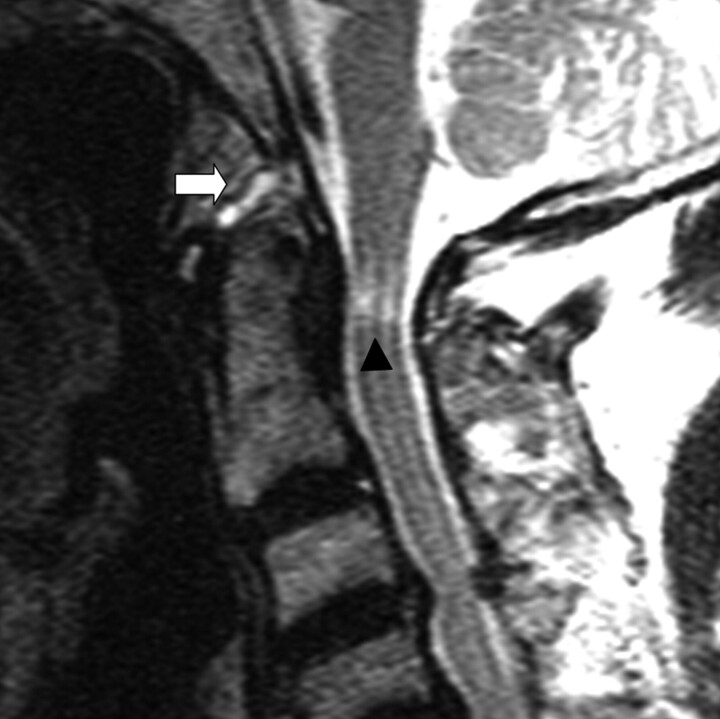
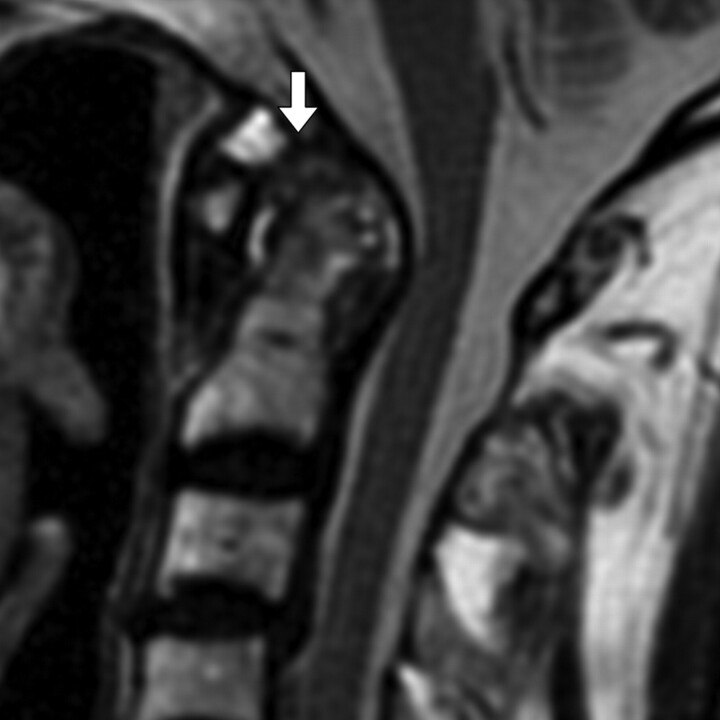
Results: Thirty-eight percent (15 of 40) of patients with AAA subluxation showed nAAA. There was no significant difference between the groups of AAA with normal and abnormal ADI except that more peridental pannus was seen in the latter group. More dens erosion (P = .022), tilting of anterior atlantoaxial joint (P = .022), peridental effusion (P < .001), lateral facet arthropathy (P < .001), abnormal spinolaminar line (P = .001), and focal myelopathy (P = .001) were observed in nAAA patients compared with the controls. The combination of peridental effusion, lateral facet arthropathy, abnormal intramedullary signals, and abnormal spinolaminar line showed a sensitivity of 100% and a specificity of 90% in diagnosing AAA subluxation.
Conclusions: MR imaging provides important biomechanical clues, other than ADI, that improve accuracy in diagnosing atlantoaxial instability.
Figures
References
-
- Zikou AK, Alamanos Y, Argyropoulou MI, et al. Radiological cervical spine involvement in patients with rheumatoid arthritis: a cross sectional study. J Rheumatol 2005;32:801–06 - PubMed
-
- Naranjo A, Carmona L, Gavrila D, et al. Prevalence and associated factors of anterior atlantoaxial luxation in a nation-wide sample of rheumatoid arthritis patients. Clin Exp Rheumatol 2004;22:427–32 - PubMed
-
- Kauppi M, Hakala M. Prevalence of cervical spine subluxations and dislocations in a community-based rheumatoid arthritis population. Scand J Rheumatol 1994;23:133–36 - PubMed
-
- Brattstrom H, Granholm L. Atlanto-axial fusion in rheumatoid arthritis: a new method of fixation with wire and bone cement. Acta Orthop Scand 1976;47:619–28 - PubMed
Publication types
MeSH terms
LinkOut - more resources
Full Text Sources
Medical