. 2010 Jan 1;327(5961):84-7.
doi: 10.1126/science.1180616.

The Tasmanian devil transcriptome reveals Schwann cell origins of a clonally transmissible cancer

Affiliations

The Tasmanian devil transcriptome reveals Schwann cell origins of a clonally transmissible cancer

Elizabeth P Murchison et al. Science. .

Abstract

The Tasmanian devil, a marsupial carnivore, is endangered because of the emergence of a transmissible cancer known as devil facial tumor disease (DFTD). This fatal cancer is clonally derived and is an allograft transmitted between devils by biting. We performed a large-scale genetic analysis of DFTD with microsatellite genotyping, a mitochondrial genome analysis, and deep sequencing of the DFTD transcriptome and microRNAs. These studies confirm that DFTD is a monophyletic clonally transmissible tumor and suggest that the disease is of Schwann cell origin. On the basis of these results, we have generated a diagnostic marker for DFTD and identify a suite of genes relevant to DFTD pathology and transmission. We provide a genomic data set for the Tasmanian devil that is applicable to cancer diagnosis, disease evolution, and conservation biology.


Figures
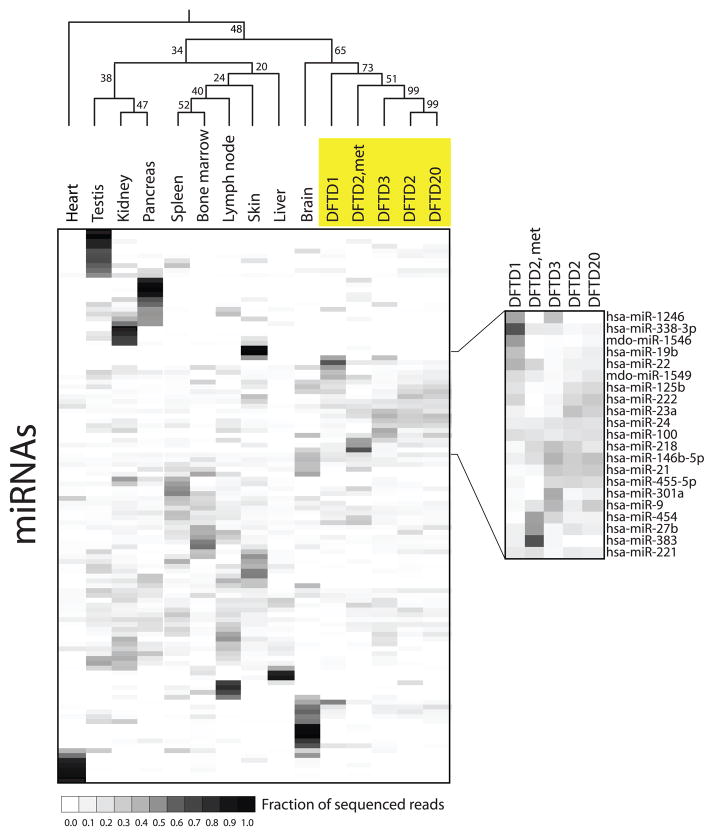
Fig. 1
Fig. 1
miRNA profiling of DFTD. Heat map of normalized miRNA reads for 114 miRNAs cloned and sequenced from 10 Tasmanian devil tissues; four DFTD facial tumors (DFTD1, 2, 3, and 20); and one DFTD mammary metastasis (DFTD2, met). miRNAs were clustered on the basis of Pearson’s correlation statistic, and bootstrap values (percentage) are indicated. The DFTD miRNA profile is shown in greater detail. miRNAs were annotated on the basis of conservation with comparison species hsa, human; mdo, opossum.
Fig. 2
Fig. 2
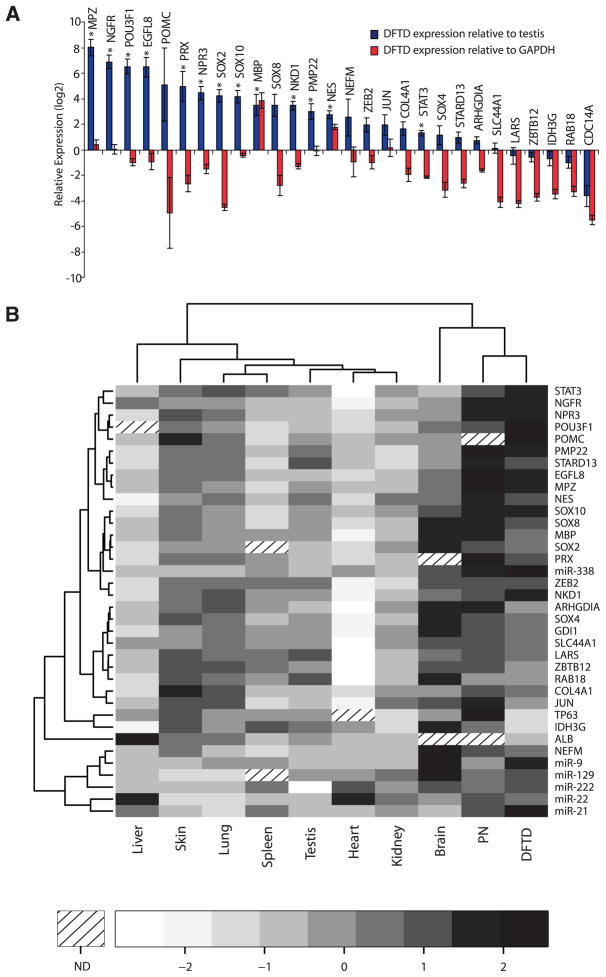
DFTD transcriptome. (A) Semiquantitative RT-PCR expression profiling of 31 genes with enriched expression in tumor relative to testis [454–read count fold change ≥2.5, P ≤ 0.05, chi-squared test; (green points in fig. S5)]. Log values of the mean expression difference of DFTD genes relative to testis (blue bars) and relative to GAPDH (red bars) are shown. Error bars represent standard deviation. Significant differences between tumor and testis expression levels (P ≤ 0.05) are indicated by an asterisk (two-sample t test, Holm’s correction for multiple testing). (B) Heat map of semiquantitative PCR expression profiles of 31 genes across a panel of tissues including peripheral nerve (PN), a Schwann cell–enriched tissue. Panel color represents the mean gene expression level, standardized across tissues (z score). Hierarchical clustering based on Pearson’s correlation statistic is indicated by dendrograms. For each tissue three biological replicates were performed (n = 3). ND, not determined.
Fig. 3
Fig. 3
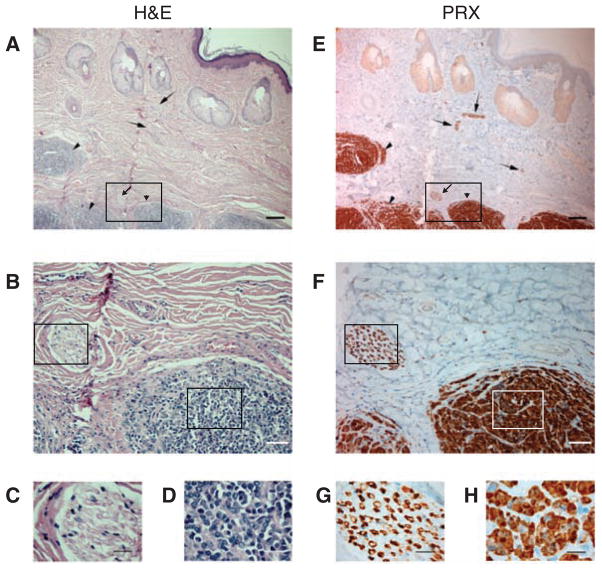
Identification of a diagnostic marker for DFTD. (A to D) Hematoxylin and eosin (H&E) and (E to H) PRX antibody stains used for DFTD tumor histology. Arrowheads, DFTD tissue; arrows, peripheral nerve bundles (containing Schwann cells). Magnification, 4× (A and E; scale bar, 200 μm); 20× (B and F; scale bar, 50 μm); and 100× (C and G) peripheral nerve bundle (scale bar, 20 μm) and (D and H) DFTD tumor (scale bar, 20 μm). Boxed areas indicate approximate locations of areas magnified in lower panels.

Comment in

References

    1. Hawkins CE, et al. Biol Conserv. 2006;131:307.
    1. Lachish S, Jones M, McCallum H. J Anim Ecol. 2007;76:926. - PubMed
    1. Loh R, et al. Vet Pathol. 2006;43:890. - PubMed
    1. McCallum H, et al. EcoHealth. 2007;4:318.
    1. Pearse AM, Swift K. Nature. 2006;439:549. - PubMed

Publication types

MeSH terms

Associated data