


The structure of the extended psychosis phenotype in early adolescence--a cross-sample replication
- PMID: 20044595
- PMCID: PMC3122288
- DOI: 10.1093/schbul/sbp154
The structure of the extended psychosis phenotype in early adolescence--a cross-sample replication
Abstract
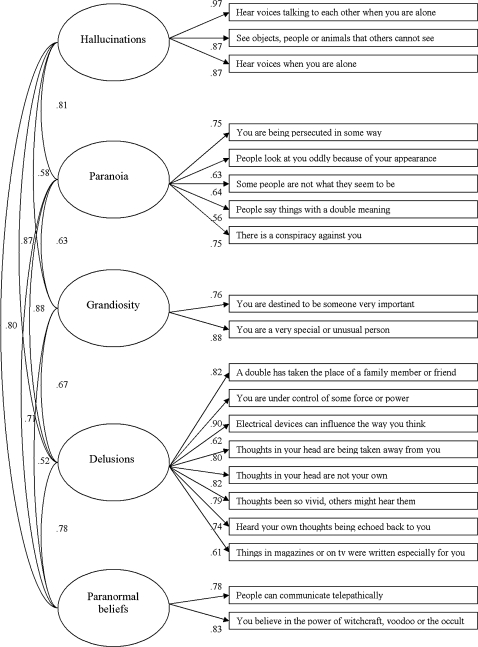
The extended psychosis phenotype, or the expression of nonclinical positive psychotic experiences, is already prevalent in adolescence and has a dose-response risk relationship with later psychotic disorder. In 2 large adolescent general population samples (n = 5422 and n = 2230), prevalence and structure of the extended psychosis phenotype was investigated. Positive psychotic experiences, broadly defined, were reported by the majority of adolescents. Exploratory analysis with Structural Equation Modelling (Exploratory Factor Analysis followed by Confirmatory Factor Analysis [CFA]) in sample 1 suggested that psychotic experiences were best represented by 5 underlying dimensions; CFA in sample 2 provided a replication of this model. Dimensions were labeled Hallucinations, Delusions, Paranoia, Grandiosity, and Paranormal beliefs. Prevalences differed strongly, Hallucinations having the lowest and Paranoia having the highest rates. Girls reported more experiences on all dimensions, except Grandiosity, and from age 12 to 16 years rates increased. Hallucinations, Delusions, and Paranoia, but not Grandiosity and Paranormal beliefs, were associated with distress and general measures of psychopathology. Thus, only some of the dimensions of the extended psychosis phenotype in young people may represent a continuum with more severe psychopathology and predict later psychiatric disorder.
Figures
References
-
- van Os J, Linscott RJ, Myin-Germeys I, Delespaul P, Krabbendam L. A systematic review and meta-analysis of the psychosis continuum: evidence for a psychosis proneness-persistence-impairment model of psychotic disorder. Psychol Med. 2009;39:179–195. - PubMed
-
- Linscott RJ, van Os J. Systematic reviews of categorical and continuum models in psychosis: evidence for discontinuous subpopulations underlying a psychometric continuum. Implications for DSM-V, DMS-VI and DSM-VII. Annu Rev Clin Psychol. 2010;6 - PubMed
-
- Poulton R, Caspi A, Moffit TE, Cannon M, Murray R, Harrington H. Children’s self-reported psychotic symptoms and adult schizophreniform disorder. A 15-year longitudinal study. Arch Gen Psychiatry. 2000;57:1053–1058. - PubMed
-
- Verdoux H, van Os J. Psychotic symptoms in non-clinical populations and the continuum of psychosis. Schizophr Res. 2002;54:59–65. - PubMed
-
- Verdoux H, van Os J, Maurice-Tison S, Gay B, Salamon R, Bourgeois M. Is early adulthood a critical developmental stage for psychosis proneness? A survey of delusional ideation in normal subjects. Schizophr Res. 1998;29:247–254. - PubMed
Publication types
MeSH terms
LinkOut - more resources
Full Text Sources
Medical
