


Engineered CH2 domains (nanoantibodies)
- PMID: 20046570
- PMCID: PMC2715188
- DOI: 10.4161/mabs.1.1.7480
Engineered CH2 domains (nanoantibodies)
Abstract
Currently, almost all FDA approved therapeutic antibodies (except ReoPro, Lucentis and Cimzia which are Fabs), and the vast majority of those in clinical trials are full-size antibodies mostly in IgG1 format of about 150 kDa size. A fundamental problem for such large molecules is their poor penetration into tissues (e.g., solid tumors) and poor or absent binding to regions on the surface of some molecules (e.g., on the HIV envelope glycoprotein) which are fully accessible only by molecules of smaller size. Therefore, much work especially during the last decade has been aimed at developing novel scaffolds of much smaller size and high stability. Here I briefly describe a proposition to use the immunoglobulin (Ig) constant CH2 domain (CH3 for IgE and IgM) as a scaffold. CH2 is critical for the Ig effector functions. Isolated CH2 is stable monomer in contrast to all other constant domains and most of the variable domains. CH2 and engineered CH2 domains with improved stability can be used as scaffolds for construction of libraries containing diverse binders to various antigens. Such binders based on a CH2 scaffold could also confer some effector functions. Because the CH2 domains are the smallest independently folded antibody domains that can be engineered to contain simultaneously antigen-binding sites and binding sites mediating effector and stability functions, and to distinguish them from domain antibodies which are used to denote engineered VH or VL domains or nanobodies which are used to denote camelid VHH, I termed them nanoantibodies (nAbs).
Keywords: CH2; Fabs; antibodies; nanoantibodies; scaffold.
Figures
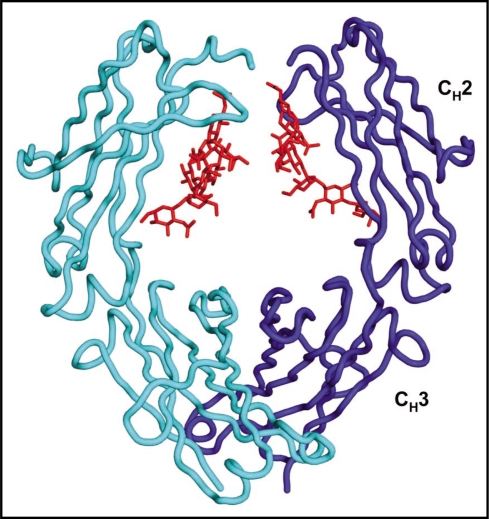
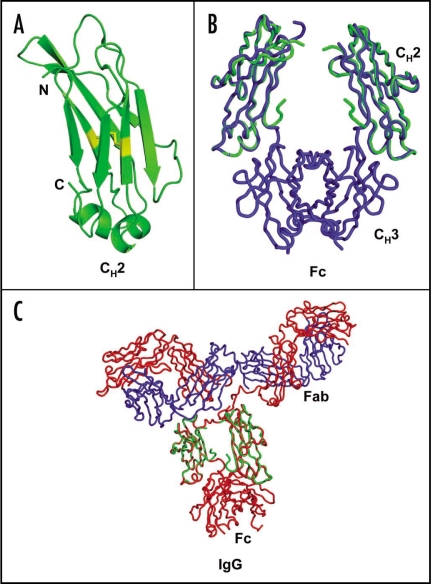
References
-
- Kolmar H, Skerra A. Alternative binding proteins get mature: rivalling antibodies. FEBS J. 2008;275:2667. - PubMed
-
- Skerra A. Alternative non-antibody scaffolds for molecular recognition. Curr Opin Biotechnol. 2007;18:295–304. - PubMed
-
- Nygren PA, Skerra A. Binding proteins from alternative scaffolds. J Immunol Methods. 2004;290:3–28. - PubMed
-
- Binz HK, Amstutz P, Pluckthun A. Engineering novel binding proteins from nonimmunoglobulin domains. Nat Biotechnol. 2005;23:1257–1268. - PubMed
-
- Hey T, Fiedler E, Rudolph R, Fiedler M. Artificial, non-antibody binding proteins for pharmaceutical and industrial applications. Trends Biotechnol. 2005;23:514–522. - PubMed
Publication types
MeSH terms
Substances
LinkOut - more resources
Full Text Sources
Other Literature Sources
