


Sinonasal mucosal melanoma: a 13-year experience at a single institution
- PMID: 20046593
- PMCID: PMC2731469
- DOI: 10.1055/s-0028-1115321
Sinonasal mucosal melanoma: a 13-year experience at a single institution
Abstract
Objective: Report the experience of the Karmanos Cancer Institute with sinonasal mucosal melanoma (SNMM) in patients diagnosed between 1995 and 2007.
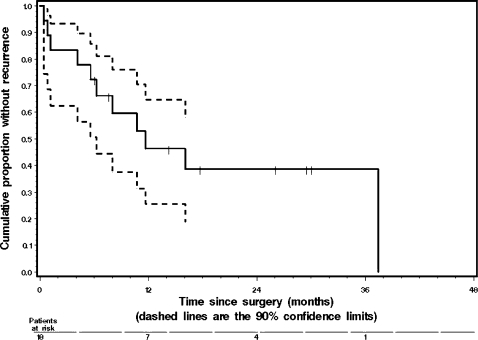
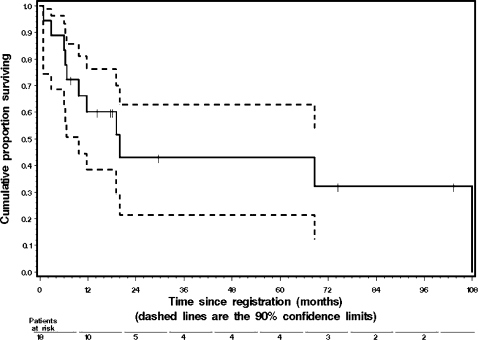
Results: Eighteen patients, ages 31 to 85 (mean, 67), whose most common presenting symptoms included epistaxis and facial pressure. Most common anatomic locations were the maxillary sinus and nasal cavity. Seventy-two percent presented with tumors extending to the skull base, frontal sinus, orbit, or cranium. Tumor size ranged from 0.3 cm to 5.3 cm. Most common surgical procedure was medial maxillectomy (12 patients). Eight patients received chemotherapy, ten received radiotherapy and six received both. One third of patients received interferon-alpha. Median recurrence-free survival (RFS) was 14.4 months, with a 1-year RFS rate of 55%. Median overall survival (OS) was 19.3 months with a 1-year OS rate of 60% and a 2-year OS rate of 42%. The 5-year OS rate was 34%.
Conclusion: SNMM remains a disease that has eluded breakthroughs in treatment. Patients are typically treated with wide local resection; however unique to our institution was the frequent use of interferon and chemoradiation. Further research in adjuvant therapies will be necessary to improve outcomes.
Keywords: Melanoma; nasal cavity; sinonasal mucosal melanoma; sinus.
Figures
References
-
- Thompson A C, Morgan D A, Bradley P J. Malignant melanoma of the nasal cavity and paranasal sinuses. Clin Otolaryngol. 1993;18:34–36. - PubMed
-
- Conley J J, Ackerman A B. Melanoma of the Head and Neck. 1st ed. New York: Georg Thieme Verlag; 1990. pp. 154–178.
-
- Thompson L DR, Wienke J A, Miettinen M. Sinonasal tract and nasopharyngeal melanomas: a clinicopathologic study of 115 cases with a proposed staging system. Am J Surg Pathol. 2003;27(5):594–611. - PubMed
-
- Cheng Y F, Lai C C, Ho C Y, Shu C H, Lin C Z. Toward a better understanding of sinonasal mucosal melanoma: clinical review of 23 cases. J Chin Med Assoc. 2007;70(1):24–29. - PubMed
-
- Lee E. Statistical Methods for Survival Data Analysis. 3rd ed. Hoboken, New Jersey: Wiley & Sons, Inc.; 2003. pp. 76–91.
