


Coordinated basal-bolus infusion for tighter postprandial glucose control in insulin pump therapy
- PMID: 20046653
- PMCID: PMC2769848
- DOI: 10.1177/193229680900300110
Coordinated basal-bolus infusion for tighter postprandial glucose control in insulin pump therapy
Abstract
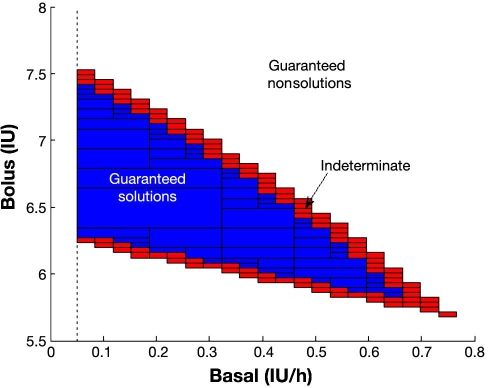
Background: Basal and bolus insulin determination in intensive insulin therapy for type 1 diabetes mellitus (T1DM) are currently considered independently of each other. A new strategy that coordinates basal and bolus insulin infusion to cope with postprandial glycemia in pump therapy is proposed. Superior performance of this new strategy is demonstrated through a formal analysis of attainable performances in an in silico study.
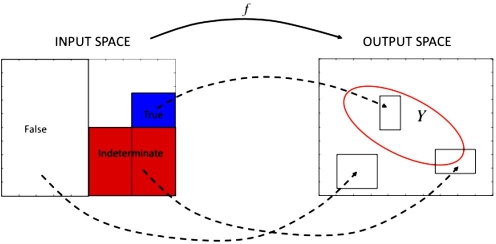
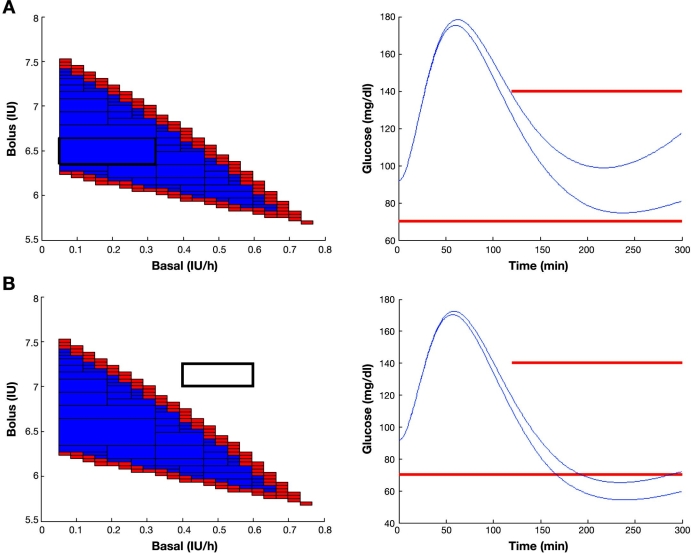
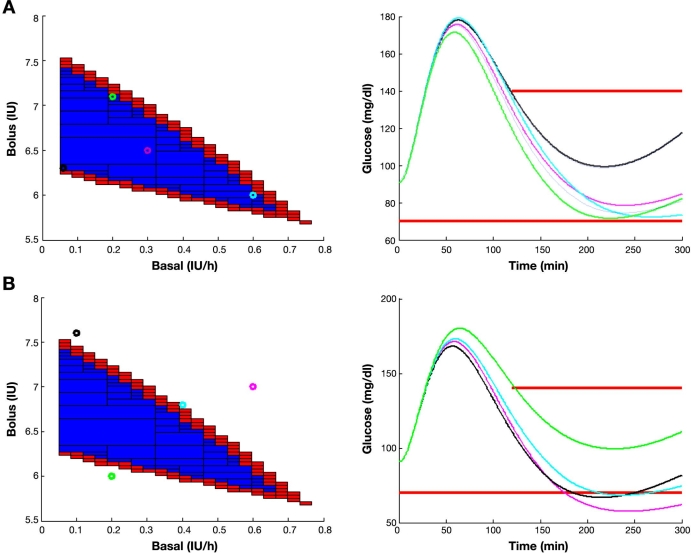
Methods: The set inversion via interval analysis algorithm has been applied to obtain the feasible set of basal and bolus doses that, for a given meal, mathematically guarantee a postprandial response fulfilling the International Diabetes Federation (IDF) guidelines (i.e., no hypoglycemia and 2 h postprandial glucose below 140 mg/dl). Hypoglycemia has been defined as a glucose value below 70 mg/dl. A 5 h time horizon has been considered for a 70 kg in silico T1DM subject consuming meals in the range of 30 to 80 g of carbohydrates.
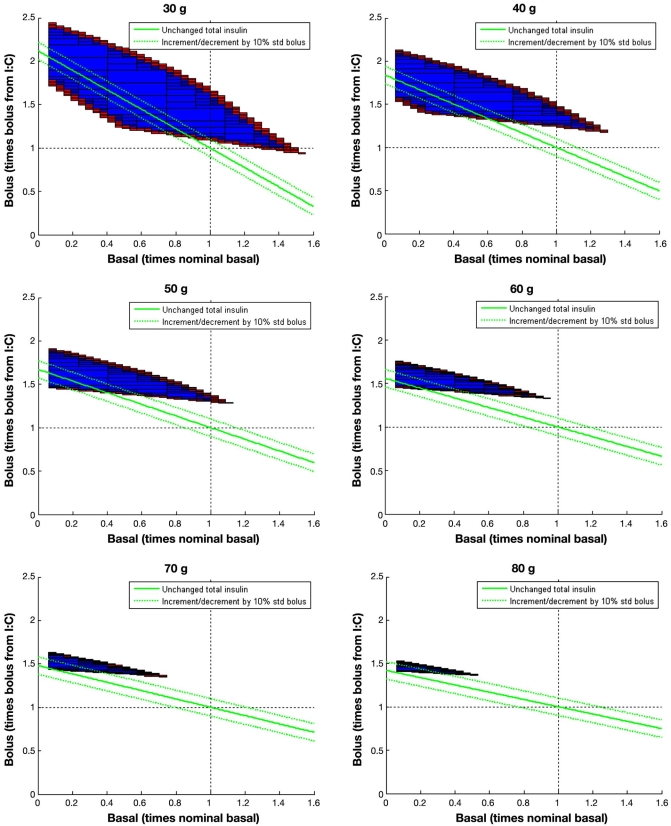
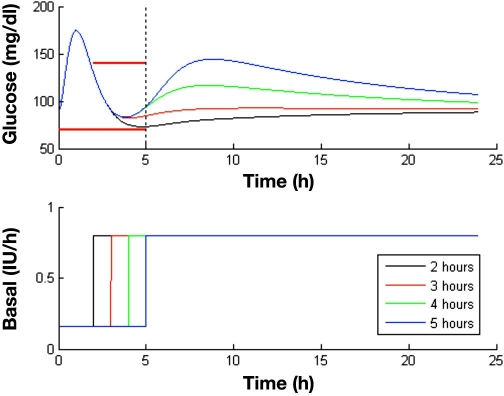
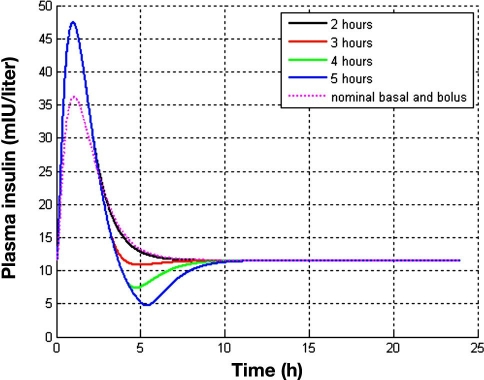
Results: The computed feasible sets demonstrate that current separated basal/bolus strategy dramatically limits the attainable performance. For a nominal basal of 0.8 IU/h leading to a basal glucose of approximately 100 mg/dl, IDF guidelines cannot be fulfilled for meals greater than 50 g of carbohydrates, independent of the bolus insulin computed. However, coordinating the basal and bolus insulin delivery can achieve this. A decrement of basal insulin during the postprandial period is required together with an increase in bolus insulin, in appropriate percentages, which is meal dependent. After 3 h, basal insulin can be restored to its nominal value.
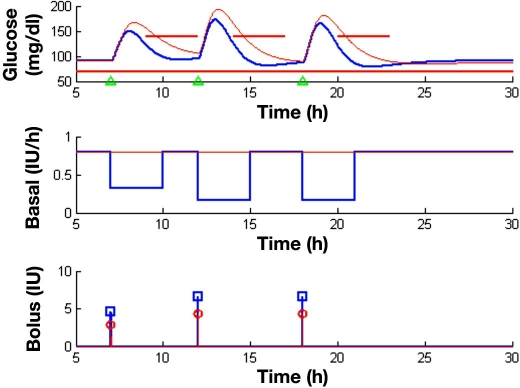
Conclusions: The new strategy meets IDF guidelines in a typical day, contrary to the standard basal/bolus strategy, yielding a mean 2 h postprandial glucose reduction of 36.4 mg/dl without late hypoglycemia. The application of interval analysis for the computation of feasible sets is demonstrated to be a powerful tool for the analysis of attainable performance in glucose control.
Keywords: glucose control; insulin pump therapy; interval analysis; set inversion; type 1 diabetes mellitus.
© Diabetes Technology Society
Figures
References
-
- Chase HP, Saib SZ, Mackenzie T, Hansen MM, Garg SK. Post-prandial glucose excursions following four methods of bolus insulin administration in subjects with type 1 diabetes. Diabet Med. 2007;19(4):317–321. - PubMed
-
- Zisser H, Robinson L, Bevier W, Dassau E, Ellingsen C, Doyle FJ, III, Jovanovič L. Bolus calculator: a review of four “smart” insulin pumps. Diabetes Technol Ther. 2008;10(6):441–444. - PubMed
-
- Moore RE. Englewood Cliffs: Prentice-Hall; 1966. Interval analysis.
-
- Moore RE. SIAM; 1979. Methods and applications of interval analysis.
-
- Alefeld G, Herzberger J. New York: Academic Press; 1983. Introduction to interval computations.
Publication types
MeSH terms
Substances
LinkOut - more resources
Full Text Sources
Medical
