


The evolution and loss of oil-offering flowers: new insights from dated phylogenies for angiosperms and bees
- PMID: 20047869
- PMCID: PMC2838259
- DOI: 10.1098/rstb.2009.0229
The evolution and loss of oil-offering flowers: new insights from dated phylogenies for angiosperms and bees
Abstract
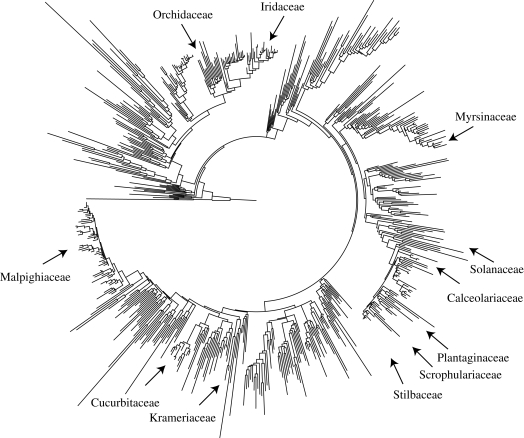
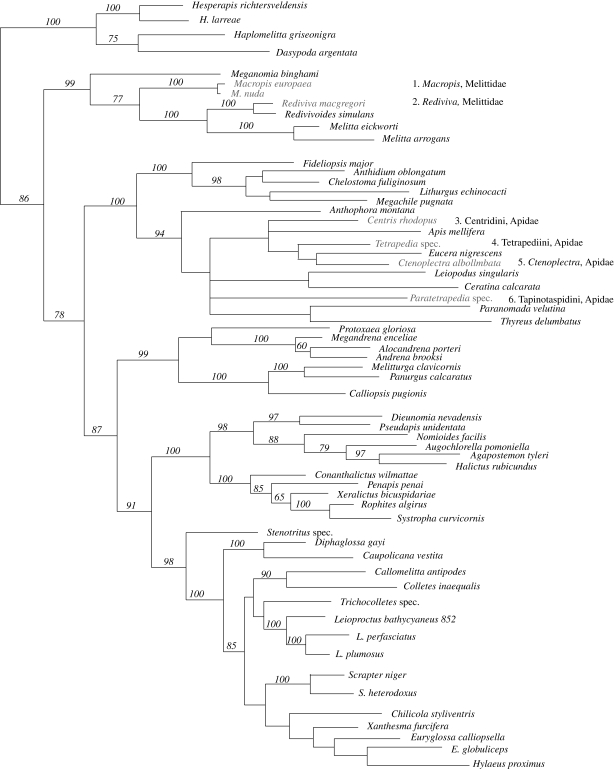
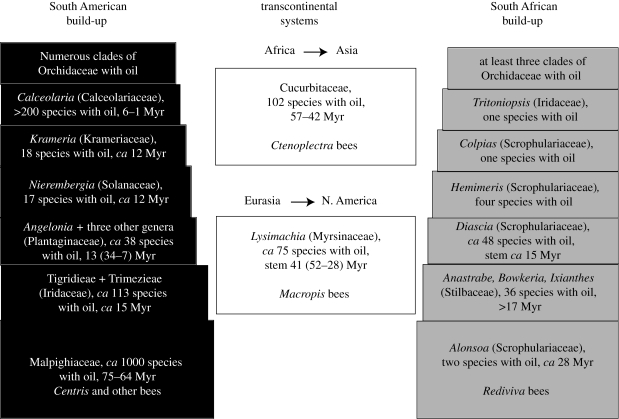
The interactions between bees that depend on floral oil for their larvae and flowers that offer oil involve an intricate mix of obligate and facultative mutualisms. Using recent phylogenies, new data on oil-offering Cucurbitaceae, and molecular-dating, we ask when and how often oil-offering flowers and oil-foraging bees evolved, and how frequently these traits were lost in the cause of evolution. Local phylogenies and an angiosperm-wide tree show that oil flowers evolved at least 28 times and that floral oil was lost at least 36-40 times. The oldest oil flower systems evolved shortly after the K/T boundary independently in American Malpighiaceae, tropical African Cucurbitaceae and Laurasian Lysimachia (Myrsinaceae); the ages of the South African oil flower/oil bee systems are less clear. Youngest oil flower clades include Calceolaria (Calceolariaceae), Iridaceae, Krameria (Krameriaceae) and numerous Orchidaceae, many just a few million years old. In bees, oil foraging evolved minimally seven times and dates back to at least 56 Ma (Ctenoplectra) and 53 Ma (Macropis). The co-occurrence of older and younger oil-offering clades in three of the four geographical regions (but not the Holarctic) implies that oil-foraging bees acquired additional oil hosts over evolutionary time. Such niche-broadening probably started with exploratory visits to flowers resembling oil hosts in scent or colour, as suggested by several cases of Muellerian or Batesian mimicry involving oil flowers.
Figures
References
-
- Aguiar J. C. A., Melo G. A. R.2009Notes on oil sources for the bee genus Caenonomada (Hymenoptera, Apidae, Tapinotaspidini). Rev. Bras. Entomol. 53, 154–156
-
- Aliscioni S. S., Torretta J. P., Bello M. E., Galati G. B.2009Elaiophores in Gomesa bifolia (Sims) M.W. Chase & N.H. Williams (Oncidiinae: Cymbidieae: Orchidaceae): structure and oil secretion. Ann. Bot. 104, 1141–1149 (doi:10.1093/aob/mcp199) - DOI - PMC - PubMed
-
- Alves dos Santos I., Melo G. A. R., Rozen G. R., Jr2002Biology and immature stages of the bee tribe Tetrapediini (Hymenoptera: Apidae). Am. Museum Nov. 3377, 1–45 (doi:10.1206/0003-0082(2002)377<0001:BAISOT>2.0.CO;2) - DOI
-
- Anderberg A. A., Manns U., Källersjö M.2007Phylogeny and floral evolution of the Lysimachieae (Ericales, Myrsinaceae): evidence from ndhF sequence data. Willdenowia 37, 407–421 (doi:10.3372/wi.37.37202) - DOI
-
- Anderson W. R.1979Floral conservatism in Neotropical Malpighiaceae. Biotropica 11, 219–223 (doi:10.2307/2388042) - DOI
Publication types
MeSH terms
Substances
Associated data
- Actions
- Actions
LinkOut - more resources
Full Text Sources
