


Floral adaptation and diversification under pollen limitation
- PMID: 20047878
- PMCID: PMC2838256
- DOI: 10.1098/rstb.2009.0226
Floral adaptation and diversification under pollen limitation
Abstract
Pollen limitation (PL) of seed production creates unique conditions for reproductive adaptation by angiosperms, in part because, unlike under ovule or resource limitation, floral interactions with pollen vectors can contribute to variation in female success. Although the ecological and conservation consequences of PL have received considerable attention in recent times, its evolutionary implications are poorly appreciated. To identify general influences of PL on reproductive adaptation compared with those under other seed-production limits and their implications for evolution in altered environments, we derive a model that incorporates pollination and post-pollination aspects of PL. Because PL always favours increased ovule fertilization, even when population dynamics are not seed limited, it should pervasively influence selection on reproductive traits. Significantly, under PL the intensity of inbreeding does not determine whether outcrossing or autonomous selfing can evolve, although it can affect which response is most likely. Because the causes of PL are multifaceted in both natural and anthropogenically altered environments, the possible outcrossing solutions are diverse and context dependent, which may contribute to the extensive variety of angiosperm reproductive characteristics. Finally, the increased adaptive options available under PL may be responsible for positive global associations between it and angiosperm diversity.
Figures
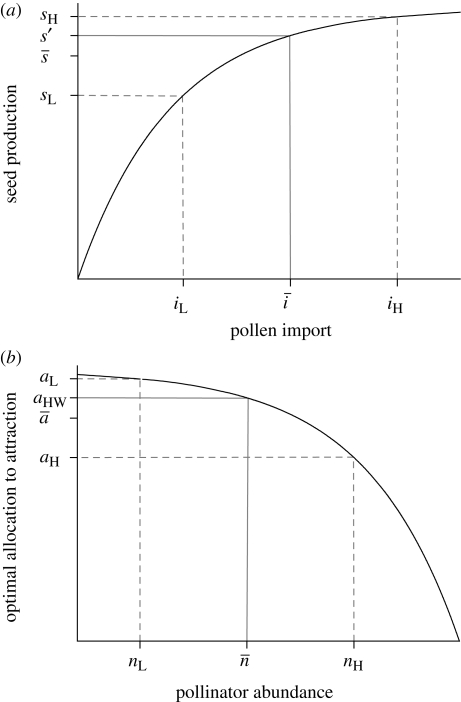
 ) is less than the fecundity expected given the mean pollen import (s′), both of which are lower than the maximum possible seed production, indicating PL. Richards et al. (2009) referred to the difference between s′ and
  as variance limitation. Similarly, because the optimal allocation to pollinator attraction declines nonlinearly with pollinator abundance, the average optimal allocation to attraction (
 ) is less than the optimum expected for average pollinator abundance (aHW), which is equivalent to the balance between pollen and resource limitation predicted by Haig & Westoby (1988), resulting in chronic PL.
References
-
- Aguilar R., Ashworth L., Galetto L., Aizen M. A.2006Plant reproductive susceptibility to habitat fragmentation: review and synthesis through a meta-analysis. Ecol. Lett. 9, 968–980 (doi:10.1111/j.1461-0248.2006.00927.x) - DOI - PubMed
-
- Aizen M. A.2001Flower sex ratio, pollinator abundance, and the seasonal pollination dynamics of a protandrous plant. Ecology 82, 127–144 (doi:10.1890/0012-9658(2001)082[0127:FSRPAA]2.0.CO;2) - DOI
-
- Aizen M. A.2003Down-facing flowers, hummingbirds and rain. Taxon 52, 675–680 (doi:10.2307/3647342) - DOI
-
- Aizen M. A., Feinsinger P.2003Bees not to be? Responses of insect pollinator faunas and flower pollination to habitat fragmentation. In How landscapes change: human disturbance and ecosystem disruptions in the Americas (eds Bradshaw G. A., Marquet P. A.), pp. 111–129 Berlin, Germany: Springer-Verlag
-
- Aizen M. A., Harder L. D.2007Expanding the limits of the pollen-limitation concept: effects of pollen quantity and quality. Ecology 88, 271–281 (doi:10.1890/06-1017) - DOI - PubMed
Publication types
MeSH terms
LinkOut - more resources
Full Text Sources
