Leaping forks at inverted repeats
- PMID: 20047996
- PMCID: PMC2802191
- DOI: 10.1101/gad.1884810
Leaping forks at inverted repeats
Abstract
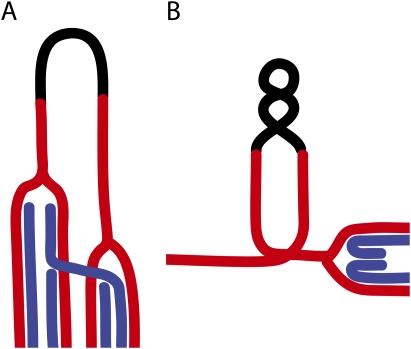
Genome rearrangements are often associated with genome instability observed in cancer and other pathological disorders. Different types of repeat elements are common in genomes and are prone to instability. S-phase checkpoints, recombination, and telomere maintenance pathways have been implicated in suppressing chromosome rearrangements, but little is known about the molecular mechanisms and the chromosome intermediates generating such genome-wide instability. In the December 15, 2009, issue of Genes & Development, two studies by Paek and colleagues (2861-2875) and Mizuno and colleagues (pp. 2876-2886), demonstrate that nearby inverted repeats in budding and fission yeasts recombine spontaneously and frequently to form dicentric and acentric chromosomes. The recombination mechanism underlying this phenomenon does not appear to require double-strand break formation, and is likely caused by a replication mechanism involving template switching.
Figures
Comment on
-
Fusion of nearby inverted repeats by a replication-based mechanism leads to formation of dicentric and acentric chromosomes that cause genome instability in budding yeast.Genes Dev. 2009 Dec 15;23(24):2861-75. doi: 10.1101/gad.1862709. Genes Dev. 2009. PMID: 20008936 Free PMC article.
-
Nearby inverted repeats fuse to generate acentric and dicentric palindromic chromosomes by a replication template exchange mechanism.Genes Dev. 2009 Dec 15;23(24):2876-86. doi: 10.1101/gad.1863009. Genes Dev. 2009. PMID: 20008937 Free PMC article.
References
-
- Ahmed A, Podemski L. Observations on template switching during DNA replication through long inverted repeats. Gene. 1998;223:187–194. - PubMed
Publication types
MeSH terms
Grants and funding
LinkOut - more resources
Full Text Sources
Molecular Biology Databases
Miscellaneous