


Anogenital distance from birth to 2 years: a population study
- PMID: 20049133
- PMCID: PMC2801188
- DOI: 10.1289/ehp.0900881
Anogenital distance from birth to 2 years: a population study
Abstract
Background: Anogenital distance (AGD) is sexually dimorphic in rodents and humans, being 2- to 2.5-fold greater in males. It is a reliable marker of androgen and antiandrogen effects in rodent reproductive toxicologic studies. Data on AGD in humans are sparse, with no longitudinal data collected during infancy.
Objective: This study was designed to determine AGD from birth to 2 years in males and females and relate this to other anthropometric measures.
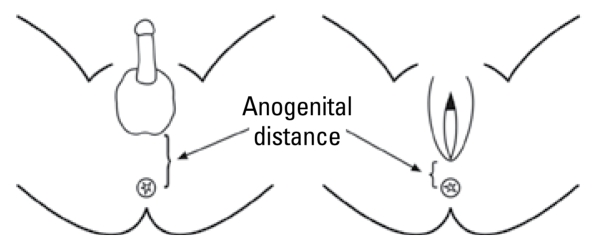
Materials and methods: Infants were recruited from the Cambridge Baby Growth Study. AGD was measured from the center of the anus to the base of the scrotum in males and to the posterior fourchette in females. Measurements were performed at birth and at 3, 12, 18, and 24 months of age.
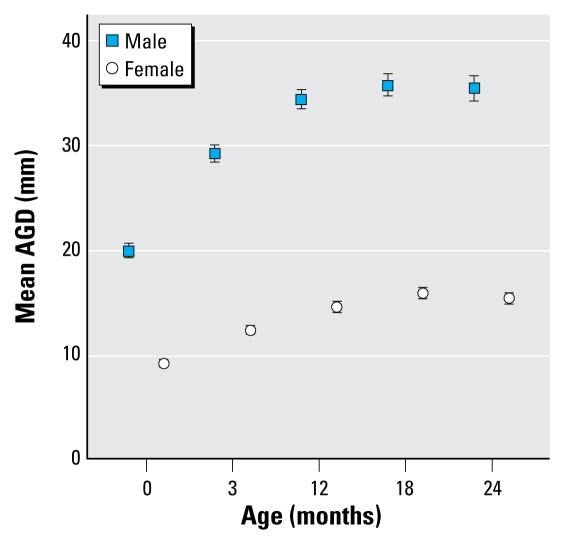
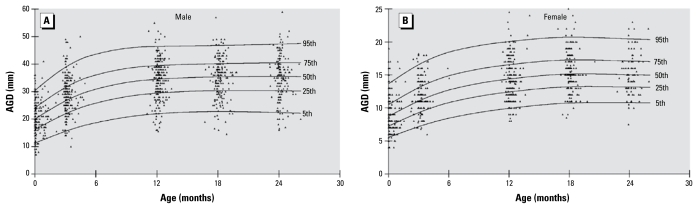
Results: Data included 2,168 longitudinal AGD measurements from 463 male and 426 female full-term infants (median = 2 measurements per infant). Mean AGD (+/- SD) at birth was 19.8 +/- 6.1 mm in males and 9.1 +/- 2.8 mm in females (p < 0.0001). AGD increased up to 12 months in both sexes and in a sex-dimorphic pattern. AGD was positively correlated with penile length at birth (r = 0.18, p = 0.003) and the increase in AGD from birth to 3 months was correlated with penile growth (r = 0.20, p = 0.001).
Conclusion: We report novel, longitudinal data for AGD during infancy in a large U.K. birth cohort. AGD was sex dimorphic at all ages studied. The availability of normative data provides a means of utilizing this biological marker of androgen action in population studies of the effects of environmental chemicals on genital development.
Keywords: anogenital distance; cryptorchidism; endocrine disruption; endocrine-disrupting chemicals; hypospadias.
Figures
References
-
- Boas M, Boisen KA, Virtanen HE, Kaleva M, Suomi AM, Schmidt IM, et al. Postnatal penile length and growth rate correlate to serum testosterone levels: a longitudinal study of 1962 normal boys. Eur J Endocrinol. 2006;154(1):125–129. - PubMed
-
- Bowman CJ, Barlow NJ, Turner KJ, Wallace DG, Foster PM. Effects of in utero exposure to finasteride on androgen-dependent reproductive development in the male rat. Toxicol Sci. 2003;74(2):393–406. - PubMed
-
- Callegari C, Everett S, Ross M, Brasel JA. Anogenital ratio: measure of fetal virilization in premature and full-term newborn infants. J Pediatr. 1987;111(2):240–243. - PubMed
Publication types
MeSH terms
Grants and funding
LinkOut - more resources
Full Text Sources
Medical