


Survival in 12,653 breast cancer patients with extensive axillary lymph node metastasis in the anthracycline era
- PMID: 20049562
- PMCID: PMC2930938
- DOI: 10.1007/s12032-009-9396-4
Survival in 12,653 breast cancer patients with extensive axillary lymph node metastasis in the anthracycline era
Abstract
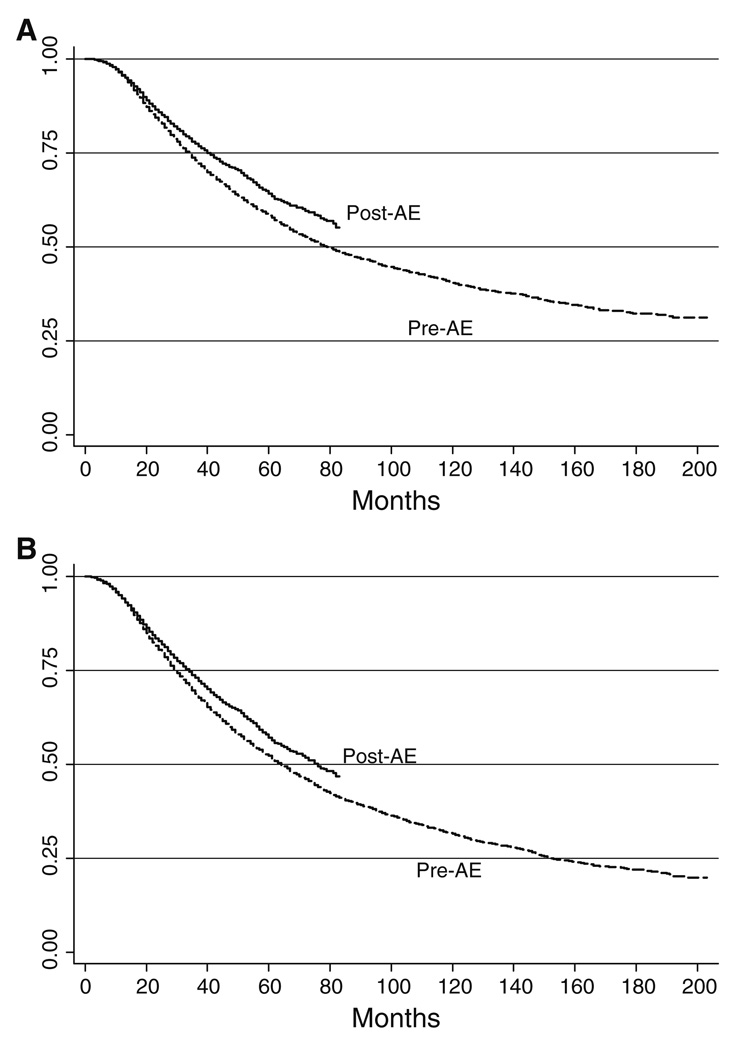
Institutional data are conflicting regarding the prognosis of breast cancer patients with extensive (≥10) axillary lymph node (ALN) metastases. We hypothesized that overall survival (OS) and disease specific survival (DSS) improved after the introduction of anthracycline-based therapy in 1997. We used the Surveillance, Epidemiology, and End results (SEER) database to identify breast cancer patients with ≥10 ALN metastases diagnosed between 1988 and 2004. Patients were categorized according to whether they were diagnosed prior to the FDA approval of anthracyclines (pre-anthracycline era, pre-AE) or after approval (post-anthracycline era, post-AE). Univariate analyses of OS and DSS were performed using the Kaplan-Meier method and differences assessed via the log rank test. Anthracycline era as an independent predictor of OS and DSS was evaluated using Cox proportional hazards models with patient age, hormone receptor status, tumor size, use of radiation therapy, and number of metastatic ALNs as covariates. Entry criteria were met by 12,653 patients. Of these, 5,655 (44.7%) and 6,998 (55.3%) were treated in the pre-AE and post-AE, respectively. On univariate analysis, post-AE patients experienced significantly improved rates of OS (P<0.001) and DSS (P<0.001) relative to pre-AE patients. On multivariate analysis, treatment in the post-AE favorably influenced both OS (Hazard Ratio [HR] 0.90, 95% Confidence Interval [CI] 0.84-0.96) and DSS (HR 0.84, CI 0.79-0.91). Both OS and DSS are poor in patients with extensive ALN metastases. Patients with advanced breast cancer treated in the post-AE demonstrated superior OS and DSS.
Figures
References
-
- Lavigne JC, Desaive CJ. Cancer of the breast. A study of prognostic factors as a guide in selecting cases for conservative treatment. Acta Chir Belg. 1975;74(1):63–81. - PubMed
-
- Fisher B, Bauer M, Wickerham DL, Redmond CK, Fisher ER, et al. Relation of number of positive axillary nodes to the prognosis of patients with primary breast cancer. An NSABP update. Cancer. 1983;52(9):1551–1557. - PubMed
-
- Nemoto T, Vana J, Bedwani RN, Baker HW, McGregor FH, Murphy GP. Management and survival of female breast cancer: results of a national survey by the American College of Surgeons. Cancer. 1980;45(12):2917–2924. - PubMed
-
- Moon TE, Jones SE, Bonadonna G, Valagussa P, Powles T, et al. Development and use of a natural history data base of breast cancer studies. Am J Clin Oncol. 1987;10(5):396–403. - PubMed
Publication types
MeSH terms
Substances
Grants and funding
LinkOut - more resources
Full Text Sources
Medical
Miscellaneous
