Molecular aging and rejuvenation of human muscle stem cells
- PMID: 20049743
- PMCID: PMC2875071
- DOI: 10.1002/emmm.200900045
Molecular aging and rejuvenation of human muscle stem cells
Abstract
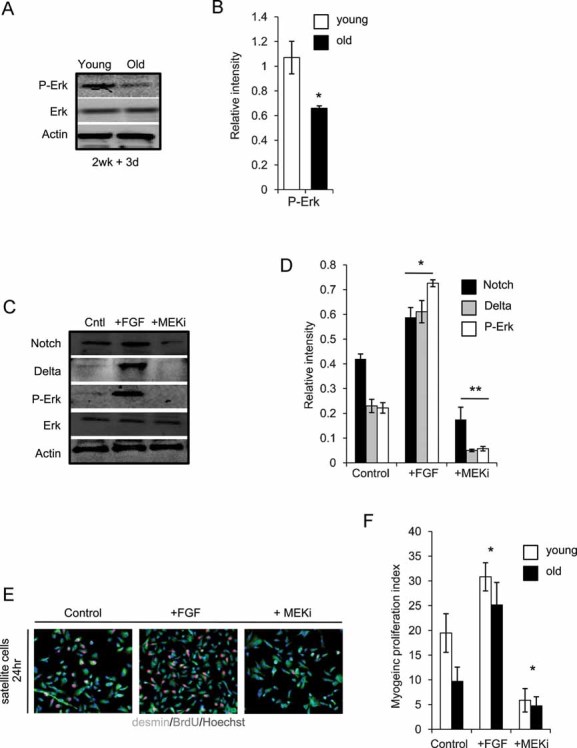
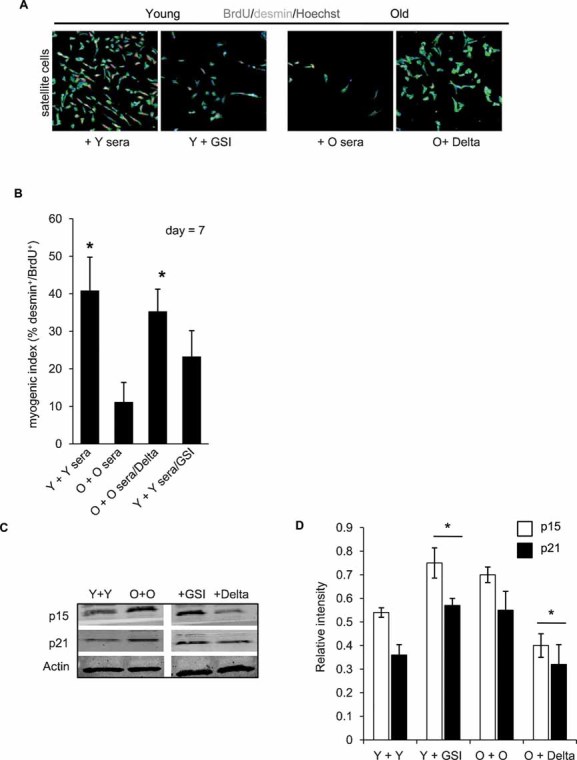
Very little remains known about the regulation of human organ stem cells (in general, and during the aging process), and most previous data were collected in short-lived rodents. We examined whether stem cell aging in rodents could be extrapolated to genetically and environmentally variable humans. Our findings establish key evolutionarily conserved mechanisms of human stem cell aging. We find that satellite cells are maintained in aged human skeletal muscle, but fail to activate in response to muscle attrition, due to diminished activation of Notch compounded by elevated transforming growth factor beta (TGF-beta)/phospho Smad3 (pSmad3). Furthermore, this work reveals that mitogen-activated protein kinase (MAPK)/phosphate extracellular signal-regulated kinase (pERK) signalling declines in human muscle with age, and is important for activating Notch in human muscle stem cells. This molecular understanding, combined with data that human satellite cells remain intrinsically young, introduced novel therapeutic targets. Indeed, activation of MAPK/Notch restored 'youthful' myogenic responses to satellite cells from 70-year-old humans, rendering them similar to cells from 20-year-old humans. These findings strongly suggest that aging of human muscle maintenance and repair can be reversed by 'youthful' calibration of specific molecular pathways.
Figures
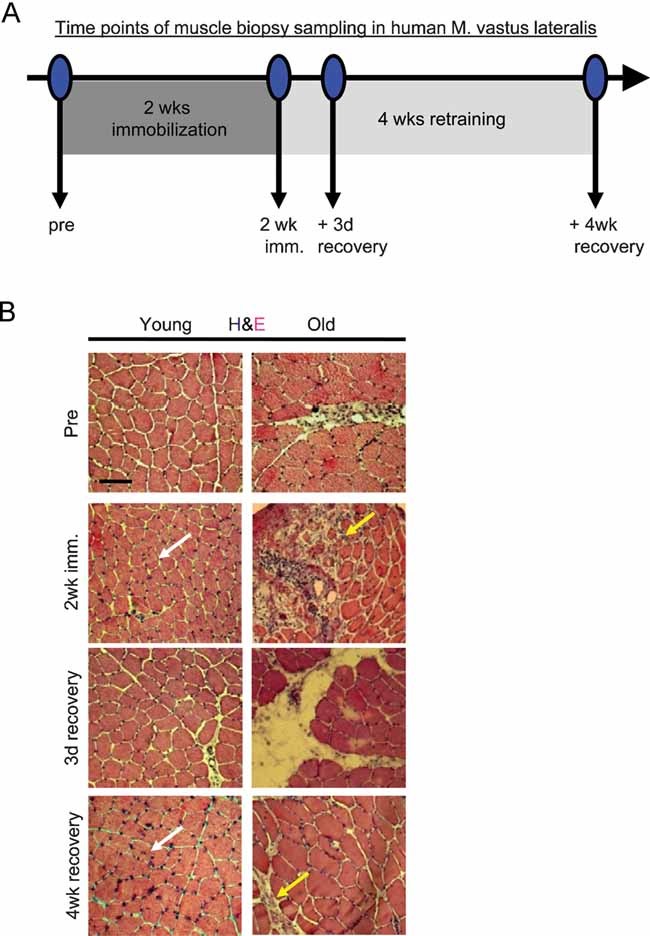
Scheme of experimental setup, as described in text.
Muscle histology from resting state (pre), immobility-atrophy (2 week imm.) and loading-recovery (3 day recovery, 4 week recovery) was analysed by haematoxylin and eosin (H & E) of 10-µm skeletal muscle cryosections. During immobilization phase of the study, areas of severe degeneration and scar tissue formation were evident in old muscles (yellow arrows) versus healthy maintenance of young immobilized muscles (white arrows). Scale bar = 100 µm. n = 10.
References
-
- Bergstrom J, Alvestrand A, Furst P, Hultman E, Sahlin K, Vinnars E, Widstrom A. Influence of severe potassium depletion and subsequent repletion with potassium on muscle electrolytes, metabolites and amino acids in man. Clin Sci Mol Med Suppl. 1976;51:589–599. - PubMed
-
- Brack AS, Conboy IM, Conboy MJ, Shen J, Rando TA. A temporal switch from notch to Wnt signaling in muscle stem cells is necessary for normal adult myogenesis. Cell Stem Cell. 2008;2:50–59. - PubMed
-
- Brooke MH, Kaiser KK. Muscle fiber types: how many and what kind? Arch Neurol. 1970;23:369–379. - PubMed
-
- Brown M, Hasser EM. Differential effects of reduced muscle use (hindlimb unweighting) on skeletal muscle with aging. Aging (Milano) 1996;8:99–105. - PubMed
Publication types
MeSH terms
Substances
Grants and funding
LinkOut - more resources
Full Text Sources