. 2010 May;18(5):553-9.
doi: 10.1038/ejhg.2009.229. Epub 2010 Jan 6.

Differential decay of parent-of-origin-specific genomic sharing in cystic fibrosis-affected sib pairs maps a paternally imprinted locus to 7q34

Affiliations

Differential decay of parent-of-origin-specific genomic sharing in cystic fibrosis-affected sib pairs maps a paternally imprinted locus to 7q34

Frauke Stanke et al. Eur J Hum Genet. 2010 May.

Abstract

Cystic fibrosis (CF) is a monogenic disease characterized by a high variability of disease severity and outcome that points to the role of environmental factors and modulating genes that shape the course of this multiorgan disease. We genotyped families of cystic fibrosis sib pairs homozygous for F508del-CFTR who represent extreme clinical phenotypes at informative microsatellite markers spanning a 38 Mb region between CFTR and 7qtel. Recombination events on both parental chromosomes were compared between siblings with concordant clinical phenotypes and siblings with discordant clinical phenotypes. Monitoring parent-of-origin-specific decay of genomic sharing delineated a 2.9-Mb segment on 7q34 in which excess of recombination on paternal chromosomes in discordant pairs was observed compared with phenotypically concordant sibs. This 2.9-Mb core candidate region was enriched in imprinting-related elements such as predicted CCCTC-binding factor consensus sites and CpG islands dense in repetitive elements. Moreover, allele frequencies at a microsatellite marker within the core candidate region differed significantly comparing mildly and severely affected cystic fibrosis sib pairs. The identification of this paternally imprinted locus on 7q34 as a modulator of cystic fibrosis disease severity shows that imprinted elements can be identified by straightforward fine mapping of break points in sib pairs with informative contrasting phenotypes.


Figures
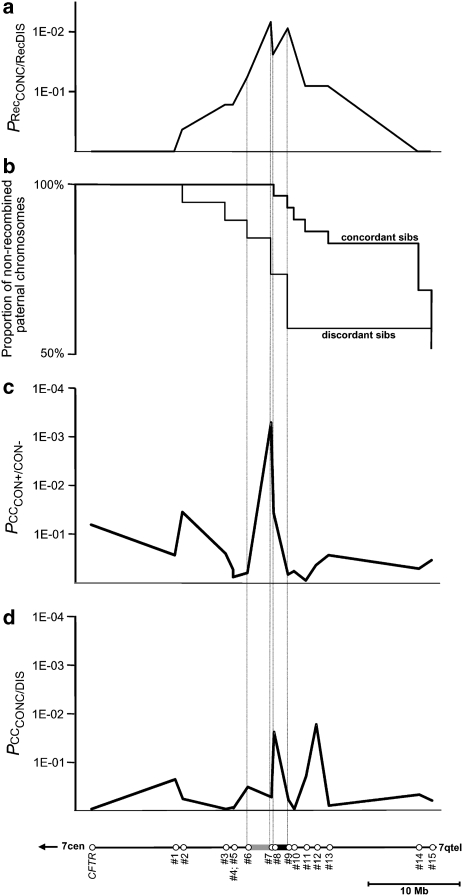
Figure 1
Figure 1
Analysis of parent-of-origin-specific decay of sharing and allelic association at CFTR to 7qtel among concordant and discordant sibs. Recombination at markers between CFTR and 7qtel (a and b), as well as allelic association to disease severity (c) and intra-pair discordance (d), is shown. The physical map is displayed below panel (d), whereby the 4.43-Mb candidate region, flanked by markers no. 6 and no. 9, and the 2.87-Mb core candidate region, flanked by markers no. 7 and no. 9, are visualized as gray and black thick lines on the physical map below. Markers no. 6 to no. 9 are indicated by vertical lines throughout this figure. (a) Comparison of distributions of recombined and nonrecombined paternal CF chromosomes between concordant and discordant CF patient pairs (uncorrected single locus P-values). Bonferroni's correction for multiple testing for observed independent genomic fragments yields Pcorr=0.047 for marker no. 7 and Pcorr=0.061 for marker no. 9. (b) Decay of sharing among concordant and discordant F508del-CFTR homozygous sib pairs visualized as proportion of nonrecombined paternal chromosomes among concordant and discordant sib pairs. The candidate region and the core candidate region are defined on the basis of this analysis (see text for details). (c) case–control (CC) comparison of allele distributions between concordant mildly affected sib pairs (CON+) and concordant severely affected sib pairs (CON−). The minimal pCCCON+/CON− is observed at marker no. 7 (D7Sat3), localized centrally in the candidate region (P=0.0005). (d) case–control (CC) comparison of allele distributions between concordant (CONC) and discordant (DIS) sib pairs.
Figure 2
Figure 2
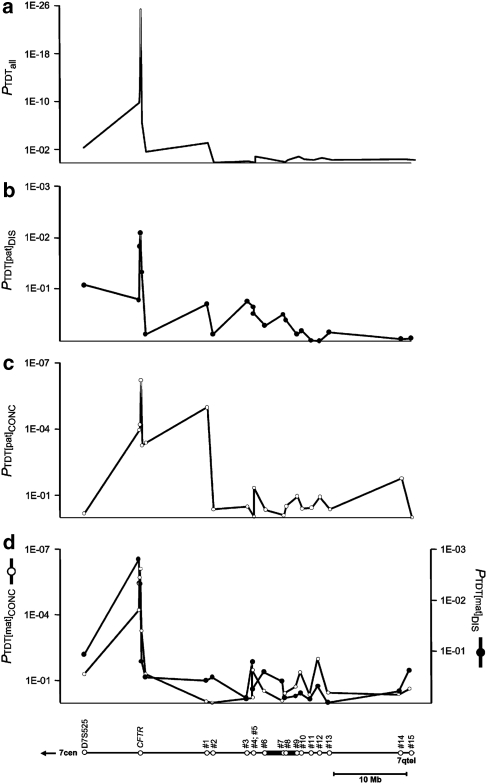
Decay of linkage disequilibrium at CFTR to 7qtel in concordant and discordant F508del-CFTR families. The transmission disequilibrium test (TDT) was carried out for all families and both parental chromosomes (a), restricted to paternal transmissions among discordant (b) and concordant (c) families and restricted to maternal transmissions among discordant (filled circles) and concordant (open circles) families (d) TDT was carried out using the software package FAMHAP with the setting ‘haptdt'. The map was extended to encompass the area 3′ to CFTR by incorporating D7S525 and four SNPs in the 5′ (XV2c, KM19) and 3′ (HUG16RS, J3.11) region of the CFTR gene. The finding of a highly significant TDT at the polymorphic microsatellite marker IVS17bTA within the CFTR gene of P=4.26 × 10⁻²⁶ is trivial, as this represents the imbalance between transmitted F508del-CFTR alleles and nontransmitted wt-CFTR alleles for the autosomal recessively inherited disease CF. However, the transmission disequilibrium on paternal, but not on maternal chromosomes of concordant pairs is still detectable at D7S514 (Marker1), located at a distance of 10 Mb 3′ to CFTR (see also Table 2).
Figure 3
Figure 3
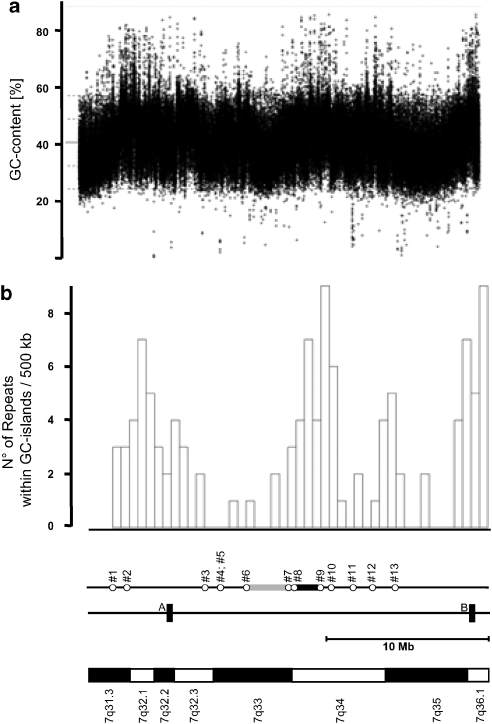
Density of GC-rich repetitive elements on 7q31.3–q36.1. The overall GC content (a) and the density of repeats within GC islands (b) are shown for a 24-Mb genomic segment on 7q. The 4.43-Mb candidate region is located centrally within this genomic segment (see physical map below (b)). (a) GC content was averaged for overlapping segments of 300 bp with a step size of 150 bp. (b) To display the density of repeats within GC islands, 24 Mb was divided into 48 segments of 500 000 bp each. GC islands were defined as a stretch of 300 bp with an average GC content exceeding 50%. Repetitive elements within GC islands were localized by comparing both data sets. Among the forty-eight 500 kb segments, 18 did not contain any repeats within GC islands. The remaining thirty 500 kb segments contained between 1 and 9 repeats within GC islands. A list of these GC-rich motifs located within the candidate region is displayed in Supplementary Table 3. The position of the 7q32 cluster of imprinted genes CPA4, PEG1/MEST and its natural antisense transcript MESTIT, COPG2 and its natural antisense transcript COPG2IT, and KLF14 is indicated below the physical map of markers no. 1 to no. 13 by the black box labeled A. The black box labeled B denotes the position of CNTNAP2 on 7q35, reported as an imprinted gene involved in autism., Chromosome bands along 7q are visualized in the cytogenetic map at the bottom of the figure.
Figure 4
Figure 4
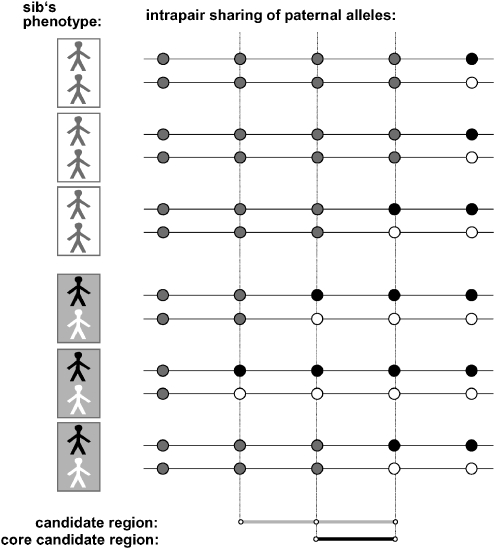
Mapping imprinted genes by parent-of-origin-specific decay of genomic sharing. The principle of the assay is illustrated by three concordant sib pairs (top panel, sibs are shown as gray pictograms) and three discordant sib pairs (bottom panel, sibs are shown as pairs of black and white pictograms). Only one parental chromosome – the paternal chromosome for mapping of a paternally imprinted gene – is shown next to the sibs. Alleles at five adjacent marker loci are visualized as circles, whereby gray color for both sibs of a pair denotes a shared chromosomal segment, and loci depicted in black for one and white for the other sib of a pair denote an unshared genomic segment. Intrapair sharing of the first locus in all sib pairs is obligatory to monitor decay of sharing. For this study on CF sibs at 7q, this locus is represented by the CFTR gene, and, as all siblings are F508del-CFTR homozygous, this locus is also shared between the pairs, although interpair sharing is not required if the method is applied to other diseases. In other words, application of this method to other regions and diseases than CF and 7q31-qtel requires that a subset of affected pairs be selected from the complete cohort for whom genomic intrapair sharing is ascertained through observed identity by descent of alleles at a marker locus, which is expected for a quarter of any sib pair sample according to Mendelian law. The candidate region, starting with the marker for which significant decay of sharing is observed among discordant pairs, and the core candidate region, starting with the marker for which maximum divergence of sharing between the two contrasting phenotypes is observed, enclose the imprinted gene(s) and/or regulatory elements that control imprinting.

References

    1. Reinhart B, Caillet JR. Genomic imprinting: cis-acting sequences and regional control. Int Rev Cytol. 2005;243:173–213. - PubMed
    1. Wood AJ, Oakey RJ. Genomic imprinting in mammals: emerging themes and established theories. PLoS Genet. 2006;2:e147. - PMC - PubMed
    1. Robertson KD. DNA methylation and human disease. Nat Rev Genet. 2005;6:597–610. - PubMed
    1. Knapp M, Strauch K. Affected-sib-pair test for linkage based on constraints for identical-by-descent distributions corresponding to disease models with imprinting. Genet Epidemiol. 2005;26:273–285. - PubMed
    1. Wu CC, Shete S, Amos CI. Linkage analysis of affected sib pairs allowing for parent-of-origin effects. Ann Hum Genet. 2005;69:113–126. - PubMed

Publication types

MeSH terms

Substances