Meta-Analysis
. 2010 Mar;19(3):370-5.
doi: 10.1007/s00586-009-1258-4. Epub 2010 Jan 6.

Functional outcome of computer-assisted spinal pedicle screw placement: a systematic review and meta-analysis of 23 studies including 5,992 pedicle screws

Affiliations
Meta-Analysis

Functional outcome of computer-assisted spinal pedicle screw placement: a systematic review and meta-analysis of 23 studies including 5,992 pedicle screws

Rajeev Verma et al. Eur Spine J. 2010 Mar.

Abstract

A number of studies have shown increased accuracy of pedicle screw placement in spine with the help of computer-assisted navigation. The literature is lacking in regard to functional benefit derived from this technique. The aim of this systematic review was to look at the functional outcomes following computer-assisted pedicle screw placement in spine. A 'Dialog Datastar' search was used using optimized search strategy covering the period from 1950 to July 2009; 23 papers were finally included which met our inclusion criteria. We report on a total of 1,288 patients with 5,992 pedicle screws. The comparison of neurological complications in two groups demonstrated an odds ratio of 0.25 (95% CI 0.06, 1.14) in favour of using navigation for pedicle screw insertion (p = 0.07). Comparative trials demonstrated a significant advantage in terms of accuracy of navigation over conventional pedicle screw insertion with a relative risk of 1.12 (95% CI 1.09, 1.15) (p < 0.00001). Navigation does not show statistically significant benefit in reducing neurological complications and there was insufficient data in the literature to infer a conclusion in terms of fusion rate, pain relief and health outcome scores.


Figures
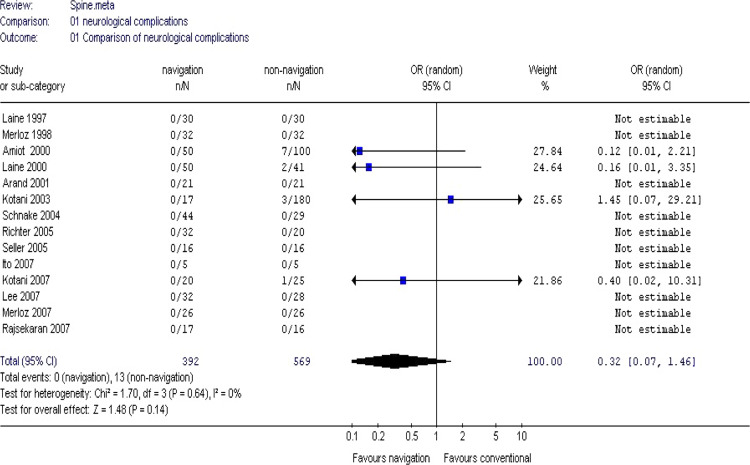
Fig. 1
Fig. 1
Forest plot showing neurological complications in comparative trials. Individual studies are plotted on y-axis with a summary estimate at the bottom. The point estimates (blue squares) are shown on a line that represents their associated 95% confidence interval. The odds ratio (OR) is shown towards the right of the diagram with the pooled estimate calculated with the random-effects model at the bottom. The pooled estimate suggests that risk of neurological complications decreases with navigation
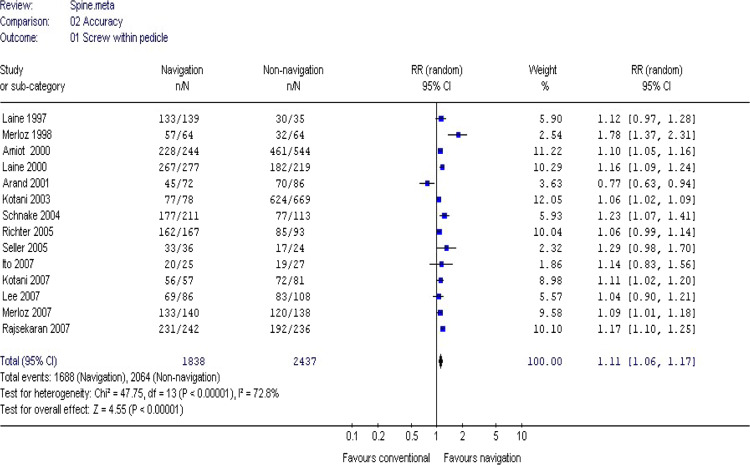
Fig. 2
Fig. 2
Forest plot showing accuracy of placement of pedicle screws in comparative trials. The relative risk (RR) is shown towards the right of the diagram with the pooled estimate calculated with the random-effects model at the bottom. The diagrammatic pooled estimate (diamond) and numerical relative risk both shows that navigation helps in more accurate placement of pedicle screws

References

    1. Gertzbein SD, Robbins SE. Accuracy of pedicular screw placement in vivo. Spine. 1990;15:11–14. doi: 10.1097/00007632-199001000-00004. - DOI - PubMed
    1. Castro WH, Halm H, Jerosch J, Malms J, Steinbeck J, Blasius S. Accuracy of pedicle screw placement in lumbar vertebrae. Spine. 1996;21:1320–1324. doi: 10.1097/00007632-199606010-00008. - DOI - PubMed
    1. Laine T, Makitalo K, Schlenzka D, Tallroth K, Poussa M, Alho A. Accuracy of pedicle screw insertion: a prospective CT study in 30 low back patients. Eur Spine J. 1997;6:402–405. doi: 10.1007/BF01834068. - DOI - PMC - PubMed
    1. Holly LT, Foley KT. Image guidance in spine surgery. Orthop Clin North Am. 2007;38:451–461. doi: 10.1016/j.ocl.2007.04.001. - DOI - PubMed
    1. Youkilis AS, Quint DJ, McGillicuddy JE, Papadopoulos SM. Stereotactic navigation for placement of pedicle screws in the thoracic spine. Neurosurgery. 2001;48:771–778. doi: 10.1097/00006123-200104000-00015. - DOI - PubMed

MeSH terms