Gender-role attitudes and behavior across the transition to parenthood
- PMID: 20053003
- PMCID: PMC3764615
- DOI: 10.1037/a0017820
Gender-role attitudes and behavior across the transition to parenthood
Abstract
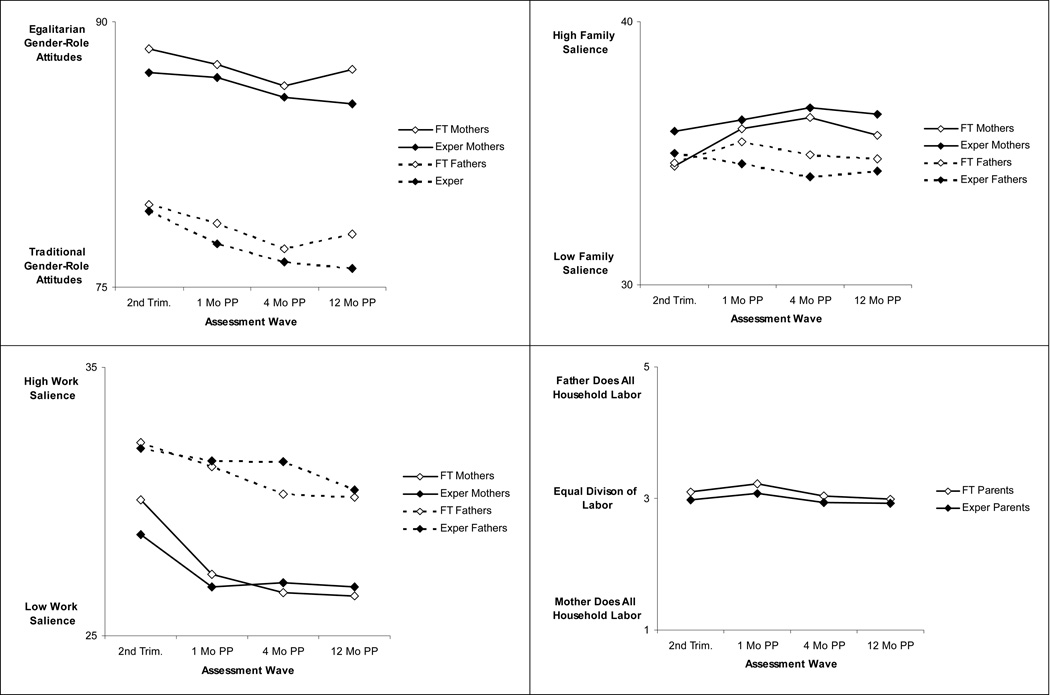
On the basis of social structural theory and identity theory, the current study examined changes in gender-role attitudes and behavior across the first-time transition to parenthood and following the birth of a second child for experienced mothers and fathers. Data were analyzed from the ongoing longitudinal Wisconsin Study of Families and Work. Gender-role attitudes, work and family identity salience, and division of household labor were measured for 205 first-time and 198 experienced mothers and fathers across 4 time points from 5 months pregnant to 12 months postpartum. Multilevel latent growth curve analysis was used to analyze the data. In general, parents became more traditional in their gender-role attitudes and behavior following the birth of a child, women changed more than men, and first-time parents changed more than experienced parents. Findings suggest that changes in gender-role attitudes and behavior following the birth of a child may be attributed to both the process of transitioning to parenthood for the first time and that of negotiating the demands of having a new baby in the family. (PsycINFO Database Record (c) 2009 APA, all rights reserved).
Figures
References
-
- Abrahams B, Feldman SS, Nash SC. Sex role self-concept and sex role attitudes: Enduring personality characteristics or adaptations to changing life situations? Developmental Psychology. 1978;14:393–400.
-
- Acock AC, Edwards JN. Egalitarian sex-role attitudes and female income. Journal of Marriage and the Family. 1982;44:581–589.
-
- Antonucci TC, Mikus K. The power of parenthood: Personality and attitudinal changes during the transition to parenthood. In: Michaels GY, Goldberg WA, editors. The transition to parenthood. Cambridge: Cambridge University Press; 1988. pp. 62–84.
-
- Arbuckle JL. Full information estimation in the presence of incomplete data. In: Marcoulides GA, Schumacker RE, editors. Advanced structural equation modeling: Issues and techniques. Mahwah, NJ: Erlbaum; 1996. pp. 243–277.
-
- Belsky J, Kelly J. The transition to parenthood. New York: Delacorte Press; 1994.