


The effects of CapZ peptide (TRTK-12) binding to S100B-Ca2+ as examined by NMR and X-ray crystallography
- PMID: 20053360
- PMCID: PMC2843395
- DOI: 10.1016/j.jmb.2009.12.057
The effects of CapZ peptide (TRTK-12) binding to S100B-Ca2+ as examined by NMR and X-ray crystallography
Abstract
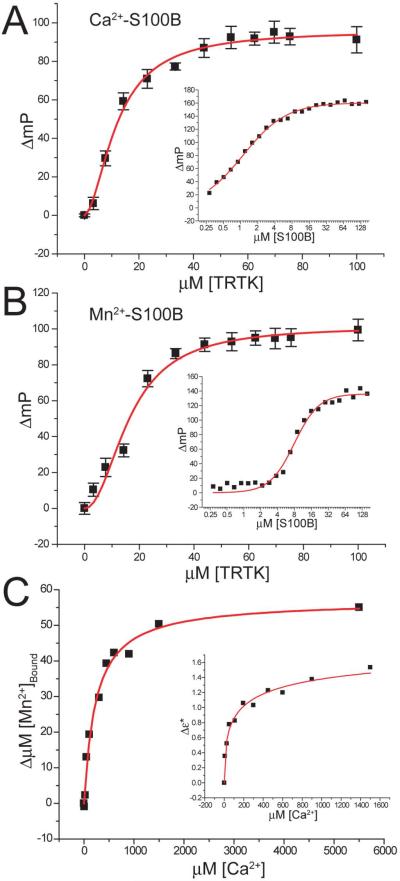
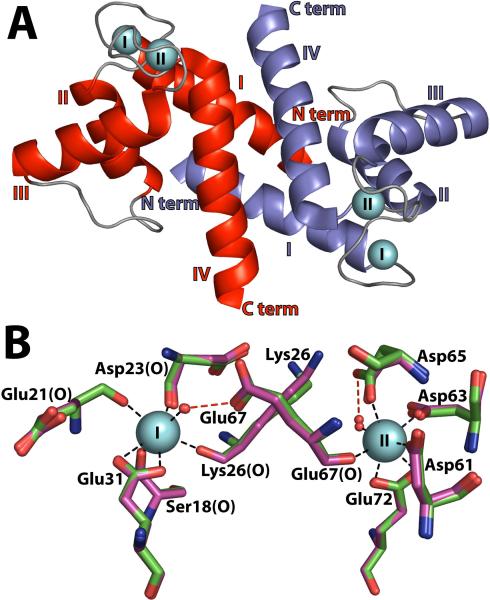
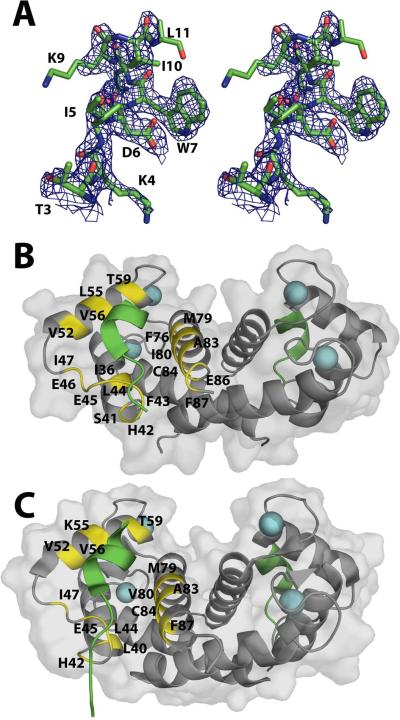
Structure-based drug design is underway to inhibit the S100B-p53 interaction as a strategy for treating malignant melanoma. X-ray crystallography was used here to characterize an interaction between Ca(2)(+)-S100B and TRTK-12, a target that binds to the p53-binding site on S100B. The structures of Ca(2+)-S100B (1.5-A resolution) and S100B-Ca(2)(+)-TRTK-12 (2.0-A resolution) determined here indicate that the S100B-Ca(2+)-TRTK-12 complex is dominated by an interaction between Trp7 of TRTK-12 and a hydrophobic binding pocket exposed on Ca(2+)-S100B involving residues in helices 2 and 3 and loop 2. As with an S100B-Ca(2)(+)-p53 peptide complex, TRTK-12 binding to Ca(2+)-S100B was found to increase the protein's Ca(2)(+)-binding affinity. One explanation for this effect was that peptide binding introduced a structural change that increased the number of Ca(2+) ligands and/or improved the Ca(2+) coordination geometry of S100B. This possibility was ruled out when the structures of S100B-Ca(2+)-TRTK-12 and S100B-Ca(2+) were compared and calcium ion coordination by the protein was found to be nearly identical in both EF-hand calcium-binding domains (RMSD=0.19). On the other hand, B-factors for residues in EF2 of Ca(2+)-S100B were found to be significantly lowered with TRTK-12 bound. This result is consistent with NMR (15)N relaxation studies that showed that TRTK-12 binding eliminated dynamic properties observed in Ca(2+)-S100B. Such a loss of protein motion may also provide an explanation for how calcium-ion-binding affinity is increased upon binding a target. Lastly, it follows that any small-molecule inhibitor bound to Ca(2+)-S100B would also have to cause an increase in calcium-ion-binding affinity to be effective therapeutically inside a cell, so these data need to be considered in future drug design studies involving S100B.
Copyright (c) 2010 Elsevier Ltd. All rights reserved.
Figures


References
-
- Moore B. A soluble protein characteristic of the nervous system. Biochem. Biophys. Res. Comm. 1965;19:739–744. - PubMed
-
- Donato R. Intracellular and extracellular roles of S100 proteins. Microsc Res Tech. 2003;60:540–51. - PubMed
-
- Heizmann CW. The multifunctional S100 protein family. Methods Mol Biol. 2002;172:69–80. - PubMed
-
- Wilder PT, Lin J, Bair CL, Charpentier TH, Yang D, Liriano M, Varney KM, Lee A, Oppenheim AB, Adhya S, Carrier F, Weber DJ. Recognition of the tumor suppressor protein p53 and other protein targets by the calcium-binding protein S100B. Biochim Biophys Acta. 2006 - PubMed
Publication types
MeSH terms
Substances
Associated data
- Actions
- Actions
Grants and funding
LinkOut - more resources
Full Text Sources
Other Literature Sources
Research Materials
Miscellaneous
