


Psychopaths know right from wrong but don't care
- PMID: 20053752
- PMCID: PMC2840845
- DOI: 10.1093/scan/nsp051
Psychopaths know right from wrong but don't care
Abstract
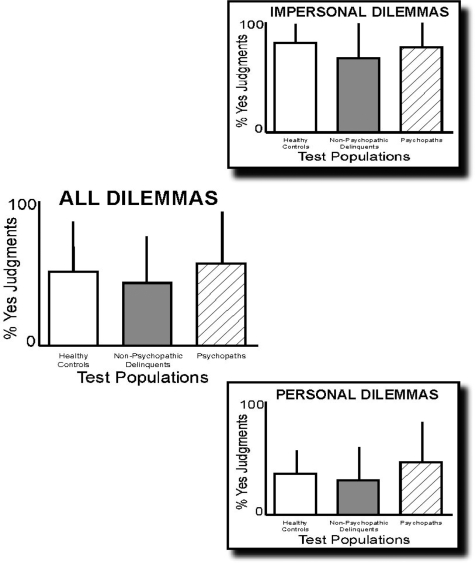
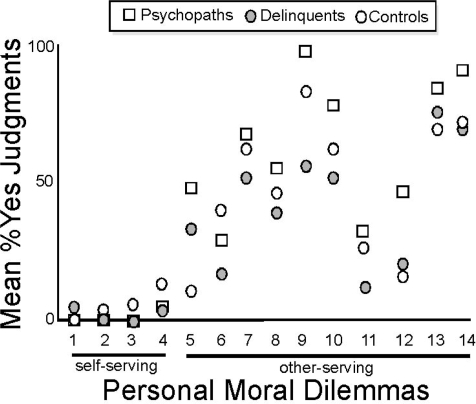
Adult psychopaths have deficits in emotional processing and inhibitory control, engage in morally inappropriate behavior, and generally fail to distinguish moral from conventional violations. These observations, together with a dominant tradition in the discipline which sees emotional processes as causally necessary for moral judgment, have led to the conclusion that psychopaths lack an understanding of moral rights and wrongs. We test an alternative explanation: psychopaths have normal understanding of right and wrong, but abnormal regulation of morally appropriate behavior. We presented psychopaths with moral dilemmas, contrasting their judgments with age- and sex-matched (i) healthy subjects and (ii) non-psychopathic, delinquents. Subjects in each group judged cases of personal harms (i.e. requiring physical contact) as less permissible than impersonal harms, even though both types of harms led to utilitarian gains. Importantly, however, psychopaths' pattern of judgments on different dilemmas was the same as those of the other subjects. These results force a rejection of the strong hypothesis that emotional processes are causally necessary for judgments of moral dilemmas, suggesting instead that psychopaths understand the distinction between right and wrong, but do not care about such knowledge, or the consequences that ensue from their morally inappropriate behavior.
Figures
References
-
- Anderson SW, Bechara A, Damasio H, Tranel D, Damasio AR. Impairment of social and moral behavior related to early damage in human prefrontal cortex. Nature Neuroscience. 1999;2:1032–1037. - PubMed
-
- Barrash J, Tranel D, Anderson SW. Acquired personality disturbances associated wtih bilateral damage to the ventromedial prefrontal region. Developmental Neuropsychology. 2000;18:355–381. - PubMed
-
- Blair RJR. A cognitive developmental approach to morality: investigating the psychopath. Cognition. 1995;57:1–29. - PubMed
-
- Blair RJR. Moral reasoning and the child with psychopathic tendencies. Personality and Individual Differences. 1997;22:731–739.
-
- Blair RJR. Fine cuts of empathy and the amygdala: dissociable deficits in psychopathy and autism. Quarterly Journal of Experimental Psychology. 2008;61:157–170. - PubMed
Publication types
MeSH terms
LinkOut - more resources
Full Text Sources
Molecular Biology Databases
