


Neuropsychological profiles in different at-risk states of psychosis: executive control impairment in the early--and additional memory dysfunction in the late--prodromal state
- PMID: 20053865
- PMCID: PMC3122293
- DOI: 10.1093/schbul/sbp155
Neuropsychological profiles in different at-risk states of psychosis: executive control impairment in the early--and additional memory dysfunction in the late--prodromal state
Abstract
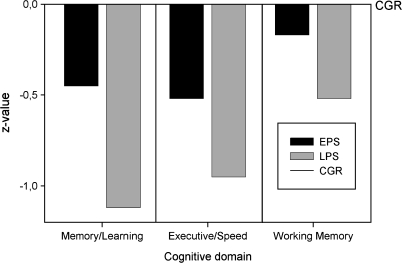
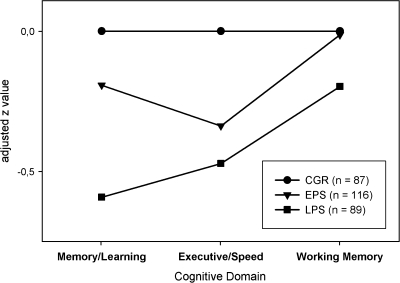
Impairments in neuropsychological functioning have been described in subjects clinically at high risk for psychosis, but the specific cognitive deficits in different clinical high-risk groups remain to be elucidated. The German Research Network on Schizophrenia employs a heuristic 2-stage model: a putatively late prodromal state (LPS), characterized by the onset of attenuated positive or brief psychotic symptoms, and an early prodromal state (EPS), mainly characterized by the presence of basic symptoms, which are predictive for psychosis within the next 10 years. A total of 205 subjects met the criteria for either an EPS or an LPS of psychosis and were assessed with a comprehensive neuropsychological test battery. Neurocognitive profiles of high-risk groups were compared with data of 87 healthy controls comparable with regard to gender, age, and premorbid verbal IQ. Patients in the LPS were impaired in all neurocognitive domains (memory/learning, executive control/processing speed, and working memory) examined, with memory being the worst. Deficits were less pronounced in patients in the EPS, with a specific deficit in the executive control/processing speed domain. Consistent with a progressive neurodevelopmental disorder, some cognitive abilities were already impaired in patients in the EPS, followed by further deterioration in the LPS. Specifically, deficits in executive control functioning were related to the presence of basic symptoms, indicating a vulnerability for psychosis. Memory deficits were associated with the onset of psychotic symptoms indicating further disease progression in the trajectory to psychosis and, thus, may be useful in predicting psychosis and targeting early intervention.
Figures
References
-
- Maier W, Cornblatt BA, Merikangas KR. Transition to schizophrenia and related disorders: toward a taxonomy of risk. Schizophr Bull. 2003;29:693–701. - PubMed
-
- Häfner H, an der Heiden W. Course and outcome of schizophrenia. In: Hirsch SR, Weinberger DR, editors. Schizophrenia. Oxford, UK: Blackwell Publishing; 2003. pp. 101–141.
-
- Häfner H, an der Heiden W. Epidemiology of schizophrenia. Can J Psychiatry. 1997;42:139–151. - PubMed
-
- Yung AR, McGorry PD. The prodromal phase of first-episode psychosis: past and current conceptualizations. Schizophr Bull. 1996;22:353–370. - PubMed
-
- Cornblatt BA, Lencz T, Smith CW, Correll CU, Auther AM, Nakayama E. The schizophrenia prodrome revisited: a neurodevelopmental perspective. Schizophr Bull. 2003;29:633–651. - PubMed
Publication types
MeSH terms
LinkOut - more resources
Full Text Sources
Medical
Miscellaneous
