


A systematic review of the effectiveness of group versus individual treatments for adult obesity
- PMID: 20054200
- PMCID: PMC6444750
- DOI: 10.1159/000186144
A systematic review of the effectiveness of group versus individual treatments for adult obesity
Abstract
Background: Both group and individual modes of delivery are employed for obesity treatments. Commercial weight loss groups commonly employ group-based delivery, while many clinical based settings employ one-to-one delivery. We systematically reviewed randomised controlled trials of treatments for adult obesity to compare the effectiveness of group-based to individual-based modes of treatment delivery.
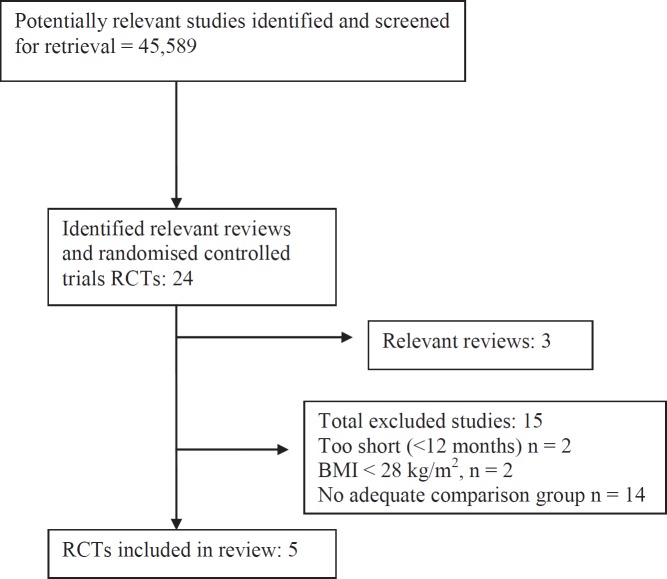
Methods: We searched 7 electronic databases and 2 journals and reviewed secondary references, based on a priori criteria to systematically review: randomised controlled trials of obesity treatments, participants with BMI >or=28 kg/m(2), age >or=18 years, comparison groups including at least 1 group-based and 1 individual-based treatment group, and follow-up >or=1 year. We extracted data and conducted meta-analysis of weight change.
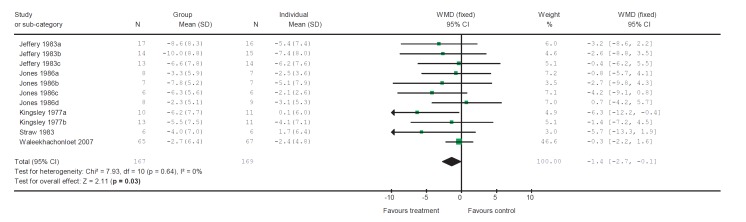
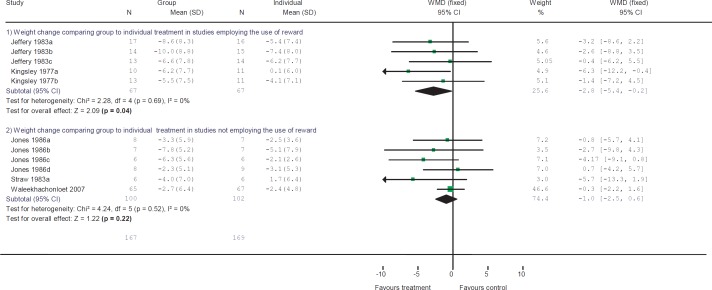
Results: Eleven comparison groups from 5 qualifying trials were obtained, representing a total participant pool of 336. Significantly greater (p = 0.03) weight change at 12 months was found in group-based over individualbased treatment, and sub-analyses showed that increased effectiveness was associated with the use of financial reward and psychologist-led interventions.
Conclusion: Group-based interventions were more effective than individual-based interventions among a predominantly female participant pool receiving psychologist-led interventions. Future studies to explore differences by professional group and interventions among men, which are accompanied by economic evaluation, are recommended.
Copyright 2009 S. Karger AG, Basel.
Figures
References
-
- Renjilian DA, Perri MG, Nezu AM, McKelvey WF, Shermer RL, Anton SD. Individual versus group therapy for obesity: effects of matching participants to their treatment preferences. J Consult Clin Psychol. 2001;69:717–721. - PubMed
-
- Avenell A, Broom J, Brown TJ, Poobalan A, Aucott L, Stearns SC, Smith WC, Jung RT, Campbell MK, Grant AM. Systematic review of the long-term effects and economic consequences of treatments for obesity and implications for health improvement. Health Technol Assess. 2004;8:21. - PubMed
-
- Deakin T, McShane CE, Cade JE, Williams RDRR. Group based training for self-management strategies in people with type 2 diabetes mellitus. Cochrane Database Syst Rev. 2005;2:CD003417. www.cochrane.org/reviews/en/ab003417.html. - PubMed
Publication types
MeSH terms
Grants and funding
LinkOut - more resources
Full Text Sources
Medical
