


Methods for Assessing Improvement in Specificity when a Biomarker is Combined with a Standard Screening Test
- PMID: 20054437
- PMCID: PMC2802069
- DOI: 10.1198/sbr.2009.0002
Methods for Assessing Improvement in Specificity when a Biomarker is Combined with a Standard Screening Test
Abstract
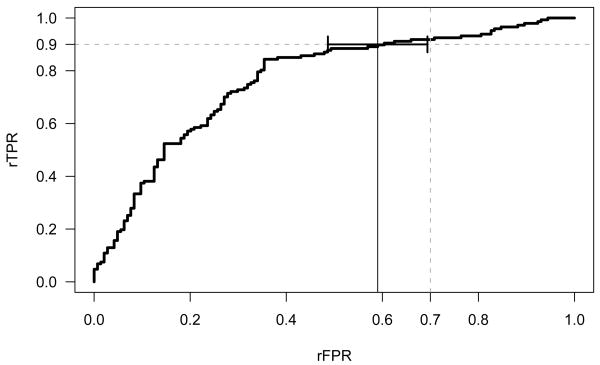
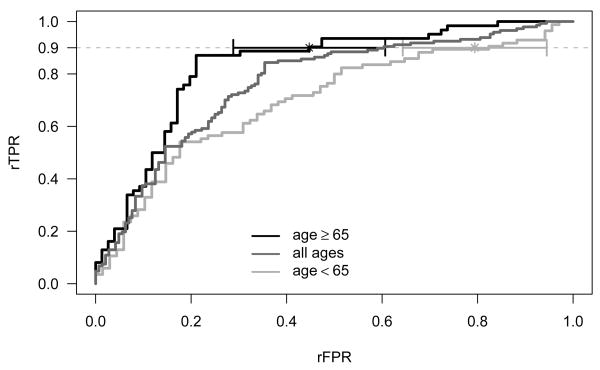
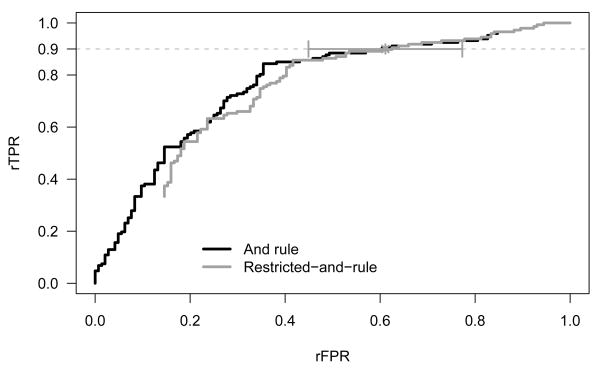
Biomarkers that can be used in combination with established screening tests to reduce false positive rates are in considerable demand. In this article, we present methods for evaluating the diagnostic performance of combination tests that require positivity on a biomarker test in addition to a standard screening test. These methods rely on relative true and false positive rates to measure the loss in sensitivity and gain in specificity associated with the combination relative to the standard test. Inference about the relative rates follows from noting their interpretation as conditional probabilities. These methods are extended to evaluate combinations with continuous biomarker tests by introducing a new statistical entity, the relative receiver operating characteristic (rROC) curve. The rROC curve plots the relative true positive rate versus the relative false positive rate as the biomarker threshold for positivity varies. Inference can be made by applying existing ROC methodology. We illustrate the methods with two examples: a breast cancer biomarker study proposed by the Early Detection Research Network (EDRN) and a prostate cancer case-control study examining the ability of free prostate-specific antigen (PSA) to improve the specificity of the standard PSA test.
Figures
References
-
- Brawer MK. Prostate-specific antigen: Current status. Ca: A Cancer Journal for Clinicians. 1999;49:264–281. - PubMed
-
- Catalona WJ, Partin AW, Slawin KM, et al. Use of the percentage of free prostate-specific antigen to enhance differentiation of prostate cancer from benign prostatic disease. Journal of the American Medical Association. 1998;279:1542–1547. - PubMed
-
- Catalona WJ, Smith DS, Wolfert RL, Tang JW, Rittenhouse HG, Ratliff TL, Nadler RB. Evaluation of percentage of free serum prostate-specific antigen to improve specificity of prostate cancer screening. Journal of the American Medical Association. 1995;274:1214–1220. - PubMed
-
- Cheng H, Macaluso M. Comparison of the accuracy of two tests with a confirmatory procedure limited to positive results. Epidemiology. 1997;8:104–106. - PubMed
-
- Dorfman DD, Alf E. Maximum likelihood estimation of parameters of signal detection theory and determination of confidence intervals –rating method data. Journal of Mathematical Psychology. 1969;6:487–496.
Grants and funding
LinkOut - more resources
Full Text Sources
Research Materials
Miscellaneous