. 2010 Apr;51(4):1401-9.
doi: 10.1002/hep.23488.

Progenitor-derived hepatocellular carcinoma model in the rat

Affiliations

Progenitor-derived hepatocellular carcinoma model in the rat

Jesper B Andersen et al. Hepatology. 2010 Apr.

Abstract

Human hepatocellular carcinoma (HCC) is a heterogeneous disease of distinct clinical subgroups. A principal source of tumor heterogeneity may be cell type of origin, which in liver includes hepatocyte or adult stem/progenitor cells. To address this issue, we investigated the molecular mechanisms underlying the fate of the enzyme-altered preneoplastic lesions in the resistant hepatocyte (RH) model. Sixty samples classified as focal lesions, adenoma, and early and advanced HCCs were microdissected after morphological and immunohistochemical evaluation and subjected to global gene expression profiling. The analysis of progression of the persistent glutathione S-transferase (GSTP)(+) focal lesions to fully developed HCC showed that approximately 50% of persistent nodules and all HCCs expressed cytokeratin 19 (CK19), whereas 14% of remodeling nodules were CK19(+). Unsupervised hierarchical clustering of the expression profiles also grouped the samples according to CK19 expression. Furthermore, supervised analysis using the differentially expressed genes in each cluster combined with gene connectivity tools identified 1308 unique genes and a predominance of the AP-1/JUN network in the CK19(+) lesions. In contrast, the CK19-negative cluster exhibited only limited molecular changes (156 differentially expressed genes versus normal liver) consistent with remodeling toward differentiated phenotype. Finally, comparative functional genomics showed a stringent clustering of CK19(+) early lesions and advanced HCCs with human HCCs characterized by poor prognosis. Furthermore, the CK19-associated gene expression signature accurately predicted patient survival (P < 0.009) and tumor recurrence (P < 0.006).

Conclusion: Our data establish CK19 as a prognostic marker of early neoplastic lesions and strongly suggest the progenitor derivation of HCC in the rat RH model. The capacity of CK19-associated gene signatures to stratify HCC patients according to clinical prognosis indicates the usefulness of the RH model for studies of stem/progenitor-derived HCC.


Figures
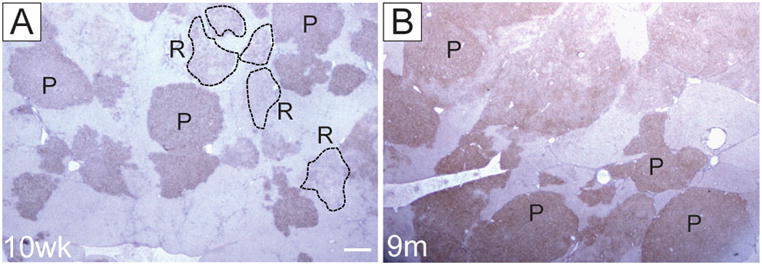
Figure 1
Figure 1
The pattern of GSTP immunostaining in livers of F344 rats submitted to RH protocol. (A) 10 weeks after DENA initiation; (B) 9 months after DENA initiation. P, persistent; R, remodelling GSTP+ foci. Sections were counterstained with hematoxylin. Original magnification, ×10.
Figure 2
Figure 2
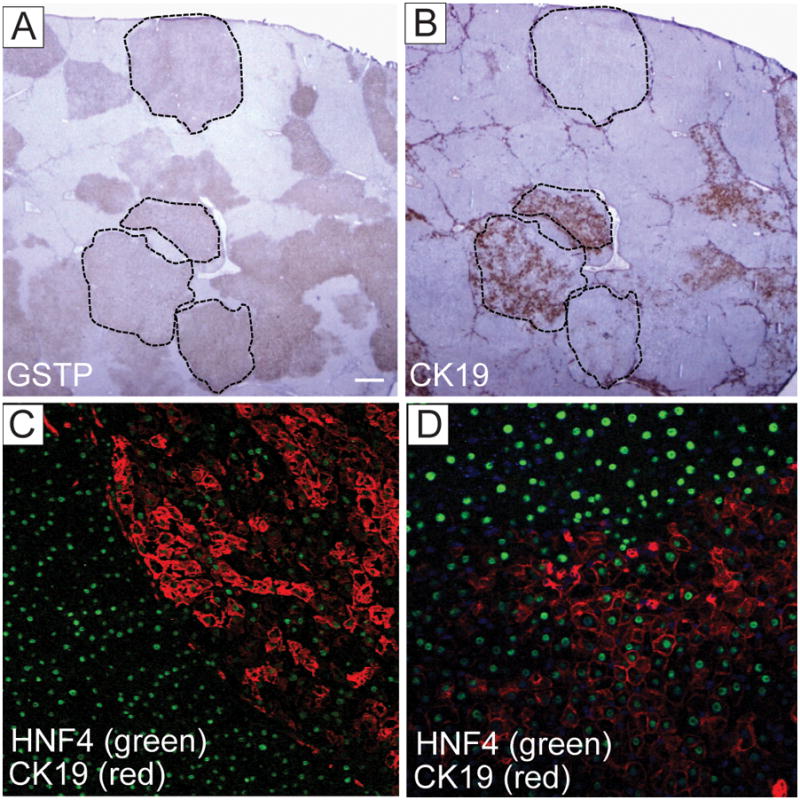
Expression of CK19 and HNF4 in persistent focal lesions. (A) GSTP and (B) CK19 immunostaining performed on parallel liver sections at 10 weeks after DENA initiation. Dashed areas demarcate the same focal lesions shown in A and B. Original magnification ×10. (C, D) Dual-color immunofluorescence staining with HNF4 (green) and CK19 (red) in liver section at 10 weeks after DENA initiation. Original magnification ×100 (C); ×200 (D).
Figure 3
Figure 3
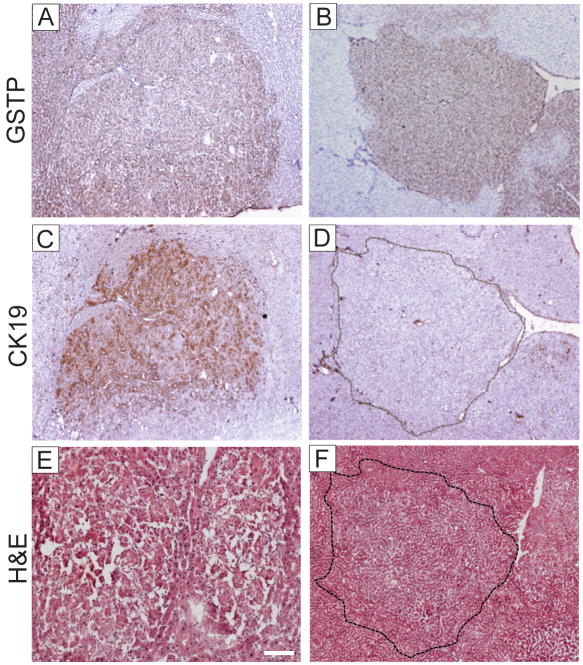
Expression of GSTP and CK19 in adenomas. (A, B) GSTP staining; (C,D) CK19 staining and (E,F) H&E staining on serial sections from two micro-dissected adenomas. Note the presence of CK19+ and CK19 persistent GSTP+ adenomas in livers at 9 months after DENA initiation. Original magnification, ×40.
Figure 4
Figure 4
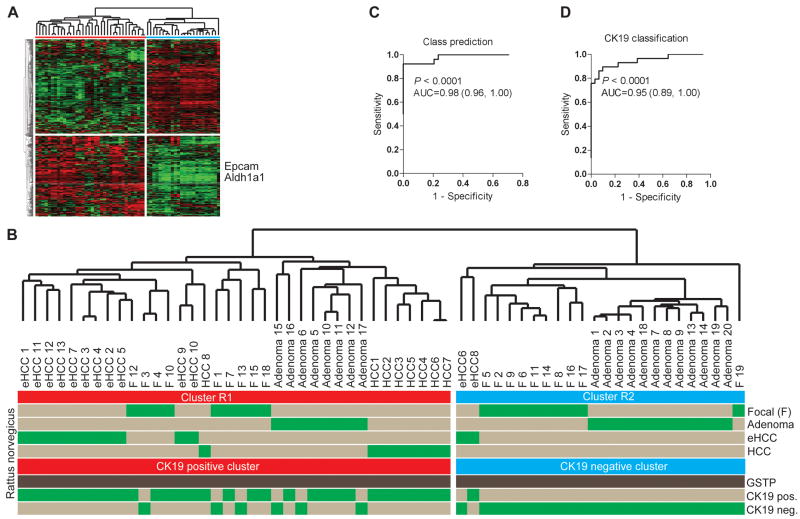
Development of the CK19-associated gene signature. (A) Unsupervised hierarchical cluster analysis of 60 micro-dissected hepatic lesions including 19 focal lesions at 10 weeks, 20 adenomas at 9 months, 13 early HCCs at 9 months and 8 advanced HCCs at 14 months following DENA administration. A list of 469 differentially expressed genes was computed at P≤0.001 using normal rat liver as a reference. The position of two well characterized progenitor/cancer stem cell markers, Epcam and Aldh1a1, are shown. (B) Unsupervised clustering of the rat lesions. The dendrogram demonstrates a significant separation of the rat lesions according to the CK19 expression profile. The CK19+ lesions belong to cluster R1 (red). (C, D) Class prediction. The probability of correct classification was estimated using a Bayesian compound covariate prediction model for (C) the gene signature (R1 and R2 classification), and (D) the CK19 expression profile during leave-one-out cross-validation (LOOCV). To ensure the accuracy in the prediction method, random permutations were repeated 1,000 times. The degree of the correct classification is represented by the area under the ROC curve (AUC).
Figure 5
Figure 5
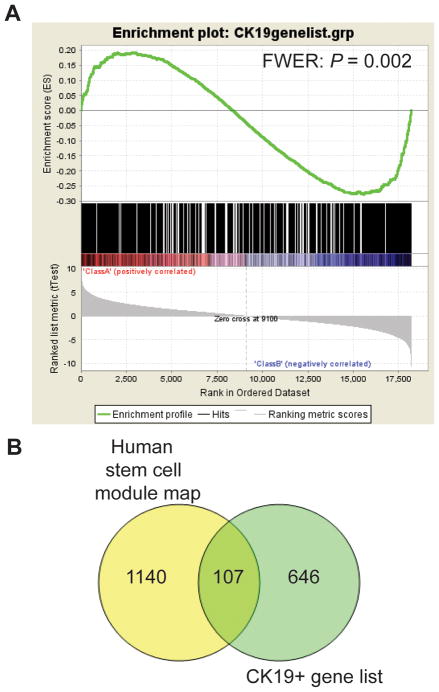
Gene set enrichment analysis of the CK19+ gene signature. (A) The analysis demonstrated a significant positive correlation between the CK19+ gene signature and the gene expression signature of subclass A and hepatoblast-like (HB) human HCCs (Red, Class A). The HB subclass was previously shown to have a fetal hepatoblast-like and progenitor-type expression signature. This subtype has the worst clinical prognosis. Several stem cell and liver specific gene sets in the Molecular Signatures Database were found among the top 10 gene sets which positively correlated with the CK19+ gene signature (Supplementary Table 2). (B) Association of the CK19+ gene signature and the stem cell module map. In this comparison, we used the genes given in the human embryonic stem cell-like module. More than 15% of the genes in the CK19+ gene expression signature overlapped with the module map.
Figure 6
Figure 6
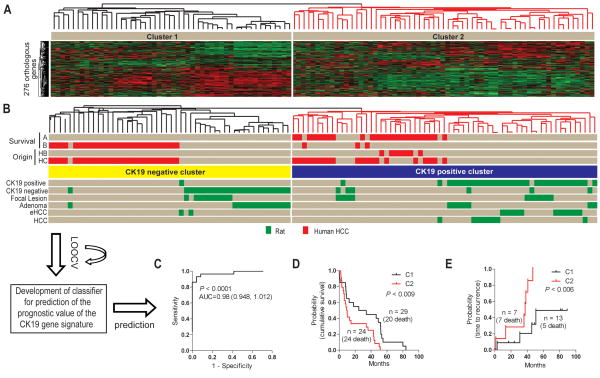
The prognostic power of the CK19 gene signature. (A) The HCC data set was generated from a cohort of 53 HCCs obtained from Caucasian and Chinese patients and hybridized to illumina bead chips. A list of 276 orthologous genes between the two species presented on both platforms was identified. (B) Comparative functional genomics. The CK19 gene signature separates the human HCC according to the previous A and B sub-classification. Individual human and rat samples are shown in red and green, respectively. (C) Development of a gene classifier for prediction of the prognostic value of the CK19 gene signature. A Bayesian compound covariate prediction analysis showed a probability of 0.98 for correct classification. The probability is represented by the area under the ROC curve (AUC). To build a classifier, a class random variance model was used to identify genes univariately significant at α≤0.001. Seven different algorithms were used in the prediction of the correct classification during LOOCV with a prediction rate 89 to 98%. The performance of the classifier estimating the correct classification in each of the prediction models is given in supplementary table 4. (D, E) Cumulative survival. Integration and cluster analysis identified clinically relevant distinct subgroups of human HCC based on the CK19 gene expression signature. Kaplan-Meier plots and Mantel-Cox statistical analysis were applied in the survival analysis.
Figure 7
Figure 7
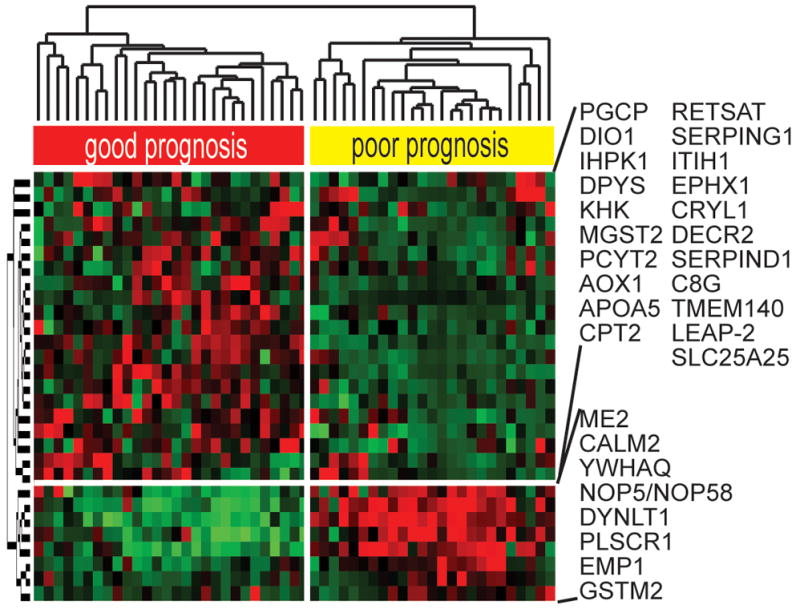
Prognostic survival genes. Hierarchical cluster analysis of the HCC data set. Genes which were significantly (P≤0.01) associated with the disease outcome were identified by applying a Cox proportional hazards model and Wald statistics. 29 genes independently demonstrated a prognostic ability. To estimate the accuracy, univariate permutation tests were repeated 10,000 times.

Comment in

References

    1. El-Serag HB, Mason AC. Rising incidence of hepatocellular carcinoma in the United States. N Engl J Med. 1999;340:745–750. - PubMed
    1. Parkin DM, Bray F, Ferlay J, Pisani P. Global cancer statistics, 2002. CA Cancer J Clin. 2005;55:74–108. - PubMed
    1. Sherman M. Hepatocellular carcinoma: epidemiology, risk factors, and screening. Semin Liver Dis. 2005;25:143–154. - PubMed
    1. El-Serag HB. Hepatocellular carcinoma: recent trends in the United States. Gastroenterology. 2004;127:S27–34. - PubMed
    1. Llovet JM, Bruix J. Molecular targeted therapies in hepatocellular carcinoma. Hepatology. 2008;48:1312–1327. - PMC - PubMed

Publication types

Substances