Changing management of suspected appendicitis in the laparoscopic era
- PMID: 20056066
- PMCID: PMC3024621
- DOI: 10.1308/003588410X12518836439920
Changing management of suspected appendicitis in the laparoscopic era
Abstract
Introduction: The aims of this study were to examine the trends in performance of open and laparoscopic appendicectomy at a district general hospital, and to compare the diagnostic outcomes in the two patient groups.
Patients and methods: Data were collected prospectively from patients undergoing an open or laparoscopic procedure for suspected appendicitis in an 8-year period between January 2000 and December 2007.
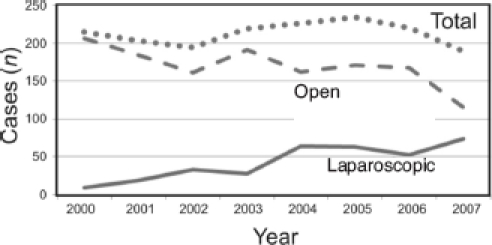
Results: A total of 1700 patients (873 women, 827 men) with a median age of 24 years underwent surgery for suspected appendicitis in the study period. There were 1357 patients (group A) who underwent an open procedure for presumed appendicitis (610 women and 747 men [F:M ratio, 1:1.2]). There were 343 patients (group B) who underwent laparoscopy with or without laparoscopic appendicectomy (82 men and 261 women [F:M ratio, 1:0.31]). Over the study period, there was an increasing trend towards the performance of laparoscopic procedures for suspected appendicitis, increasing from 4% to 39% of the total per year. In group A, 1172 (86%) patients had appendicular pathology, while the appendix was normal histologically in 178 (13%). Other pathologies were diagnosed intra-operatively in 1%. In group B, 193 patients (56%) had appendicular pathology while in 150 (44%) the appendix was normal. In the subgroup with a normal appendix, 56 patients (37%) had another cause for their symptoms identified.
Conclusions: Laparoscopic appendicectomy is increasingly being performed. Laparoscopy is often used as a diagnostic tool in general surgical patients, particularly women, with lower abdominal pain. In effect, these patients are undergoing diagnostic laparoscopy, with or without appendicectomy. This has resulted in a lower positive appendicectomy rate, but a higher yield of diagnoses other than appendicitis, in the laparoscopic group. Overall appendicectomy rates, however, have remained unchanged.
Figures

Comment in
-
Comment on: Acute appendicitis--is there still a place for active observation?Ann R Coll Surg Engl. 2010 May;92(4):358-9. doi: 10.1308/003588410X12664192076737. Ann R Coll Surg Engl. 2010. PMID: 20501025 Free PMC article. No abstract available.
References
-
- Nicolson A, Patel P, Jambulingam P. Laparoscopic era yields higher negative appendicectomy rate. Br J Surg. 2008;95(Suppl 3):143.
-
- McBurney C. Experience with early operative interference in cases of disease of the vermiform appendix. NY Med J. 1889;1:676–84.
-
- Semm K. Endoscopic appendectomy. Endoscopy. 1983;15:59–64. - PubMed
-
- Sweeney KJ, Keane FBV. Moving from open to laparoscopic appendicectomy. Br J Surg. 2003;90:257–8. - PubMed
-
- Ansell J, Rees BI. The negative appendectomy in Wales. Ann R Coll Surg Engl. 2004;86:477–8.
Publication types
MeSH terms
LinkOut - more resources
Full Text Sources
Medical