


Blood mercury concentrations in CHARGE Study children with and without autism
- PMID: 20056569
- PMCID: PMC2831962
- DOI: 10.1289/ehp.0900736
Blood mercury concentrations in CHARGE Study children with and without autism
Abstract
Background: Some authors have reported higher blood mercury (Hg) levels in persons with autism, relative to unaffected controls.
Objectives: We compared blood total Hg concentrations in children with autism or autism spectrum disorder (AU/ASD) and typically developing (TD) controls in population-based samples, and determined the role of fish consumption in differences observed.
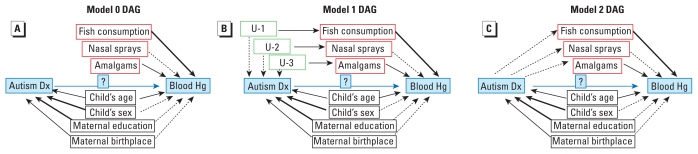
Methods: The Childhood Autism Risk from Genetics and the Environment (CHARGE) Study enrolled children 2-5 years of age. After diagnostic evaluation, we analyzed three groups: AU/ASD, non-AU/ASD with developmental delay (DD), and population-based TD controls. Mothers were interviewed about household, medical, and dietary exposures. Blood Hg was measured by inductively coupled plasma mass spectrometry. Multiple linear regression analysis was conducted (n = 452) to predict blood Hg from diagnostic status controlling for Hg sources.
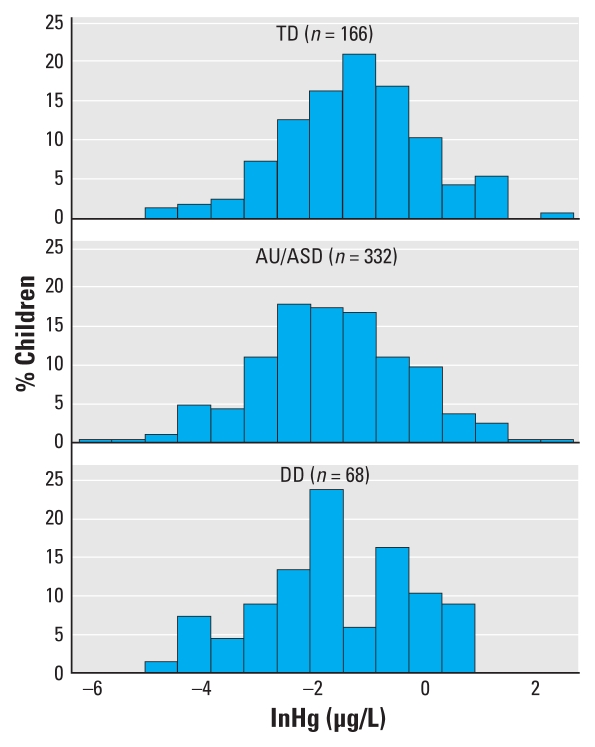
Results: Fish consumption strongly predicted total Hg concentration. AU/ASD children ate less fish. After adjustment for fish and other Hg sources, blood Hg levels in AU/ASD children were similar to those of TD children (p = 0.75); this was also true among non-fish eaters (p = 0.73). The direct effect of AU/ASD diagnosis on blood Hg not through the indirect pathway of altered fish consumption was a 12% reduction. DD children had lower blood Hg concentrations in all analyses. Dental amalgams in children with gum-chewing or teeth-grinding habits predicted higher levels.
Conclusions: After accounting for dietary and other differences in Hg exposures, total Hg in blood was neither elevated nor reduced in CHARGE Study preschoolers with AU/ASD compared with unaffected controls, and resembled those of nationally representative samples.
Figures
References
-
- American Psychiatric Association. Diagnostic and Statistical Manual of Mental Disorders. 4th ed. Arlington, VA: American Psychiatric Publishing; 2000.
-
- Beyrouty P, Chan HM. Co-consumption of selenium and vitamin E altered the reproductive and developmental toxicity of methylmercury in rats. Neurotoxicol Teratol. 2006;28(1):49–58. - PubMed
-
- Centers for Disease Control and Prevention. Blood mercury levels in young children and childbearing-aged women—United States, 1999–2002. MMWR Morb Mortal Wkly Rep. 2004;53(43):1018–1020. - PubMed
Publication types
MeSH terms
Substances
Grants and funding
LinkOut - more resources
Full Text Sources
Medical
Research Materials