


Progressive resistance training improves overall physical activity levels in patients with early osteoarthritis of the knee: a randomized controlled trial
- PMID: 20056719
- PMCID: PMC2836140
- DOI: 10.2522/ptj.20090041
Progressive resistance training improves overall physical activity levels in patients with early osteoarthritis of the knee: a randomized controlled trial
Abstract
Background: Prescription of resistance training (RT) exercises is an essential aspect of management for knee osteoarthritis (OA). However, whether patients with knee OA who are randomly assigned to receive RT simply substitute RT for other modes of physical activity remains unclear.
Objective: The aim of this study was to determine the effect of a structured RT intervention on overall levels of moderate- and vigorous-intensity physical activity (MVPA) in patients with early-onset knee OA. The study compared patients with early-onset OA who participated in an RT program, those who participated in a self-management (SM) program, and those who participated in both RT and SM. Because participants randomly assigned to receive the RT intervention may simply switch activity modes, resulting in little net effect, we assessed total MVPA in addition to tracking changes in strength (force-generating capacity).
Design and intervention: This study was a randomized controlled trial comparing the effectiveness of SM alone, RT alone, and combined RT+SM on MVPA in patients with early OA of the knee.
Setting: The study was conducted on a university campus, with patient recruitment from the local community.
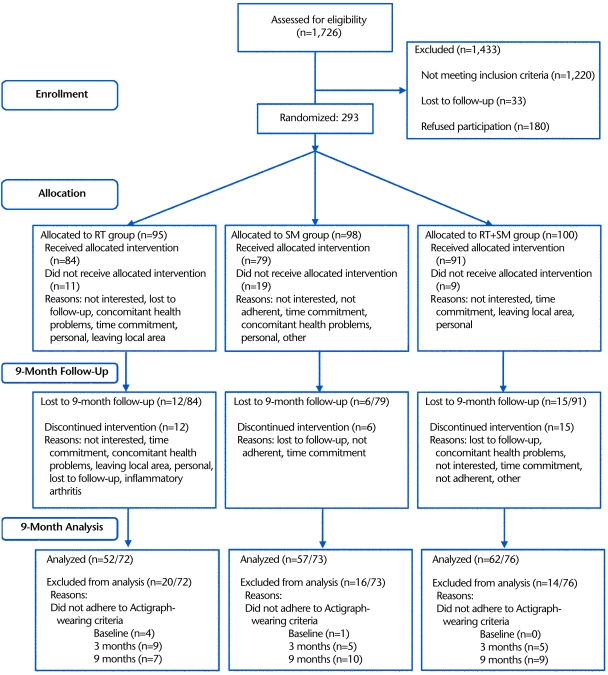
Participants: The participants in this study were 171 patients (74% women, 26% men) with knee OA. They had a mean age of 55.1 (SD=7.1) years, a mean body mass index of 27.6 (SD=4.2) kg/m(2), and radiographic status of grade II OA (and no higher) in at least one knee, as defined by the Kellgren and Lawrence classification. They wore an accelerometer while awake (X=14.2 [SD=2.2] hours) for 5 to 7 contiguous days (X=6.8 [SD=0.5] days) at baseline and at 3 and 9 months of intervention.
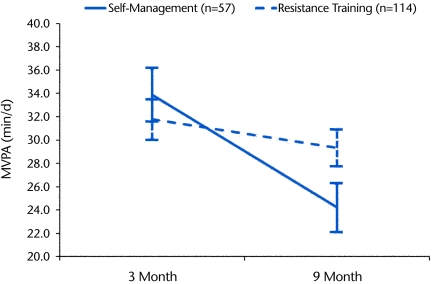
Results: The participants engaged in MVPA a mean of 26.2 (SD=19.3) minutes per day at baseline. Both groups significantly increased their MVPA from baseline to 3 months (RT group by 18% [effect size (d)=0.26]; SM group by 22% [effect size (d)=0.25]), but only the RT group sustained those changes at 9 months (RT group maintained a 10% increase [effect size (d)=0.15]; SM group maintained a 2% increase [effect size (d)=0.03]). A significant group x time interaction for MVPA indicated that the RT group maintained higher MVPA levels than the SM group.
Limitations: Lack of direct measures of energy expenditure and physical function was a limitation of the study.
Conclusions: Patients with early-onset OA of the knee can engage in an RT program without sacrificing their overall MVPA levels. These results support the value of RT for management of knee OA.
Trial registration: ClinicalTrials.gov NCT00586300.
Figures
References
-
- Mazzuca SA. Is behavioral graded activity effective for the treatment of hip and knee osteoarthritis? Nat Clin Pract Rheumatol 2007;3:322–323 - PubMed
-
- American College of Rheumatology Subcommittee on Osteoarthritis Guidelines Recommendations for the medical management of osteoarthritis of the hip and knee: 2000 update. Arthritis Rheum 2000;43:1905–1915 - PubMed
-
- Jordan KM, Arden NK, Doherty M, et al. EULAR Recommendations 2003: an evidence-based approach to the management of knee osteoarthritis: Report of a Task Force of the Standing Committee for International Clinical Studies Including Therapeutic Trials (ESCISIT). Ann Rheum Dis 2003;62:1145–1155 - PMC - PubMed
-
- Scott DL, Shipley M, Dawson A, et al. The clinical management of rheumatoid arthritis and osteoarthritis: strategies for improving clinical effectiveness. Br J Rheumatol 1998;37:546–554 - PubMed
-
- American College of Sports Medicine Position Stand : The recommended quantity and quality of exercise for developing and maintaining cardiorespiratory and muscular fitness, and flexibility in healthy adults. Med Sci Sports Exerc 1998;30:975–991 - PubMed
Publication types
MeSH terms
Associated data
Grants and funding
LinkOut - more resources
Full Text Sources
Medical
