


Assessment and improvement of figures to visually convey benefit and risk of stroke thrombolysis
- PMID: 20056928
- PMCID: PMC2909659
- DOI: 10.1161/STROKEAHA.109.566935
Assessment and improvement of figures to visually convey benefit and risk of stroke thrombolysis
Abstract
Background and purpose: Deciding whether to use intravenous fibrinolytic therapy for acute cerebral ischemia within 3 hours of onset is challenging for patients, family members, and health care providers. Visual displays can permit individuals to rapidly understand response patterns to therapy. This study sought to evaluate, refine, and improve existing visual aids for stroke fibrinolytic decision-making.
Methods: Existing visual aids were identified by Medline search and querying of national guideline organizations, pharmaceutical manufacturers, and stroke specialists, and were rated on a formal 8-point quality rating scale (0, lowest; 8, highest). Based on available instruments, new visual displays were developed to improve informed decision-making in routine practice.
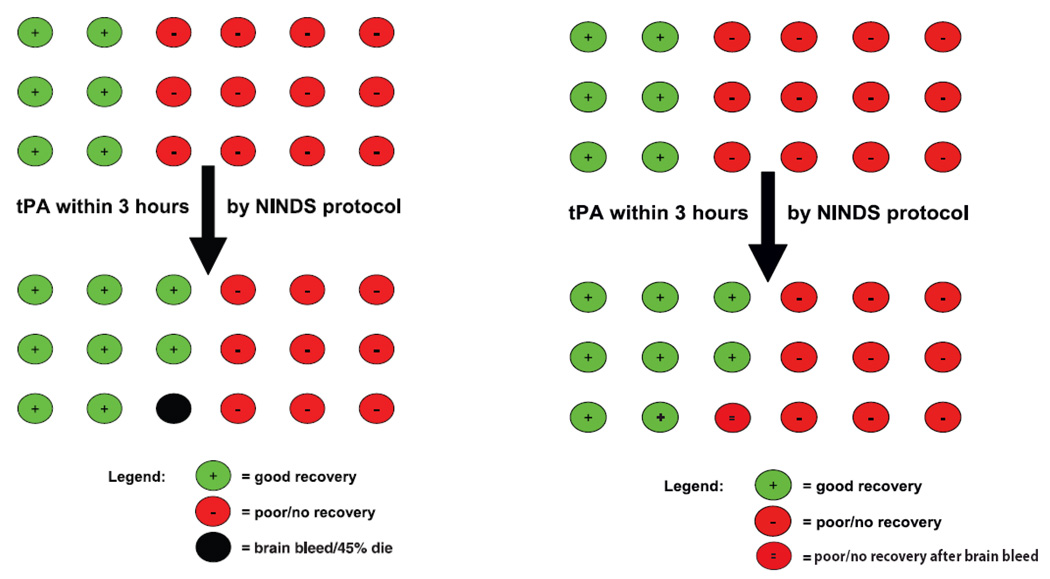
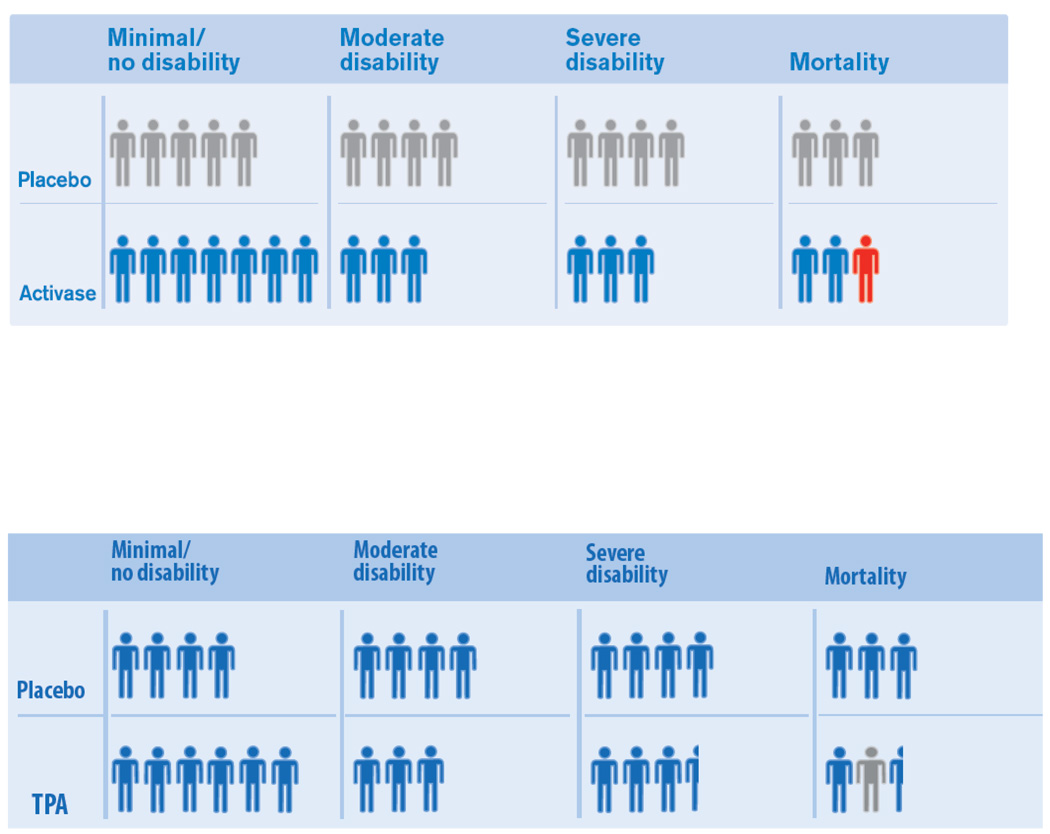
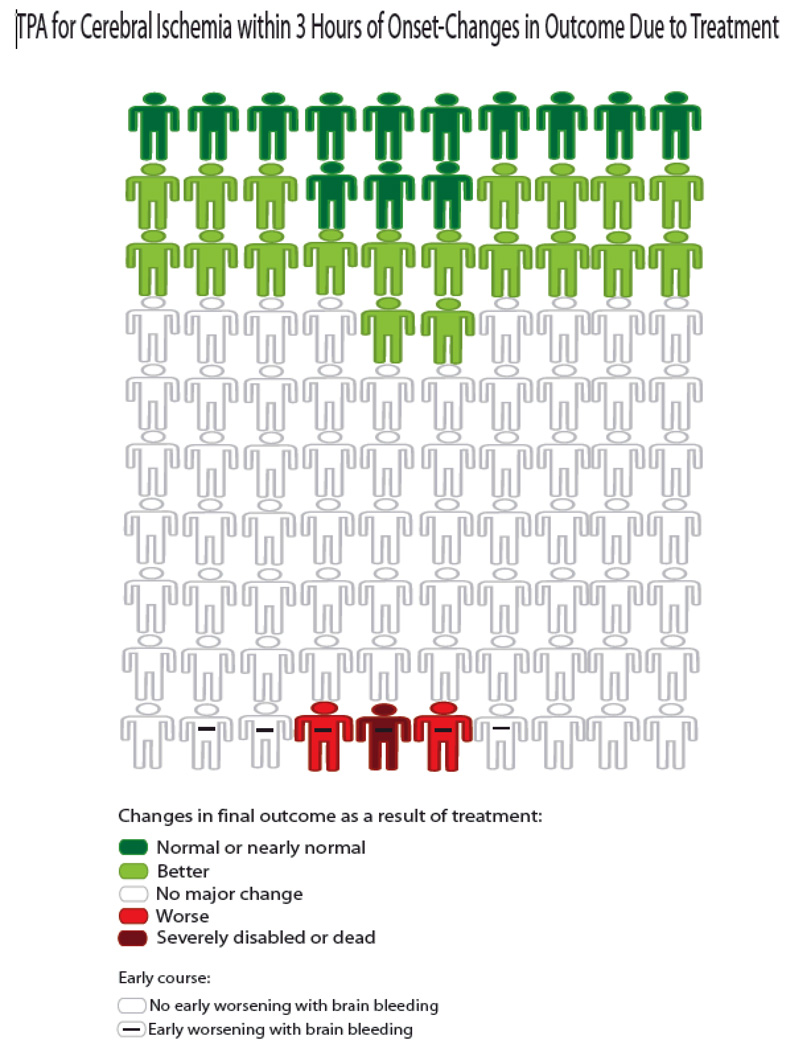
Results: Two existing visual aids were identified, one from an emergency medicine society and one from a pharmaceutical company. Both were comparison visual displays of outcomes with and without treatment; no decision matrix visual aid was found. Both scored 4.0 on the quality scale, showing defects of effect size distortion, privileging less salient outcomes, dissimilar representation by treatment group, and limited stakeholder participation in generation. Revised versions of these graphics were developed with higher quality scores (6.75 and 7.75). In addition, a new decision matrix display with quality score 8.0 was developed that complements the numeric text of a national patient education tool developed jointly by US neurology, emergency medicine, and stroke patient organizations.
Conclusions: Existing visual aids for stroke fibrinolysis decision-making have deficiencies. New visual displays are now available to convey the health benefits and risks of fibrinolytic stroke therapy efficiently and informatively to patients and family members.
Figures
References
-
- Marler JR, Winters Jones P, Emr M. The National Institute of Neurological Disorders and Stroke: Proceedings of National Symposium on Rapid Identification and Treatment of Acute Stroke; Bethesda, MD: National Institute of Neurological Disorders and Stroke; 1997.
-
- Cosmides L, Tooby J. Are humans good intuitive statisticians after all? Rethinking some conclusions from the literature on judgment under uncertainty. Cognition. 1996;58:1–73.
-
- International Patient Decision Aids Collaboration. IPDAS 2005: Criteria for judging the quality of patient decision aids [online] Available at: http://www.ipdas.ohri.ca/IPDAS_checklist.pdf.
Publication types
MeSH terms
Grants and funding
LinkOut - more resources
Full Text Sources
Other Literature Sources
Medical
Molecular Biology Databases
