


Randomized trial: Quitline specialist training in gain-framed vs standard-care messages for smoking cessation
- PMID: 20056957
- PMCID: PMC2808347
- DOI: 10.1093/jnci/djp468
Randomized trial: Quitline specialist training in gain-framed vs standard-care messages for smoking cessation
Abstract
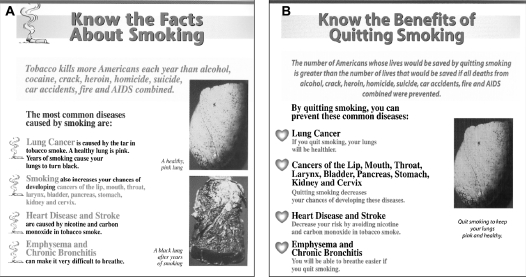
Background: Smoking accounts for a large proportion of cancer-related mortality, creating a need for better smoking cessation efforts. We investigated whether gain-framed messages (ie, presenting benefits of quitting) will be a more persuasive method to encourage smoking cessation than standard-care messages (ie, presenting both costs of smoking [loss-framed] and benefits of quitting).
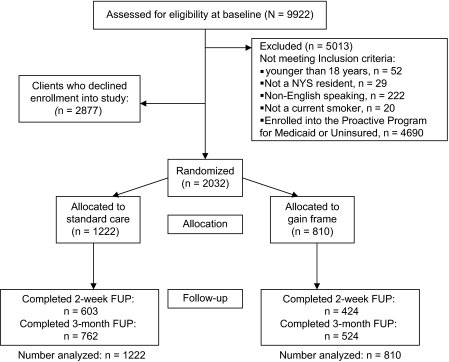
Methods: Twenty-eight specialists working at the New York State Smokers' Quitline (a free telephone-based smoking cessation service) were randomly assigned to provide gain-framed or standard-care counseling and print materials. Smokers (n = 2032) who called the New York State Smokers' Quitline between March 10, 2008, and June 13, 2008, were exposed to either gain-framed (n = 810) or standard-care (n = 1222) messages, and all medically eligible callers received nicotine replacement therapy. A subset of 400 call recordings was coded to assess treatment fidelity. All treated smokers were contacted for 2-week and 3-month follow-up interviews. All statistical tests were two-sided.
Results: Specialists providing gain-framed counseling used gain-framed statements statistically significantly more frequently than those providing standard-care counseling as assessed with frequency ratings for the two types of gain-framed statements, achieving benefits and avoiding negative consequences (for achieving benefits, gain-framed mean frequency rating = 3.9 vs standard-care mean frequency rating = 1.4; mean difference = -2.5; 95% confidence interval [CI] = -2.8 to -2.3; P < .001; for avoiding negative consequences, gain-framed mean frequency rating = 1.5 vs standard-card mean frequency rating = 1.0; mean difference = -0.5; 95% CI = -0.6 to -0.3; P < .001). Gain-framed counseling was associated with a statistically significantly higher rate of abstinence at the 2-week follow-up (ie, 99 [23.3%] of the 424 in the gain-framed group vs 76 [12.6%] of the 603 in the standard-care group, P < .001) but not at the 3-month follow-up (ie, 148 [28.4%] of the 522 in the gain-framed group vs 202 [26.6%] of the 760 in the standard-care group, P = .48).
Conclusions: Quitline specialists can be trained to provide gain-framed counseling with good fidelity. Also, gain-framed messages appear to be somewhat more persuasive than standard-care messages in promoting early success in smoking cessation.
Figures
Comment in
-
Increasing the effectiveness of tobacco quitlines.J Natl Cancer Inst. 2010 Jan 20;102(2):72-3. doi: 10.1093/jnci/djp476. Epub 2010 Jan 7. J Natl Cancer Inst. 2010. PMID: 20056954 Free PMC article. No abstract available.
References
-
- US Department of Health and Human Services. Cancer Facts & Figures 2008. Atlanta, GA: American Cancer Society; 2008.
-
- US Department of Health and Human Services. Reducing the Health Consequences of Smoking: 25 Years of Progress: A Report of the Surgeon General: 1989 Executive Summary. Rockville, MD: US Department of Health and Human Services, Public Health Service, Centers for Disease Control, Center for Chronic Disease Prevention and Health Promotion, Office on Smoking and Health; 1989.
-
- Mokdad AH, Marks JS, Stroup DF, Gerberding JL. Actual causes of death in the United States, 2000. JAMA. 2004;291(10):1238–1245. - PubMed
-
- US Department of Health and Human Services. The Health Benefits of Smoking Cessation. Rockville, MD: US Department of Health and Human Services, Public Health Service, Centers for Disease Control, Center for Chronic Disease Prevention and Health Promotion, Office on Smoking and Health; 1990.
-
- National Center for Health Statistics. Health, United States, 2006, With Chartbook With Trends in the Health of Americans. Hyattsville, MD: Public Health Service; 2006. - PubMed
Publication types
MeSH terms
Grants and funding
LinkOut - more resources
Full Text Sources
Medical
Miscellaneous
