


Using the word 'cancer' in communication about an abnormal Pap test: finding common ground with patient-provider communication
- PMID: 20060255
- PMCID: PMC2891944
- DOI: 10.1016/j.pec.2009.11.022
Using the word 'cancer' in communication about an abnormal Pap test: finding common ground with patient-provider communication
Abstract
Objective: To investigate provider and patient views about communication regarding cervical cancer screening follow-up.
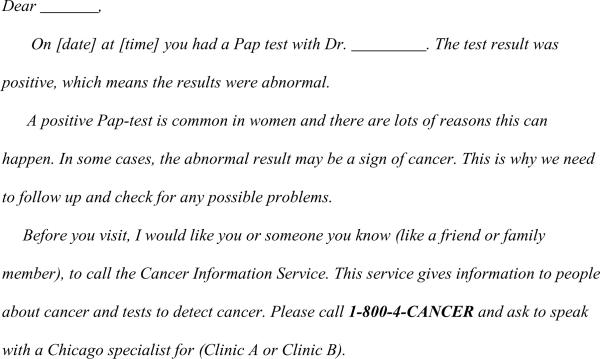
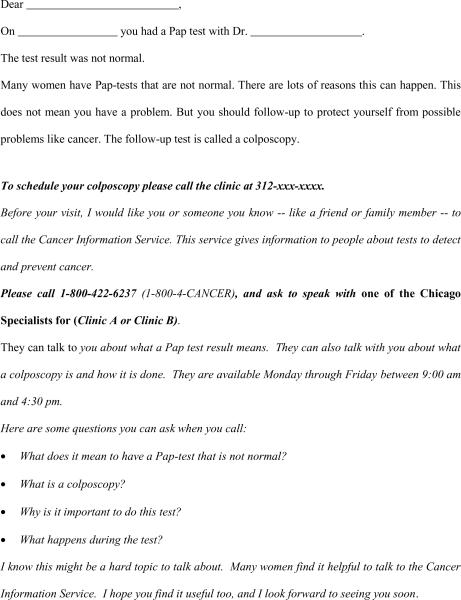
Methods: Using qualitative analysis, we interviewed 20 providers and 10 patients from two urban clinics that serve low-income African American and Hispanic women. Semi-structured interviews and focus groups assessed familiarity with National Cancer Institute's Cancer Information Service (CIS) and reactions to a letter asking women with abnormal Pap test to telephone CIS. The letter suggested questions to ask prior to receiving follow-up.
Results: No patient or provider was familiar with CIS. Providers but not patients expressed discomfort with use of the word 'cancer' in the letter and in CIS's name. Providers feared that reference to cancer would provoke fatalism and impede timely follow-up, whereas patients felt information about cancer risk was needed to prompt timely follow-up. Information providers found necessary to convey in order to accurately explain abnormal Pap tests surpassed patients' literacy levels.
Conclusion: Qualitative data suggest important gaps in perspective between providers and patients. There is a need to bridge the gap and overcome communication challenges to promote timely medical follow-up and have better health outcomes.
Practice implications: Implications and strategies for improving patient-provider education and communication about abnormal Pap test are discussed.
(c) 2009 Elsevier Ireland Ltd. All rights reserved.
Figures
References
-
- Benard VB, Lawson HW, Eheman CR, Anderson C, Helsel W. Adherence to guidelines for follow-up of low-grade cytologic abnormalities among medically underserved women. Obstetrics & Gynecology. 2005;105(6):1323–1328. - PubMed
-
- Engelstadt LP, Stewart SL, Nguyen BH, Bedeian KL, Rubin MM, Pasick RJ, Hiatt RA. Abnormal Pap smear follow-up in a high-risk population. Cancer Epidemiology, Biomarkers & Prevention. 2001;10:1015–1020. - PubMed
-
- Benard VB, Lee NC, Piper M, Richardson L. Race-specific results of Papanicolaou testing and the rate of cervical neoplasia in the National Breast and Cervical Cancer Early Detection Program, 1991–1998 (United States) Cancer Causes and Control. 2001;12:61–68. - PubMed
-
- Paskett ED, Carter WB, Chu J, White E. Compliance behavior in women with abnormal Pap smears: developing and testing a decision model. Med Care. 28(1990):643–656. E D. - PubMed
-
- Paskett, Phillips KC, Miller ME. Improving compliance among women with abnormal Papanicolaou smears. Obstet Gynecol. 86(1995):353–359. - PubMed
Publication types
MeSH terms
Grants and funding
LinkOut - more resources
Full Text Sources
Medical
Research Materials
Miscellaneous
