. 2010 Apr;298(4):L564-74.
doi: 10.1152/ajplung.00298.2009. Epub 2010 Jan 8.

20-HETE-induced nitric oxide production in pulmonary artery endothelial cells is mediated by NADPH oxidase, H2O2, and PI3-kinase/Akt

Affiliations

20-HETE-induced nitric oxide production in pulmonary artery endothelial cells is mediated by NADPH oxidase, H2O2, and PI3-kinase/Akt

Sreedhar Bodiga et al. Am J Physiol Lung Cell Mol Physiol. 2010 Apr.

Abstract

We have shown that 20-hydroxyeicosatetraenoic acid (20-HETE) increases both superoxide and nitric oxide (NO) production in bovine pulmonary artery endothelial cells (BPAECs). The current study was designed to determine mechanisms underlying 20-HETE-stimulated NO release, and particularly the role of NADPH oxidase, reactive oxygen species, and PI3-kinase in stimulated NO release. Intracellular hydrogen peroxide (H(2)O(2)) and NO production were detected by dichlorofluorescein or dihydrorhodamine and diaminofluorescein fluorescence, respectively. Activation of endothelial nitric oxide synthase (eNOS) (Ser1179) and Akt (Ser473) was assessed by comparing the ratio of phosphorylated to total protein expression by Western blotting. Addition of 20-HETE to BPAECs caused an increase in superoxide and hydrogen peroxide, but not peroxynitrite. 20-HETE-evoked activation of Akt and eNOS, as well as enhanced NO release, are dependent on H(2)O(2) as opposed to superoxide in that these endpoints are blocked by PEG-catalase and not PEG-superoxide dismutase. Similarly, 20-HETE-stimulated NO production in BPAECs is blocked by NADPH oxidase inhibitors apocynin or gp91 blocking peptide, and by PI3-kinase/Akt blockers wortmannin, LY-294002, or Akt inhibitor, implicating NADPH oxidase, PI3-kinase, and Akt signaling pathways, respectively, in this process. Together, these data suggest the following scheme: 20-HETE stimulates NADPH oxidase-dependent formation of superoxide. Superoxide is rapidly dismutated to hydrogen peroxide, which then mediates activation of PI3-kinase/Akt, phosphorylation of eNOS, and enhanced release of NO from eNOS in response to 20-HETE in BPAECs.


Figures
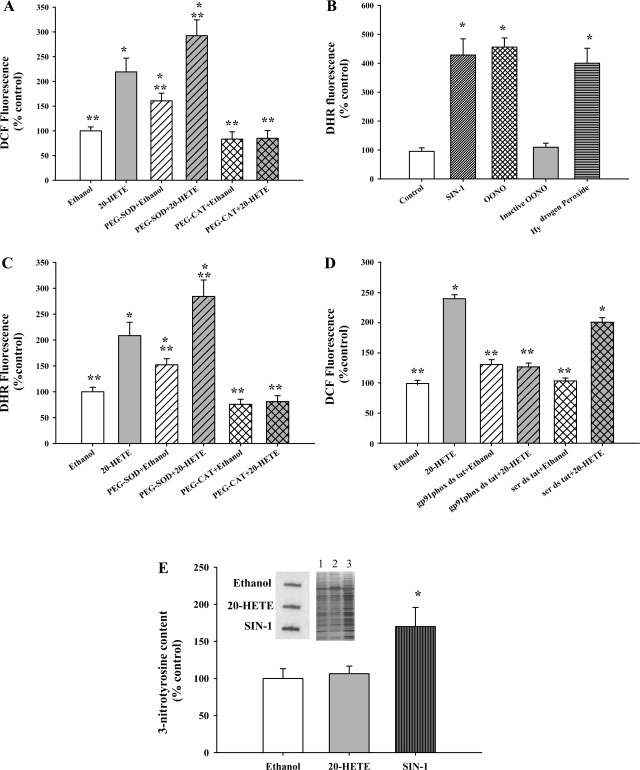
Fig. 1.
Fig. 1.
20-HETE increases dichlorofluorescein (DCF) and dihydrorhodamine (DHR) fluorescence in bovine pulmonary artery endothelial cells (BPAECs). A: 20-HETE (gray bar) increased the DCF fluorescence compared with vehicle (open bar). PEG-SOD pretreatment (gray hatched bar) enhanced 20-HETE-induced DCF fluorescence signal, indicating facilitated formation of hydrogen peroxide. PEG-CAT treatment (gray cross-hatched bar) effectively lowered 20-HETE-induced DCF fluorescence. Signal remaining after treatment with PEG-CAT represents background, whereas the difference in DCF fluorescence in cells treated with vehicle and 20-HETE reflects hydrogen peroxide. B: an increase in DHR signal was observed with either authentic ONOO (100 μM) or ONOO derived from SIN-1 (10 μM), but not with pH-inactivated ONOO. Hydrogen peroxide (100 μM) also increased the DHR fluorescence. *P < 0.05 relative to control (no treatment). C: BPAECs incubated with DHR123 were imaged for quantitation of fluorescent signal 10 min after treatment with vehicle (open bars) or 20-HETE (gray bars), pretreatment with PEG-SOD (gray hatched bars) or PEG-CAT (gray cross-hatched bars). The same pattern of increased fluorescence signal after PEG-SOD and decreased signal after PEG-CAT treatment as was observed with DCF was detected with DHR123. These data support a major contribution of hydrogen peroxide to 20-HETE-evoked DHR fluorescence signal in BPAECs. D: 20-HETE (gray bar) increased the DCF fluorescence compared with vehicle (open bar). gp91phox ds tat peptide pretreatment (gray hatched bar) effectively lowered 20-HETE-induced DCF fluorescence signal, but not the scr ds tat peptide (gray cross-hatched bar) indicating that NADPH oxidase inhibition lowers 20-HETE-induced production of H2O2. A–D: data are composite of at least 60 cells for each experimental condition and 3 independent culture preparations. *P < 0.05 relative to vehicle control (ethanol); **P < 0.05 relative to 20-HETE. E: BPAECs were treated with ethanol, 20-HETE (1 μM), or SIN-1 (10 μM) for 60 min, and whole cell extracts (3 μg of protein) were used for analysis of tyrosine nitration by slot blot analysis. A representative slot blot image and Western blot are shown in inset. Lanes 1–3 are ethanol, 20-HETE, and SIN-1, respectively. Densitometric quantitation of relative abundance of 3-nitrotyrosine from the slot blots is shown (n = 4 for each group). SIN-1 treatment (dark gray vertical bar) induced an increase in the 3-nitrotyrosine compared with both the vehicle (open bar) and 20-HETE (gray bar). *P < 0.05 relative to both vehicle and 20-HETE.
Fig. 2.
Fig. 2.
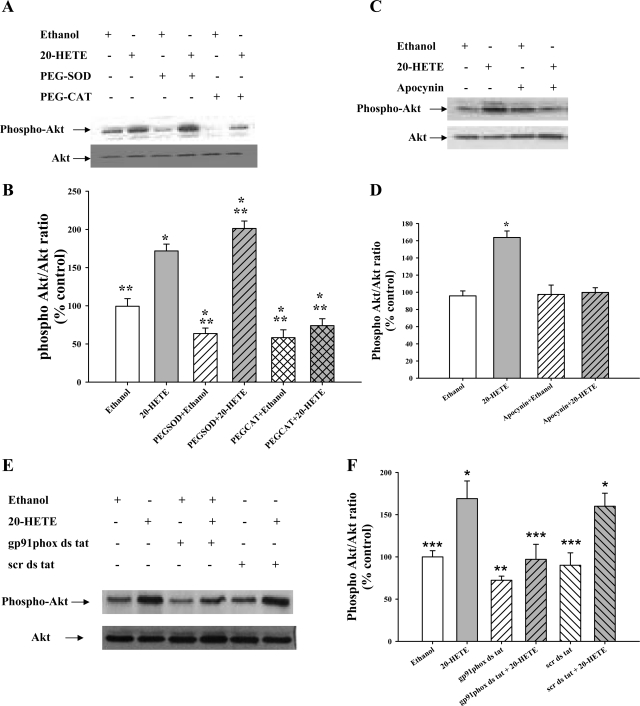
Activation of Akt in response to 20-HETE is mediated by H2O2 and NADPH oxidase. A: BPAECs were treated with PEG-SOD (100 U/ml) or PEG-CAT (500 U/ml) for 30 min before 20-HETE stimulation (1 μM, 30 min). Cells were then lysed, and the lysates were analyzed for levels of phospho-Akt (Ser473) and total Akt (n = 5 for each group). A representative Western blot of cell lysates probed with phospho-Akt-Ser473 is shown. B: phospho-Akt and Akt band densities were analyzed by densitometry, and the means ± SE from 5 independent experiments from 2 different isolates of BPAECs were used to calculate the ratio of phospho-Akt/Akt. 20-HETE (gray bar) increases phospho-Akt (Ser473) compared with vehicle control, and this increase is further enhanced by pretreatment with PEG-SOD (gray hatched bar). Removal of H2O2 using PEG-CAT (gray cross-hatched bar) lowers the phospho-Akt levels without altering total Akt levels. *P < 0.05 relative to vehicle control (ethanol); **P < 0.05 relative to 20-HETE. C: BPAECs were incubated for 30 min in RPMI serum-free medium containing an inhibitor of NADPH oxidase, apocynin (1 μM), for 30 min before 20-HETE stimulation (1 μM, 30 min). A representative Western blot of cell lysates probed with phospho-Akt-Ser473 is shown (top) (n = 5 for each group). D: 20-HETE (gray bar) increases phospho-Akt (Ser473) compared with vehicle control, and this increase is blunted by pretreatment with apocynin (gray hatched bar), likely due to a block in NADPH-derived H2O2. *P < 0.05 relative to vehicle control (ethanol; n = 5). E: BPAECS were incubated in serum-free medium with the gp91 peptide inhibitor or the scrambled peptide. A representative Western blot is shown. Like apocynin, the gp91 peptide inhibited the increase in phospho-Akt associated with 20-HETE, whereas the scrambled peptide did not. F: 20-HETE (gray bar) increases phospho-Akt compared with control, and this increase is blocked by pretreatment with the gp91phox inhibitory peptide. **P < 0.05 relative to vehicle control (ethanol n = 4).
Fig. 3.
Fig. 3.
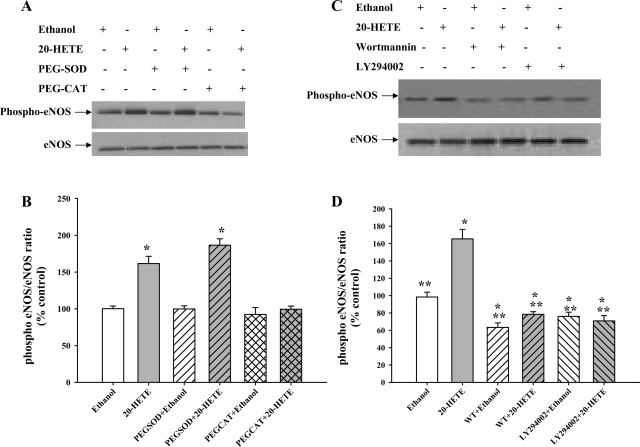
20-HETE-induced activation of eNOS is mediated by H2O2 production and controlled by PI3 kinase (PI3K). A: BPAECs were treated with vehicle, PEG-SOD (100 U/ml), or PEG-CAT (500 U/ml) for 30 min before 20-HETE stimulation (1 μM, 30 min). A representative Western blot of cell lysates probed with phospho-eNOS-Ser1179 is shown (top) (n = 5 for each group). B: 20-HETE (gray bar) increases phospho-eNOS (Ser1179) compared with vehicle control, and this increase is not blocked by pretreatment with PEG-SOD (gray hatched bar; n = 5 each). Facilitated elimination of H2O2 using PEG-CAT (gray cross-hatched bar) reduced the phospho-eNOS levels without altering total eNOS levels. *P < 0.005 relative to vehicle control (ethanol). C: BPAECs were incubated for 30 min with vehicle or inhibitors of PI3K, wortmannin (WT; 200 nM), or LY-294002 (20 μM) before vehicle or 20-HETE (1 μM, 30 min) stimulation. A representative Western blot of cell lysates probed with phospho-eNOS-Ser1179 is shown (top) (n = 5). D: phospho-eNOS and eNOS band densities were analyzed by densitometry, and the means ± SE from 5 independent experiments from 2 different isolates of BPAECs were used to calculate the ratio of phospho-eNOS/eNOS. 20-HETE (gray bar) increases phospho-eNOS (Ser1179) compared with vehicle control, and this increase is abolished by pretreatment with either inhibitor of PI3K, wortmannin or LY-294002 (hatched bars). *P < 0.05 relative to vehicle control (ethanol); **P < 0.05 relative to 20-HETE.
Fig. 4.
Fig. 4.
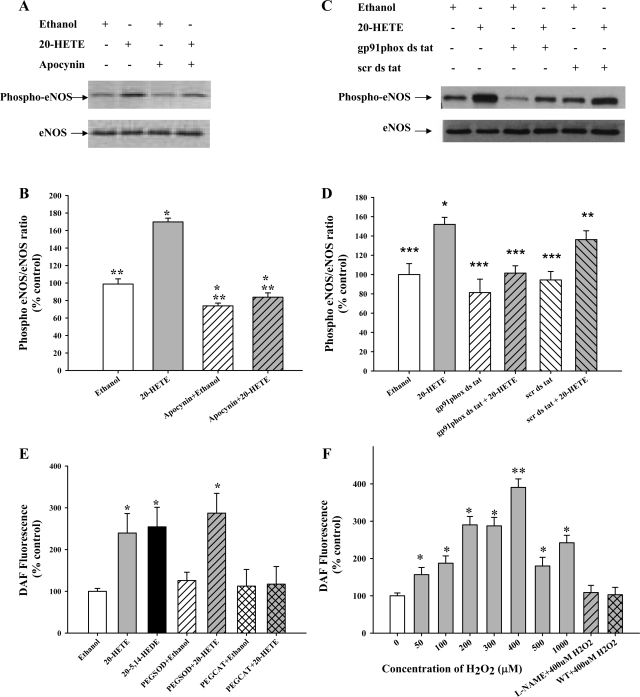
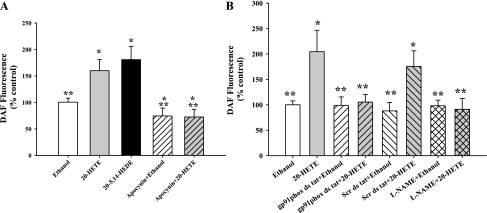
20-HETE-induced eNOS (Ser1179) phosphorylation depends on H2O2. NO generation is mediated by H2O2 and PI3K. A: BPAECs were incubated for 30 min with an inhibitor of NADPH oxidase, apocynin (1 μM), before 20-HETE stimulation (1 μM, 30 min). A representative Western blot of cell lysates probed with phospho-eNOS-Ser1179 is shown (top). The blots were stripped and reprobed with eNOS as shown (bottom) (n = 5). B: phospho-eNOS and eNOS bands were analyzed by densitometry and used to calculate the ratio of phospho-eNOS/eNOS. 20-HETE (gray bar) increases phospho-eNOS (Ser1179) compared with vehicle control, and this increase is attenuated by pretreatment with apocynin (hatched bars). *P < 0.05 relative to vehicle control (ethanol); **P < 0.05 relative to20-HETE. C: BPAECs were incubated with the gp91phox inhibitor or the scrambled peptide and treated with 20-HETE or vehicle. A representative Western blot shows that 20-HETE increased phospho-eNOS/eNOS ratio in cells treated with the scrambled peptide, but not the gp91phox peptide. D: 20-HETE (gray bar) increases phospho-eNOS (Ser1179) compared with vehicle control, and this increase is attenuated by pretreatment with gp91phox peptide (hatched bars), but not the scrambled peptide. *P < 0.05 relative to vehicle control (ethanol); ***P < 0.05 relative to scrambled peptide control. E: 20-HETE (gray bar) increased DAF fluorescence (NO levels) compared with vehicle (open bar). Similar to 20-HETE, a stable analog, 20–5,14-HEDE (1 μM, black bar), increased the DAF fluorescence significantly compared with vehicle. The increase in DAF fluorescence was unaffected by PEG-SOD (gray hatched bar; 100 U/ml) and attenuated by PEG-CAT (gray cross-hatched bar; 500 U/ml). *P < 0.05 relative to vehicle control. A total of >50 cells in 3 randomly chosen fields during each experiment was processed for obtaining average fluorescence intensity. F: BPAECs were treated with vehicle or 50–1,000 μM H2O2 for 20 min and then assessed for DAF fluorescence. Starting at 50 μM, H2O2 had a significant effect on DAF fluorescence. Increasing concentrations of H2O2 (gray bars) elicited a bell-shaped response curve, with a peak observed at 400 μM H2O2. Pretreatment with the NOS inhibitor l-NAME (1 mM, gray hatched bar) or PI3K inhibitor wortmannin (200 nM, gray cross-hatched bar) attenuated the DAF fluorescence seen with 400 μM H2O2, suggesting these changes in DAF fluorescence are mediated by activation of PI3K and NOS. Data represent composite results from at least 60 cells for each experimental condition and 3 independent culture preparations. *P < 0.05 relative to no treatment (control, 0 μM H2O2); **P < 0.05 relative to different concentrations of H2O2 used in the study.
Fig. 5.
Fig. 5.
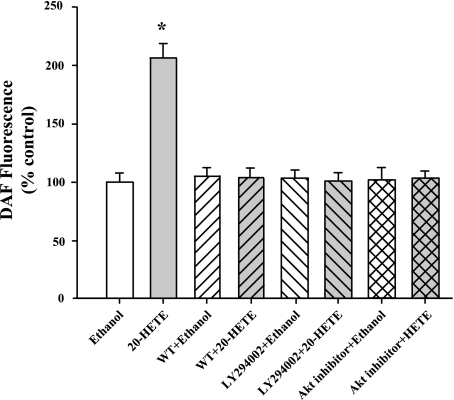
20-HETE-induced NO formation is dependent on PI3K/Akt. 20-HETE resulted in an increase in DAF fluorescence, which was prevented by wortmannin (200 nM), LY-294002 (10 μM), or Akt inhibitor (10 μM), further suggesting that 20-HETE-induced NO formation is modulated by PI3K/Akt. N ≥ 50 cells in each group. *P < 0.05 relative to ethanol.
Fig. 6.
Fig. 6.
20-HETE-induced NO formation is mediated by NADPH oxidase. A: 20-HETE and its structural analog, 20–5,14-HEDE, enhanced DAF fluorescence compared with ethanol in a manner that was blunted by apocynin, an inhibitor of NADPH oxidase. N ≥ 50 cells for each experiment. *P < 0.05 relative to ethanol; **P < 0.05 relative to 20-HETE. B: pretreatment with 50 μM gp91phox ds tat peptide for 30 min (hatched bars) effectively blocked both vehicle and 20-HETE-induced DAF fluorescence. In contrast, scrambled peptide inhibitor (hatched bars) did not block the 20-HETE-induced DAF signal relative to scrambled peptide control. N ≥ 60 cells from each group. *P < 0.05 relative to ethanol; **P < 0.05 relative to 20-HETE.
Fig. 7.
Fig. 7.
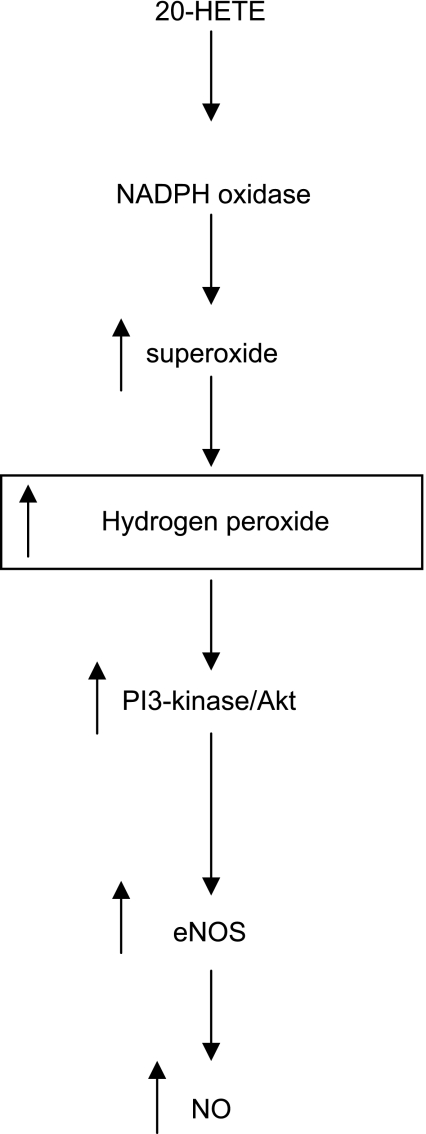
Hypothesis schematic. A unifying hypothesis depicting the cascade of signaling events in response to 20-HETE that result in the increased production of NO in BPAECs. We speculate that 20-HETE activates NADPH oxidase, which produces superoxide that is rapidly dismutated to H2O2. H2O2 activates PI3K and Akt, which in turn phosphorylates eNOS. Phosphorylation of eNOS at Ser1179 promotes enhanced NO production.

References

    1. Alonso-Galicia M, Falck JR, Reddy KM, Roman RJ. 20-HETE agonists and antagonists in the renal circulation. Am J Physiol Renal Physiol 277: F790–F796, 1999 - PubMed
    1. Amaral SL, Maier KG, Schippers DN, Roman RJ, Greene AS. CYP4A metabolites of arachidonic acid and VEGF are mediators of skeletal muscle angiogenesis. Am J Physiol Heart Circ Physiol 284: H1528–H1535, 2003 - PubMed
    1. Antunes F, Cadenas E. Estimation of H2O2 gradients across biomembranes. FEBS Lett 475: 121–126, 2000 - PubMed
    1. Bilski P, Belanger AG, Chignell CF. Photosensitized oxidation of 2′,7′-dichlorofluorescin: singlet oxygen does not contribute to the formation of fluorescent oxidation product 2′,7′-dichlorofluorescein. Free Radic Biol Med 33: 938–946, 2002 - PubMed
    1. Boo YC, Hwang J, Sykes M, Michell BJ, Kemp BE, Lum H, Jo H. Shear stress stimulates phosphorylation of eNOS at Ser(635) by a protein kinase A-dependent mechanism. Am J Physiol Heart Circ Physiol 283: H1819–H1828, 2002 - PubMed

Publication types

MeSH terms

Substances

LinkOut - more resources