


Review
doi: 10.1097/BCR.0b013e3181c7ed82.
Molecular mediators of angiogenesis
Affiliations
- PMID: 20061852
- PMCID: PMC2818794
- DOI: 10.1097/BCR.0b013e3181c7ed82
Item in Clipboard
Review
Molecular mediators of angiogenesis
J Burn Care Res.
2010 Jan-Feb.
Abstract
Angiogenesis, or the formation of new blood vessels from the preexisting vasculature, is a key component in numerous physiologic and pathologic responses and has broad impact in many medical and surgical specialties. In this review, we discuss the key cellular steps that lead to the neovascularization of tissues and highlight the main molecular mechanisms and mediators in this process. We include discussions on proteolytic enzymes, cell-matrix interactions, and pertinent cell signaling pathways and end with a survey of the mechanisms that lead to the stabilization and maturation of neovasculatures.
Figures
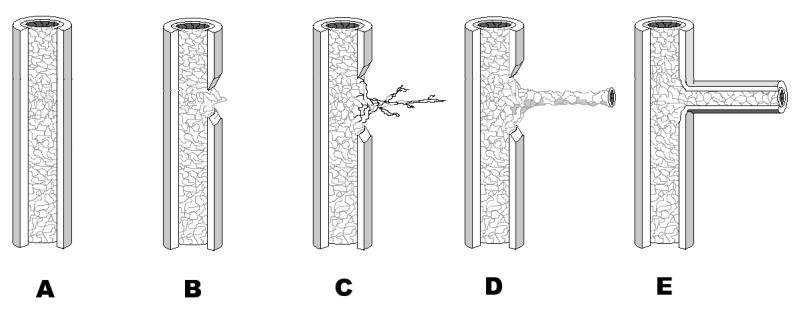
Diagrammatic description of the steps involved in angiogenesis. A) A stable vascular structure comprised of an endothelial monolayer surrounded by mural tissue (i.e. basement membrane, pericytes, and adventitia); B) Destabilized vessel demonstrating the disruption of mural tissue by endothelial cells; C) Endothelial cell invasion into perivascular tissue and subsequent sprout formation; D) Endothelial cell lumenogenesis and tube formation with inosculation (not shown) to other pre-existing vascular structures; E) Stabilization of the capillary sprout by recruitment of pericytes and deposition of basement membrane.
References
-
- Carmeliet P. Angiogenesis in life, disease and medicine. Nature. 2005 Dec 15;438(7070):932. - PubMed
-
- Scholz D, Cai WJ, Schaper W. Arteriogenesis, a new concept of vascular adaptation in occlusive disease. Angiogenesis. 2001;4(4):247–257. - PubMed
-
- Risau W. Mechanisms of angiogenesis. Nature. 1997 Apr 17;386(6626):671. - PubMed
-
- Burri PH, Djonov V. Intussusceptive angiogenesis--the alternative to capillary sprouting. Mol Aspects Med. 2002 Dec;23(6S):S1–27. - PubMed
-
- Francis ME, Uriel S, Brey EM. Endothelial cell-matrix interactions in neovascularization. Tissue Eng Part B Rev. 2008 Mar;14(1):19–32. - PubMed
Publication types
MeSH terms
Substances
Grants and funding
LinkOut - more resources
Full Text Sources
Other Literature Sources
