. 2010 Mar;11(3):214-9.
doi: 10.1038/embor.2009.272. Epub 2010 Jan 8.

The iron-sulphur protein RNase L inhibitor functions in translation termination

Affiliations

The iron-sulphur protein RNase L inhibitor functions in translation termination

Sohail Khoshnevis et al. EMBO Rep. 2010 Mar.

Abstract

The iron-sulphur (Fe-S)-containing RNase L inhibitor (Rli1) is involved in ribosomal subunit maturation, transport of both ribosomal subunits to the cytoplasm, and translation initiation through interaction with the eukaryotic initiation factor 3 (eIF3) complex. Here, we present a new function for Rli1 in translation termination. Through co-immunoprecipitation experiments, we show that Rli1 interacts physically with the translation termination factors eukaryotic release factor 1 (eRF1)/Sup45 and eRF3/Sup35 in Saccharomyces cerevisiae. Genetic interactions were uncovered between a strain depleted for Rli1 and sup35-21 or sup45-2. Furthermore, we show that downregulation of RLI1 expression leads to defects in the recognition of a stop codon, as seen in mutants of other termination factors. By contrast, RLI1 overexpression partly suppresses the read-through defects in sup45-2. Interestingly, we find that although the Fe-S cluster is not required for the interaction of Rli1 with eRF1 or its other interacting partner, Hcr1, from the initiation complex eIF3, it is required for its activity in translation termination; an Fe-S cluster mutant of RLI1 cannot suppress the read-through defects of sup45-2.


Conflict of interest statement

The authors declare that they have no conflict of interest.

Figures
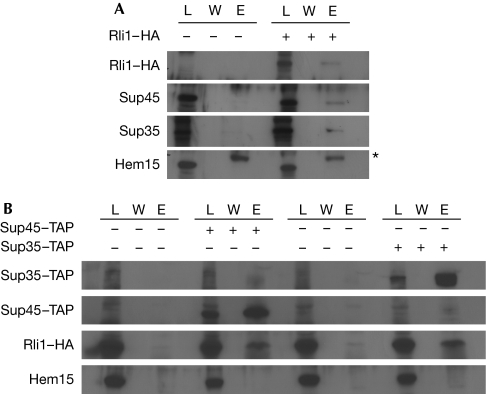
Figure 1
Figure 1
Rli1 interacts physically with the translation termination factors eRF1/Sup45 and eRF3/Sup35. (A) Co-immunoprecipitation experiments were performed with HA-tagged Rli1, Sup45 and Sup35 from log-phase yeast cells. Lysates (L), wash fractions (W) and the eluates (E) are shown in western blot analyses. A volume of 10 μl of each lysate and the complete eluates were loaded onto the gel. Each 200 μl eluate including the beads was resuspended in 20 μl of sample buffer and entirely loaded, which represents 20 × the lysate. HA, Sup45, Sup35 and Hem15 (negative control) antibodies were used for detection. The bands visible in the Hem15 eluate fractions are caused by the presence of the cross-reacting antibody chains and are marked by an asterisk. (B) TAP-tagged SUP45 and SUP35 were purified from log-phase yeast cells, carrying a plasmid encoding RLI1–HA. Wild-type cells expressing plasmid-encoded RLI1–HA were the negative control. Western blots of L, W and E are shown. The ratio of lysate to eluate is 1:20. HA and Hem15 (negative control) antibodies were used for detection. HA, haemagglutinin; Rli1, RNase L inhibitor; TAP, tandem affinity purification.
Figure 2
Figure 2
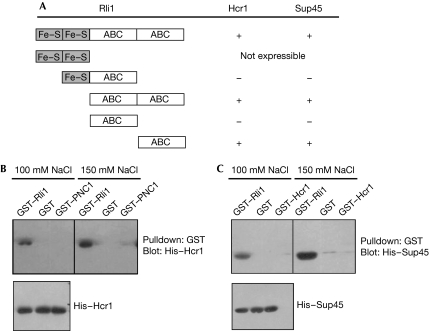
Identification of the Rli1 protein interaction domain for Hcr1 and Sup45. (A) A yeast two-hybrid assay with either full-length or the indicated truncations of Rli1 as bait and either Hcr1 or Sup45 as prey. The domain structure of Rli1 is indicated and positive interactions are shown by +, whereas no interaction is shown by −. (B) GST pulldown assays using His-tagged Hcr1 were performed under the indicated salt concentrations with full-length Rli1 (GST–Rli1) or GST and GST–PNC1 as negative controls. The eluate fractions (top) and the input (bottom) are shown. (C) GST pulldown assays using His-tagged Sup45 and GST–Rli1, GST or GST–Hcr1 were performed as described in (B). ABC, ATP-binding cassette; Fe–S, iron–sulphur; GST, glutathione-S-transferase; Rli1, RNase L inhibitor.
Figure 3
Figure 3
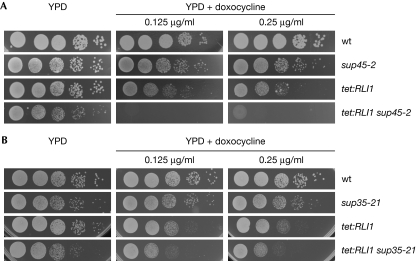
Genetic interactions between RLI1 and translation termination factors eRF1 and eRF3. (A) Serial dilutions of wild type, sup45-2, tet:RLI1 and the double mutant tet:RLI1 sup45-2 were spotted onto full medium plates (YPD) and plates containing the indicated concentrations of doxocycline, which downregulates RLI1 expression. Plates shown are after incubation at 25°C for three days (B) Serial dilutions of wild type, sup35-21, tet:RLI1 and the double mutant tet:RLI1 sup35-21 are shown on YPD and doxocycline plates after incubation at 25°C for three days. eRF, eukaryotic release factor; Rli1, RNase L inhibitor; wt, wild type; YPD, yeast extract–peptone–dextrose.
Figure 4
Figure 4
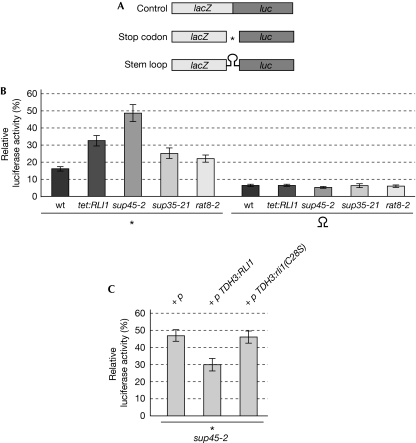
Rli1 is required for efficient stop codon recognition. (A) Scheme of the reporter constructs used to determine the read-through activity. (B) Read-through activities are shown for wild type, a strain that downregulates the RLI1 expression (tet:RLI1), sup45-2, sup35-21 and rat8-2, encoding the defective DEAD-box RNA helicase Dbp5. All strains carrying either of the reporter constructs were grown to log phase and incubated at 37°C for 15 min before cell lysis. β-Galactosidase and luciferase activities were measured and their ratios were used to calculate the relative molar luciferase expression. (C) Suppression of the termination read-through defects of sup45-2 by increased Rli1 level (TDH3:RLI1), but not an Fe–S cluster mutant (TDH3:rli1(C28S)), is shown. All strains carrying the reporter construct and the indicated plasmids were treated as described in (B). The results of at least 10 independent experiments are shown. The asterisks represent the termination codon UAG. Rli1, RNase L inhibitor; wt, wild type.

Comment in

References

    1. Bhattacharya A, Czaplinski K, Trifillis P, He F, Jacobson A, Peltz SW (2000) Characterization of the biochemical properties of the human Upf1 gene product that is involved in nonsense-mediated mRNA decay. RNA 6: 1226–1235 - PMC - PubMed
    1. Bidou L, Stahl G, Hatin I, Namy O, Rousset JP, Farabaugh PJ (2000) Nonsense-mediated decay mutants do not affect programmed -1 frameshifting. RNA 6: 952–961 - PMC - PubMed
    1. Bisbal C, Martinand C, Silhol M, Lebleu B, Salehzada T (1995) Cloning and characterization of a RNAse L inhibitor. A new component of the interferon-regulated 2-5A pathway. J Biol Chem 270: 13308–13317 - PubMed
    1. Bolger TA, Folkmann AW, Tran EJ, Wente SR (2008) The mRNA export factor Gle1 and inositol hexakisphosphate regulate distinct stages of translation. Cell 134: 624–633 - PMC - PubMed
    1. Cole CN, Scarcelli JJ (2006) Transport of messenger RNA from the nucleus to the cytoplasm. Curr Opin Cell Biol 18: 299–306 - PubMed

MeSH terms