


Course of neurocognitive deficits in the prodrome and first episode of schizophrenia
- PMID: 20063952
- PMCID: PMC2808194
- DOI: 10.1037/a0016791
Course of neurocognitive deficits in the prodrome and first episode of schizophrenia
Abstract
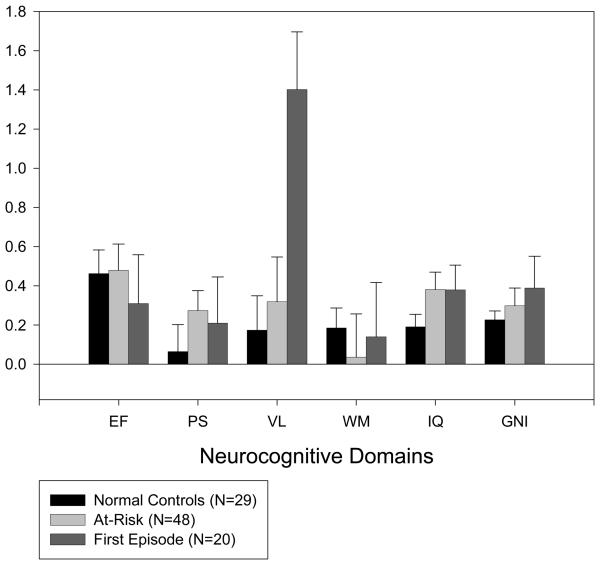
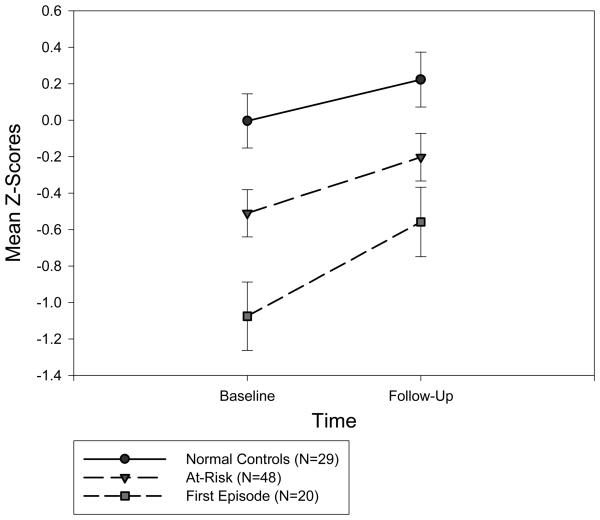
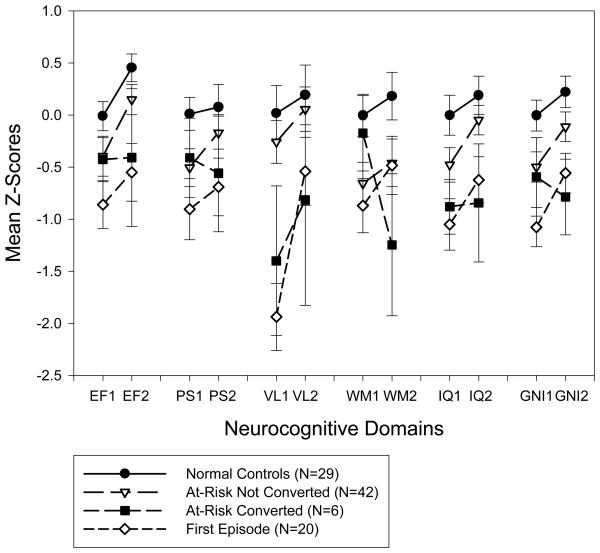
Understanding the trajectory of cognitive changes in the development of schizophrenia may shed light on the neurodevelopmental processes in the beginning stage of illness. Subjects at risk for psychosis (AR, n = 48), patients in their first episode of schizophrenia (FE, n = 20), and normal comparison subjects (n = 29) were assessed on a neurocognitive battery at baseline and at a 6-month follow-up. There were significant group differences across all cognitive domains as well as a significant group by time interaction in the verbal learning domain. After statistically controlling for practice effects and regression to the mean, a high proportion of FE subjects showed an improvement in verbal learning, and a significant number of AR subjects improved in general intelligence. Moreover, a higher than expected percentage of FE subjects, as well as AR subjects who later converted to psychosis, showed a deterioration in working memory and processing speed. These inconsistent trajectories suggest that some domains may improve with stabilization in the early stages of psychosis, whereas others may decline with progression of the illness, indicating possible targets for cognitive remediation strategies and candidate vulnerability markers for future psychosis.
Copyright 2009 APA, all rights reserved.
Figures
References
-
- Addington J, Saeedi H, Addington D. The course of cognitive functioning in first episode psychosis: Changes over time and impact on outcome. Schizophrenia Research. 2005;78:35–43. - PubMed
-
- Albus M, Hubmann W, Mohr F, Hecht S, Hinterberger-Weber P, Seitz N, et al. Neurocognitive functioning in patients with first-episode schizophrenia: results of a prospective 5-year follow-up study. European Archives of Psychiatry and Clinical Neuroscience. 2006;256(7):442–451. - PubMed
-
- Ando J, Ono Y, Wright MJ. Genetic structure of spatial and verbal working memory. Behavior Genetics. 2001;31(6):615–24. - PubMed
-
- Andreasen NC, Endicott J, Spitzer RL, Winokur G. The family history method using diagnostic criteria: Reliability and validity. Archives of General Psychiatry. 1977;34(10):1229–35. - PubMed
Publication types
MeSH terms
Grants and funding
LinkOut - more resources
Full Text Sources
Medical
Research Materials
