


Machine learning methods for metabolic pathway prediction
- PMID: 20064214
- PMCID: PMC3146072
- DOI: 10.1186/1471-2105-11-15
Machine learning methods for metabolic pathway prediction
Abstract
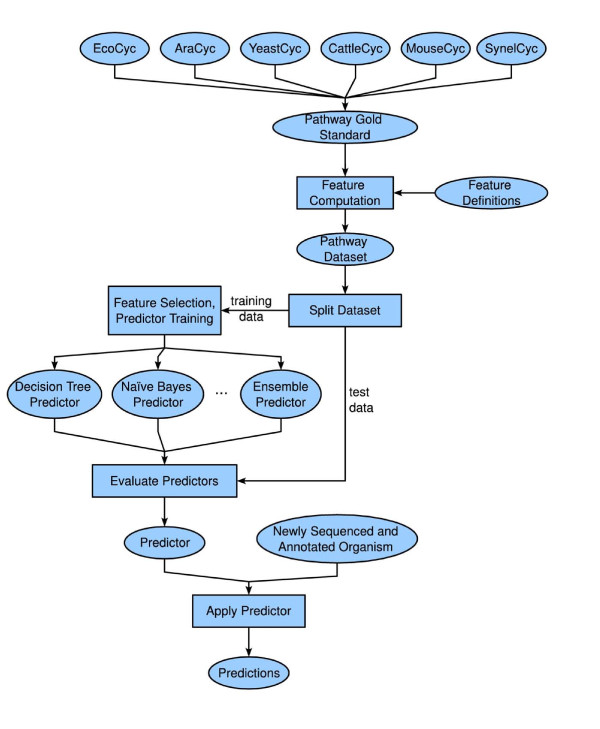
Background: A key challenge in systems biology is the reconstruction of an organism's metabolic network from its genome sequence. One strategy for addressing this problem is to predict which metabolic pathways, from a reference database of known pathways, are present in the organism, based on the annotated genome of the organism.
Results: To quantitatively validate methods for pathway prediction, we developed a large "gold standard" dataset of 5,610 pathway instances known to be present or absent in curated metabolic pathway databases for six organisms. We defined a collection of 123 pathway features, whose information content we evaluated with respect to the gold standard. Feature data were used as input to an extensive collection of machine learning (ML) methods, including naïve Bayes, decision trees, and logistic regression, together with feature selection and ensemble methods. We compared the ML methods to the previous PathoLogic algorithm for pathway prediction using the gold standard dataset. We found that ML-based prediction methods can match the performance of the PathoLogic algorithm. PathoLogic achieved an accuracy of 91% and an F-measure of 0.786. The ML-based prediction methods achieved accuracy as high as 91.2% and F-measure as high as 0.787. The ML-based methods output a probability for each predicted pathway, whereas PathoLogic does not, which provides more information to the user and facilitates filtering of predicted pathways.
Conclusions: ML methods for pathway prediction perform as well as existing methods, and have qualitative advantages in terms of extensibility, tunability, and explainability. More advanced prediction methods and/or more sophisticated input features may improve the performance of ML methods. However, pathway prediction performance appears to be limited largely by the ability to correctly match enzymes to the reactions they catalyze based on genome annotations.
Figures
References
-
- Keseler I, Bonavides-Martinez C, Collado-Vides J, Gama-Castro S, Gunsalus R, Johnson DA, Krummenacker M, Nolan L, Paley S, Paulsen I, Peralta-Gil M, Santos-Zavaleta A, Shearer A, Karp P. EcoCyc: A comprehensive view of E. coli biology. Nuc Acids Res. 2009;37:D464–70. doi: 10.1093/nar/gkn751. - DOI - PMC - PubMed
-
- Feist A, Henry C, Reed J, Krummenacker M, Joyce A, Karp P, Broadbelt L, Hatzimanikatis V, Palsson B. A genome-scale metabolic reconstruction for Escherichia coli K-12 MG1655 that accounts for 1260 ORFs and thermodynamic information. Mol Syst Biol. 2007;3:121–38. doi: 10.1038/msb4100155. - DOI - PMC - PubMed
-
- Caspi R, Foerster H, Fulcher C, Kaipa P, Krummenacker M, Latendresse M, Paley S, Rhee SY, Shearer A, Tissier C, Walk T, Zhang P, Karp PD. The MetaCyc database of metabolic pathways and enzymes and the BioCyc collection of Pathway/Genome Databases. Nuc Acids Res. 2008;36:D623–31. doi: 10.1093/nar/gkm900. - DOI - PMC - PubMed
Publication types
MeSH terms
Grants and funding
LinkOut - more resources
Full Text Sources
Other Literature Sources
