


Different subsets of tumor infiltrating lymphocytes correlate with NPC progression in different ways
- PMID: 20064222
- PMCID: PMC2818695
- DOI: 10.1186/1476-4598-9-4
Different subsets of tumor infiltrating lymphocytes correlate with NPC progression in different ways
Abstract
Background: Increasing amounts of evidence indicate that tumor infiltrating lymphocytes (TIL) are correlated with the prognosis of cancer patients. This study focuses on the association between the densities of tumor infiltrating cytotoxic T lymphocytes (CTL), activated CTL, regulatory T lymphocytes (Treg) and Th17 lymphocytes, and the prognosis and clinicopathological features of nasopharyngeal carcinoma (NPC) patients.
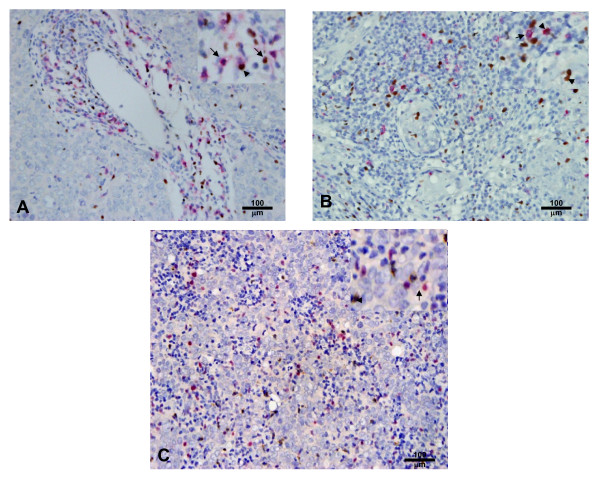
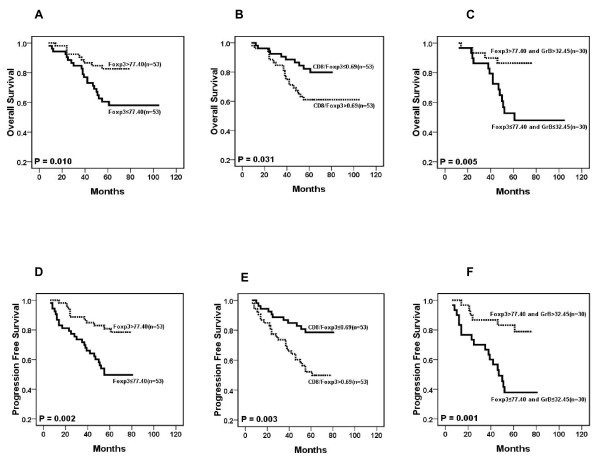
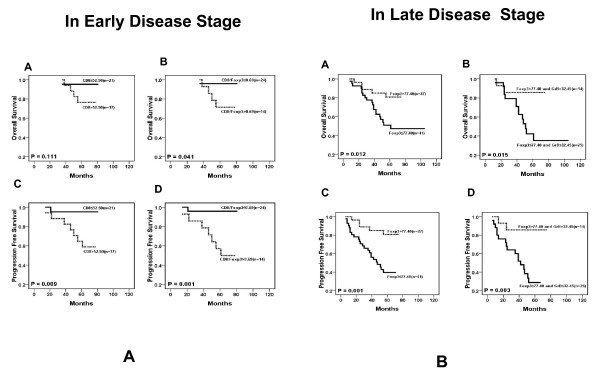
Results: Double immunohistochemical staining was performed in 106 biopsy specimens from newly diagnosed NPC patients. Prognostic values of infiltrating lymphocyte densities were evaluated by Kaplan-Meier analysis and Cox regression. The density of CD8+ TIL was positively correlated with lymph node metastasis, while the density of Foxp3+ TIL was negatively associated with T stage (P < 0.05). For survival evaluation, the density of Foxp3+ TIL or Foxp3+ TIL combined with GrB+ TIL together was associated with better overall survival (OS) and progression-free survival (PFS) (P < 0.01) in all patients and in the patients with late-stage diseases (Stages III and IV, P < 0.01). Meanwhile a low density of CD8+TIL or high ratio of FOXP3+TIL to CD8+TIL was correlated with better PFS in early stage patients (Stages I and II, P < 0.05). No significant association was found between IL-17+ TIL and clinicopathological characteristic or survival of NPC patients.
Conclusions: Our study identifies for the first time the tumor infiltrating Foxp3+ TIL as an independent favorable factor in the prognosis of NPC patients, especially for the patients with late-stage diseases.
Figures
References
-
- Sanguineti G, Bossi P, Pou A, Licitra L. Timing of chemoradiotherapy and patient selection for locally advanced nasopharyngeal carcinoma. Clin Oncol (R Coll Radiol) 2003;15:451–460. - PubMed
-
- Ayyoub M, Deknuydt F, Raimbaud I, Dousset C, Leveque L, Bioley G, Valmori D. Human memory FOXP3+ Tregs secrete IL-17 ex vivo and constitutively express the T(H)17 lineage-specific transcription factor RORgamma t. Proc Natl Acad Sci USA. 2009;106:8635–8640. doi: 10.1073/pnas.0900621106. - DOI - PMC - PubMed
Publication types
MeSH terms
Substances
LinkOut - more resources
Full Text Sources
Other Literature Sources
Research Materials
