


Estimates of sensitivity and specificity can be biased when reporting the results of the second test in a screening trial conducted in series
- PMID: 20064254
- PMCID: PMC2819240
- DOI: 10.1186/1471-2288-10-3
Estimates of sensitivity and specificity can be biased when reporting the results of the second test in a screening trial conducted in series
Abstract
Background: Cancer screening reduces cancer mortality when early detection allows successful treatment of otherwise fatal disease. There are a variety of trial designs used to find the best screening test. In a series screening trial design, the decision to conduct the second test is based on the results of the first test. Thus, the estimates of diagnostic accuracy for the second test are conditional, and may differ from unconditional estimates. The problem is further complicated when some cases are misclassified as non-cases due to incomplete disease status ascertainment.
Methods: For a series design, we assume that the second screening test is conducted only if the first test had negative results. We derive formulae for the conditional sensitivity and specificity of the second test in the presence of differential verification bias. For comparison, we also derive formulae for the sensitivity and specificity for a single test design, both with and without differential verification bias.
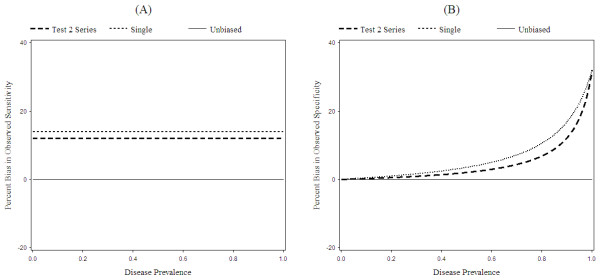
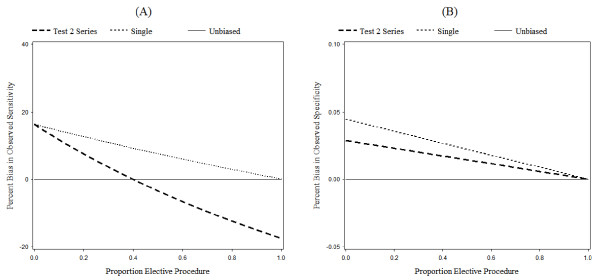
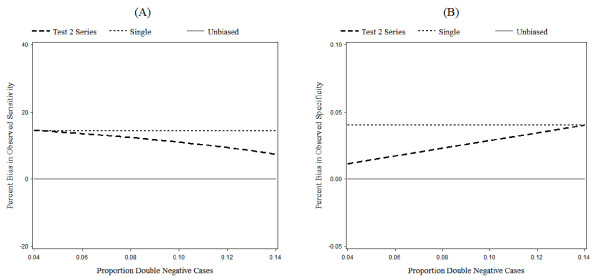
Results: Both the series design and differential verification bias have strong effects on estimates of sensitivity and specificity. In both the single test and series designs, differential verification bias inflates estimates of sensitivity and specificity. In general, for the series design, the inflation is smaller than that observed for a single test design.The degree of bias depends on disease prevalence, the proportion of misclassified cases, and on the correlation between the test results for cases. As disease prevalence increases, the observed conditional sensitivity is unaffected. However, there is an increasing upward bias in observed conditional specificity. As the proportion of correctly classified cases increases, the upward bias in observed conditional sensitivity and specificity decreases. As the agreement between the two screening tests becomes stronger, the upward bias in observed conditional sensitivity decreases, while the specificity bias increases.
Conclusions: In a series design, estimates of sensitivity and specificity for the second test are conditional estimates. These estimates must always be described in context of the design of the trial, and the study population, to prevent misleading comparisons. In addition, these estimates may be biased by incomplete disease status ascertainment.
Figures
References
-
- Breast Cancer: Statistics, Center for Disease Control (CDC) and Prevention Homepage. http://www.cdc.gov/cancer/breast/statistics/
-
- Hendrick RE. Benefit of screening mammography in women aged 40-49: a new meta-analysis of randomized controlled trials. J Natl Cancer I Mono. 1997;22:87–92. - PubMed
-
- Lewin JM, Hendrick RE, D'Orsi CJ, Isaacs PK, Moss LJ, Karellas A, Sisney GA, Kuni CC, Cutter GR. Comparison of full-field digital mammography with screenfilm mammography for cancer detection: results of 4,945 paired examinations. Radiology. 2001;218:873–880. - PubMed
-
- Lehman CD, Gatsonis C, Kuhl CK, Hendrick RE, Pisano ED, Hanna L, Peacock S, Smazal SF, Maki DD, Julian TB, DePeri ER, Bluemke DA, Schnall MD. for the ACRIN Trial 6667 Investigators Group. MRI evaluation of the contralateral breast in women with recently diagnosed breast cancer. N Engl J Med. 2007;356:1295–1303. doi: 10.1056/NEJMoa065447. - DOI - PubMed
Publication types
MeSH terms
Grants and funding
LinkOut - more resources
Full Text Sources
Research Materials
