


Quantifying clinical narrative redundancy in an electronic health record
- PMID: 20064801
- PMCID: PMC2995640
- DOI: 10.1197/jamia.M3390
Quantifying clinical narrative redundancy in an electronic health record
Abstract
Objective: Although electronic notes have advantages compared to handwritten notes, they take longer to write and promote information redundancy in electronic health records (EHRs). We sought to quantify redundancy in clinical documentation by studying collections of physician notes in an EHR.
Design and methods: We implemented a retrospective design to gather all electronic admission, progress, resident signout and discharge summary notes written during 100 randomly selected patient admissions within a 6 month period. We modified and applied a Levenshtein edit-distance algorithm to align and compare the documents written for each of the 100 admissions. We then identified and measured the amount of text duplicated from previous notes. Finally, we manually reviewed the content that was conserved between note types in a subsample of notes.
Measurements: We measured the amount of new information in a document, which was calculated as the number of words that did not match with previous documents divided by the length, in words, of the document. Results are reported as the percentage of information in a document that had been duplicated from previously written documents.
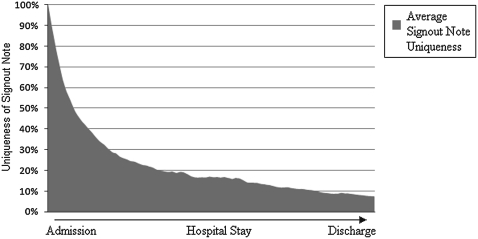
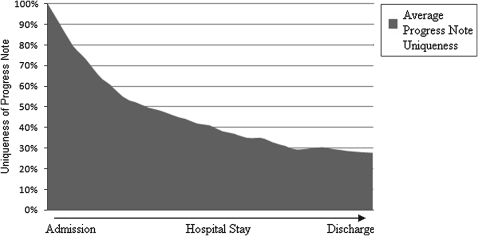
Results: Signout and progress notes proved to be particularly redundant, with an average of 78% and 54% information duplicated from previous documents respectively. There was also significant information duplication between document types (eg, from an admission note to a progress note).
Conclusion: The study established the feasibility of exploring redundancy in the narrative record with a known sequence alignment algorithm used frequently in the field of bioinformatics. The findings provide a foundation for studying the usefulness and risks of redundancy in the EHR.
Conflict of interest statement
Figures

References
-
- United States Statutes at Large American Recovery and Reinvestment Act of 2009, PL 111–5, February 7, 2009.
-
- Amarasingham R, Plantinga L, Diener-West M, et al. Clinical information technologies and inpatient outcomes: a multiple hospital study. Arch Intern Med 2009;169:108–14 - PubMed
-
- Stead WW, Lin HS. Computational technology for effective health care: immediate steps and strategic directions. Washington, DC: National Academies Press, 2009 - PubMed
-
- Codd EF. The relational model for database management. Version 2. Boston, MA: Addison-Wesley Longman Publishing Co, Inc, 2009
