


Use of population health data to refine diagnostic decision-making for pertussis
- PMID: 20064807
- PMCID: PMC2995623
- DOI: 10.1197/jamia.M3061
Use of population health data to refine diagnostic decision-making for pertussis
Abstract
Objective: To improve identification of pertussis cases by developing a decision model that incorporates recent, local, population-level disease incidence.
Design: Retrospective cohort analysis of 443 infants tested for pertussis (2003-7).
Measurements: Three models (based on clinical data only, local disease incidence only, and a combination of clinical data and local disease incidence) to predict pertussis positivity were created with demographic, historical, physical exam, and state-wide pertussis data. Models were compared using sensitivity, specificity, area under the receiver-operating characteristics (ROC) curve (AUC), and related metrics.
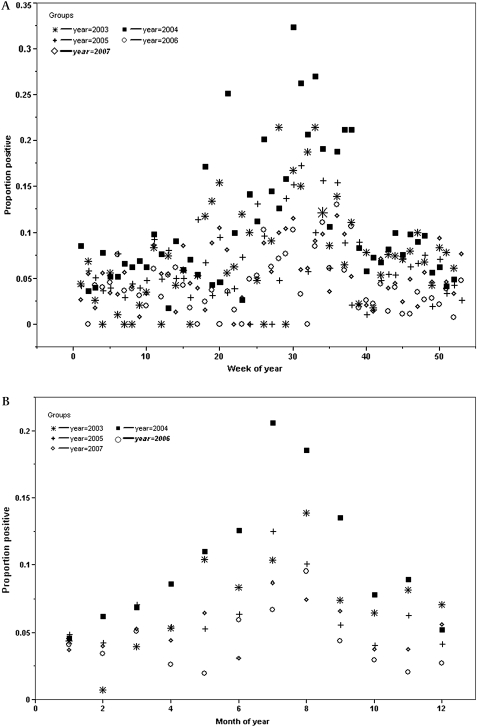
Results: The model using only clinical data included cyanosis, cough for 1 week, and absence of fever, and was 89% sensitive (95% CI 79 to 99), 27% specific (95% CI 22 to 32) with an area under the ROC curve of 0.80. The model using only local incidence data performed best when the proportion positive of pertussis cultures in the region exceeded 10% in the 8-14 days prior to the infant's associated visit, achieving 13% sensitivity, 53% specificity, and AUC 0.65. The combined model, built with patient-derived variables and local incidence data, included cyanosis, cough for 1 week, and the variable indicating that the proportion positive of pertussis cultures in the region exceeded 10% 8-14 days prior to the infant's associated visit. This model was 100% sensitive (p<0.04, 95% CI 92 to 100), 38% specific (p<0.001, 95% CI 33 to 43), with AUC 0.82.
Conclusions: Incorporating recent, local population-level disease incidence improved the ability of a decision model to correctly identify infants with pertussis. Our findings support fostering bidirectional exchange between public health and clinical practice, and validate a method for integrating large-scale public health datasets with rich clinical data to improve decision-making and public health.
Conflict of interest statement
Figures
References
-
- Cherry JD. Pertussis in adults. Ann Intern Med 1998;128:64–6 - PubMed
-
- Lee GM, Lett S, Schauer S, et al. Societal costs and morbidity of pertussis in adolescents and adults. Clin Infect Dis 2004;39:1572–80 - PubMed
-
- Sotir MJ, Cappozzo DL, Warshauer DM, et al. A countywide outbreak of pertussis: initial transmission in a high school weight room with subsequent substantial impact on adolescents and adults. Arch Pediatr Adolesc Med 2008;162:79–85 - PubMed
-
- Murphy TV, Slade BA, Broder KR, et al. Prevention of pertussis, tetanus, and diphtheria among pregnant and postpartum women and their infants: recommendations of the Advisory Committee on Immunization Practices (ACIP). MMWR Morb Mortal Wkly Rep 2008;57:1–47 - PubMed
-
- Davis JP. Clinical and economic effects of pertussis outbreaks. Pediatr Infect Dis J 2005;24(6 Suppl):S109–16 - PubMed
Publication types
MeSH terms
Grants and funding
LinkOut - more resources
Full Text Sources
Medical
