Blood lead level and kidney function in US adolescents: The Third National Health and Nutrition Examination Survey
- PMID: 20065202
- PMCID: PMC3718466
- DOI: 10.1001/archinternmed.2009.417
Blood lead level and kidney function in US adolescents: The Third National Health and Nutrition Examination Survey
Abstract
Background: Chronic, high-level lead exposure is a known risk factor for kidney disease. The effect of current low-level environmental lead exposure is less well known, particularly among children, a population generally free from kidney disease risk factors such as hypertension and diabetes mellitus. Therefore, in this study, we investigated the association between lead exposure and kidney function in a representative sample of US adolescents.
Methods: Participants included 769 adolescents aged 12 to 20 years for whom whole blood lead and serum cystatin C were measured in the Third National Health and Nutrition Examination Survey, conducted from 1988-1994. The association between blood lead level and level of kidney function (glomerular filtration rate [GFR]), determined by cystatin C-based and creatinine-based estimating equations, was examined.
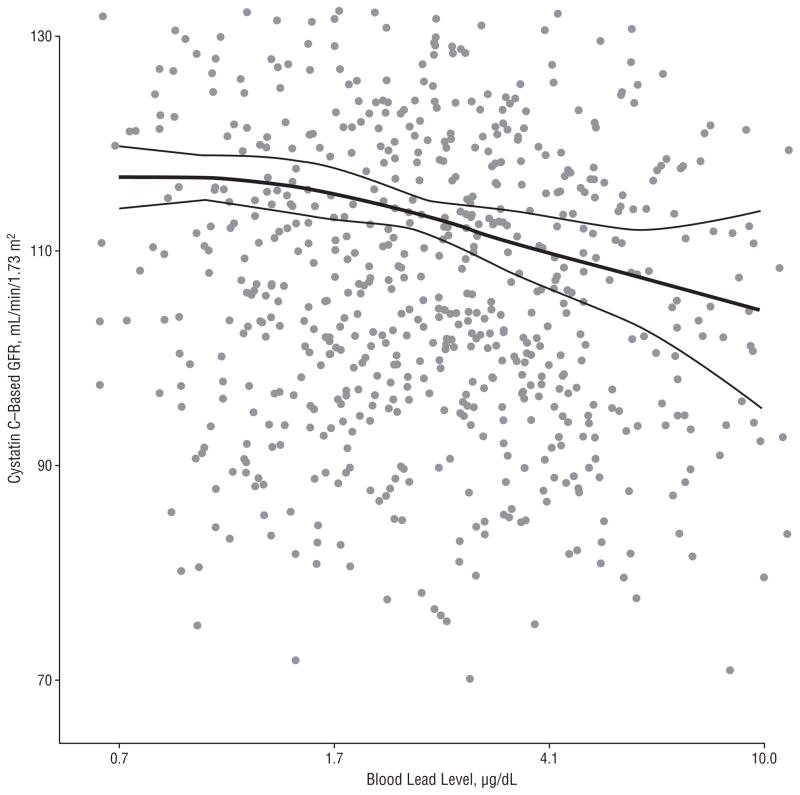
Results: Median whole blood lead level was 1.5 microg/dL (to convert to micromoles per liter, multiply by 0.0483), and median cystatin C-estimated GFR was 112.9 mL/min/1.73 m(2). Participants with lead levels in the highest quartile (> or =3.0 microg/dL) had 6.6 mL/min/1.73 m(2)-lower estimated GFR (95% confidence interval, -0.7 to -12.6 mL/min/1.73 m(2)) compared with those in the first quartile (<1 microg/dL). A doubling of blood lead level was associated with a 2.9 mL/min/1.73 m(2)-lower estimated GFR (95% confidence interval, -0.7 to -5.0 mL/min/1.73 m(2)). Lead levels were also associated with lower creatinine-based estimated GFR levels, but the association was weaker than with cystatin C-based GFR and not statistically significant.
Conclusions: Higher blood lead levels in a range below the current Centers for Disease Control and Prevention-designated level of concern (10 microg/dL) were associated with lower estimated GFRs in a representative sample of US adolescents. This finding contributes to the increasing epidemiologic evidence indicating an adverse effect of low-level environmental lead exposure.
Figures
References
-
- Agency for Toxic Substances and Disease Registry. Toxicological Profile for Lead. Atlanta, GA: US Department of Health and Human Services, Public Health Service; 2007.
-
- Ekong EB, Jaar BG, Weaver VM. Lead-related nephrotoxicity: a review of the epidemiologic evidence. Kidney Int. 2006;70(12):2074–2084. - PubMed
-
- Khalil-Manesh F, Gonick HC, Cohen AH, et al. Experimental model of lead nephropathy, I: continuous high-dose lead administration. Kidney Int. 1992;41 (5):1192–1203. - PubMed
-
- Inglis JA, Henderson DA, Emmerson BT. The pathology and pathogenesis of chronic lead nephropathy occurring in Queensland. J Pathol. 1978;124(2):65–76. - PubMed