


Anti-leukemic activity of lintuzumab (SGN-33) in preclinical models of acute myeloid leukemia
- PMID: 20065652
- PMCID: PMC2759498
- DOI: 10.4161/mabs.1.5.9288
Anti-leukemic activity of lintuzumab (SGN-33) in preclinical models of acute myeloid leukemia
Abstract
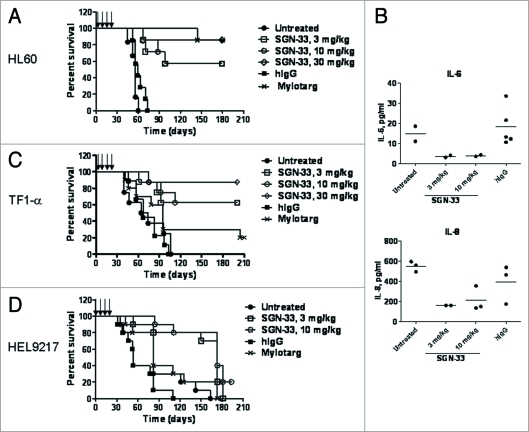
Despite therapeutic advances, the long-term survival rates for acute myeloid leukemia (AML) are estimated to be 10% or less, pointing to the need for better treatment options. AML cells express the myeloid marker CD33, making it amenable to CD33-targeted therapy. Thus, the in vitro and in vivo anti-tumor activities of lintuzumab (SGN-33), a humanized monoclonal anti-CD33 antibody undergoing clinical evaluation, were investigated. In vitro assays were used to assess the ability of lintuzumab to mediate effector functions and to decrease the production of growth factors from AML cells. SCID mice models of disseminated AML with the multi-drug resistance (MDR)-negative HL60 and the MDR(+), HEL9217 and TF1-alpha, cell lines were developed and applied to examine the in vivo antitumor activity. In vitro, lintuzumab significantly reduced the production of TNFalpha-induced pro-inflammatory cytokines and chemokines by AML cells. Lintuzumab promoted tumor cell killing through antibody-dependent cellular cytotoxicity (ADCC) and phagocytosis (ADCP) activities against MDR(-) and MDR(+) AML cell lines and primary AML patient samples. At doses from 3 to 30 mg/kg, lintuzumab significantly enhanced survival and reduced tumor burden in vivo, regardless of MDR status. Survival of the mice was dependent upon the activity of resident macrophages and neutrophils. The results suggest that lintuzumab may exert its therapeutic effects by modulating the cytokine milieu in the tumor microenvironment and through effector mediated cell killing. Given that lintuzumab induced meaningful responses in a phase 1 clinical trial, the preclinical antitumor activities defined in this study may underlie its observed therapeutic efficacy in AML patients.
Figures


References
-
- Frohling S, Schlenk RF, Kayser S, Morhardt M, Benner A, Dohner K, Dohner H. Cytogenetics and age are major determinants of outcome in intensively treated acute myeloid leukemia patients older than 60 years: results from AMLSG trial AML HD98-B. Blood. 2006;108:3280–3288. - PubMed
-
- Lowenberg B, Downing JR, Burnett A. Acute myeloid leukemia. N Engl J Med. 1999;341:1051–1062. - PubMed
-
- Leith CP, Kopecky KJ, Godwin J, McConnell T, Slovak ML, Chen IM, et al. Acute myeloid leukemia in the elderly: assessment of multidrug resistance (MDR1) and cytogenetics distinguishes biologic subgroups with remarkably distinct responses to standard chemotherapy. A Southwest Oncology Group study. Blood. 1997;89:3323–3329. - PubMed
-
- Drach J, Zhao S, Drach D, Korbling M, Engel H, Andreeff M. Expression of MDR1 by normal bone marrow cells and its implication for leukemic hematopoiesis. Leuk Lymphoma. 1995;16:419–424. - PubMed
MeSH terms
Substances
LinkOut - more resources
Full Text Sources
Other Literature Sources
Medical
